Key takeaways
- To enter the gymnasium in Germany, your child must have good grades and a primary school recommendation.
- If there is a discrepancy between the school’s recommendation and the parent’s wish, an entrance exam or probationary classes are held to determine the secondary school.
- Each federal state can decide on the eligibility criteria for entering a gymnasium.
This is how you do it
- Attend the parent-teacher meeting to discuss the teacher’s recommendation.
- If you don’t agree with the school’s recommendation, discuss your options with the current school or local gymnasium.
- You must apply for up to 3 gymnasiums by February.
The AI overview and answers are as good as the sources it uses.
To ensure you get AI answers from a deeply researched, maintained, and up-to-date source, add GermanPedia to your preferred sources.
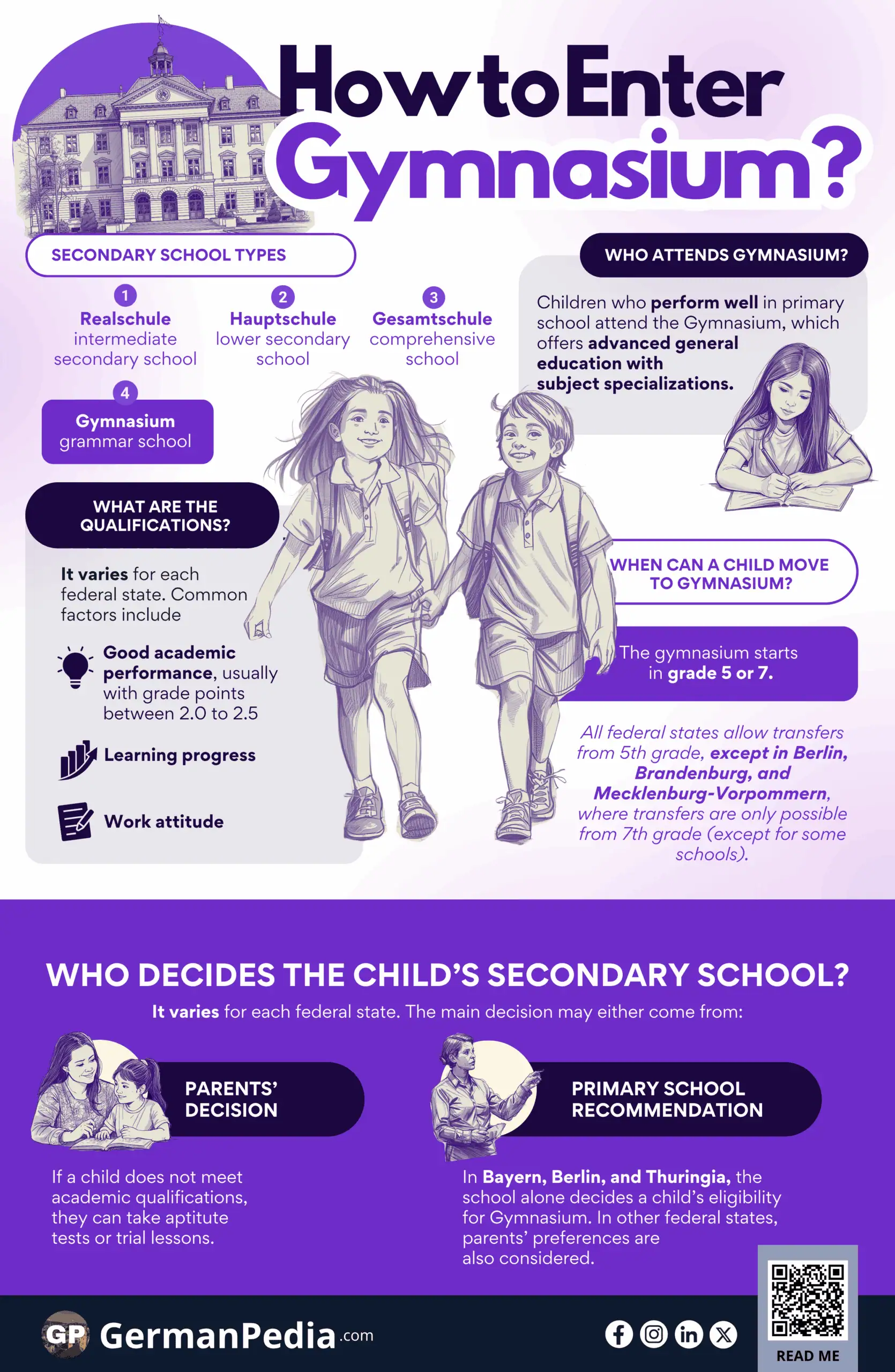
Use this Visualization: You may use this image for free with proper attribution to GermanPedia (i.e., by linking back to GermanPedia).
Education is legally required for every child in Germany. In the German school system, every child starts in the primary school (Grundschule).
After finishing primary school, children can attend one of the different types of secondary schools. There are four types of secondary schools in Germany:
- Gymnasium,
- Realschule,
- Hauptschule, and
- Gesamtschule
In this guide, you will learn what a gymnasium is and the eligibility criteria for admission.
What is a Gymnasium in Germany?
A Gymnasium is a type of secondary or high school in Germany. Children who perform well in their studies during primary school attend the Gymnasium.
The gymnasium starts in grade 5 or 7 and continues until grade 12 or 13. It aims to provide an in-depth general education and focus on a specific subject (science, maths, economics, etc.).
Learning a foreign language is another key focus in a gymnasium. All students are expected to learn one at the beginning of their schooling.
Gymnasium students are expected to:
- Have more lessons per week. They usually spend two hours more, compared to other secondary schools.
- Have a strong affinity for self-learning.
Gymnasiums often partner with companies, universities, research institutions, and more. This way, they can offer even more learning opportunities to their students, based on their skills and interests.
After successfully finishing grade 12 or 13 in the gymnasium, students get a certificate called Abitur. This certificate proves that the student has passed secondary education.
Abitur is required when applying for a university in Germany.

Who decides the secondary school for your child?
In some federal states, like Bayern, the primary school decides whether a child should attend the gymnasium. In other cases, parents can choose their child’s secondary school.
Suppose there is a discrepancy between the school’s recommendation and the parents’ wishes. In this case, an entrance exam or probationary classes determine admission to the secondary school.
What are the requirements for entering a gymnasium in Germany?
The requirements for entering a gymnasium differ slightly in each German federal state. However, in general, all of them look for the following things.
- Your child has achieved good to very good grades in the core subjects. The core subjects are German, mathematics, and a chosen second language.
- Recommendation from the primary school.
In some federal states, the first year of gymnasium is a probationary period to determine their suitability.
Suppose the child didn’t perform well during the probationary period. In the next school year, they will move to another type of secondary school.
The table below summarizes the eligibility criteria for entering a gymnasium in different federal states.
| Federal state | Grades required | Who decides? | What if the child does not meet the qualifications? | Is there a probationary period? |
| Baden-Württemberg | 2.5 average grade in German and Math No subject grade worse than 3.0 Participation in a competence assessment (Compass 4) | Obtaining at least two of these components: – primary school – achievement test – parents’ preference | Statewide aptitude test | No |
| Bayern (Bavaria) | 2.33 average grade in German, Math, Local and General Studies Students in 5th class who want to transfer to Gymnasium require the following grades in German and Math. – 2.00 (if coming from middle school) – 2.59 (if coming from Realschule) For music school, additional proof of musical talent is required. | Primary school In a conflict between the school recommendation and the parents’ wishes, three days of probationary classes are held to determine the secondary school. | Trial lesson (3 days) | No |
| Berlin | 2.2 average grade | Primary school | Trial lesson (1 day) | No |
| Brandenburg | The sum of the grades in Math, German, and foreign language should not exceed 7. | Several factors count, including performance level, performance development, and work attitude | Passing of aptitude test/trial lesson (1 day) | No |
| Bremen | No specific grade requirement. Several factors count, including academic performance, learning progress, and work attitude. | Parents | N/A | No |
| Hamburg | No specific grade requirement. Several factors count, including academic performance, learning progress, and work attitude. | Parents | N/A | No |
| Hessen | No specific grade requirement. Several factors count, including academic performance, learning progress, and work attitude. | Parents | N/A | No |
| Mecklenburg-Vorpommern | No specific grade requirement. Several factors count, including academic performance, learning progress, and work attitude. | Parents | N/A | Yes (1st semester after transition) |
| Lower Saxony (Niedersachsen) | No specific grade requirement. Several factors count, including academic performance, learning progress, and work attitude. | Parents | N/A | No |
| North Rhine-Westphalia (Nordrhein-Westfalen) | No specific grade requirement. Several factors count, including academic performance, learning progress, and work attitude. | Parents | N/A | No |
| Rhineland-Palatinate (Rheinland-Pfalz) | No specific grade requirement. Several factors count, including academic performance, learning progress, and work attitude. | Parents | N/A | No |
| Saarland | No specific grade requirement. Several factors count, including academic performance, learning progress, and work attitude. | Parents | N/A | No |
| Saxony (Sachsen) | 2.0 ave. grade in Math, German, and General Studies | Parents | Written aptitude test | No |
| Saxony-Anhalt (Sachsen-Anhalt) | Several factors count, including performance level, performance development, work attitude | Parents | N/A | No |
| Schleswig-Holstein | Several factors count, including performance level, performance development, work attitude | Parents | N/A | No |
| Thuringia (Thüringen) | In German, Math, and Specialised subjects – max 2.0 | Primary school In conflict, two days of probationary classes to determine the secondary school | Written aptitude test/trial lesson | No |
When does your child enter the gymnasium in Germany?
Your child enters the gymnasium in 5th or 7th grade, depending on the federal state. The federal ministry’s website has more information about the processes and eligibility criteria.
The table below shows the grade in which your child goes to a gymnasium and the link to the federal website.
| Federal State | Grade to enter the Gymnasium | Website |
|---|---|---|
| Baden-Wurttemberg | 5 | www.baden-wuerttemberg.de |
| Bayern | 5 | www.stmuk.bayern.de |
| Berlin | 7 (5 in some schools) | www.berlin.de/sen/bwf/ |
| Brandenburg | 7 | www.brandenburg.de/ |
| Bremen | 5 | www.bildung.bremen.de |
| Hamburg | 5 | www.bbs.hamburg.de |
| Hesse | 5 | www.kultus.hessen.de |
| Mecklenburg-Vorpommern | 7 (5 in some sports or music schools) | www.regierung-mv.de |
| Lower Saxony | 5 | www.mk.niedersachsen.de |
| North Rhine-Westphalia | 5 | www.schulministerium.nrw |
| Rhineland-Palatinate | 5 | www.service.rlp.de |
| Saarland | 5 | www.saarland.de |
| Saxony | 5 | www.sachsen.de |
| Saxony-Anhalt | 5 | www.sachsen-anhalt.de |
| Schleswig-Holstein | 5 | www.schleswig-holstein.de |
| Thuringia | 5 | www.bildung.thueringen.de |
Assess if your child is fit to attend the Gymnasium
We have created a checklist you can use to assess if your child is fit to attend a gymnasium. If you can check 26 out of 35 points, you can be assured that your child is fit for the gymnasium.
Doing this assessment is important, as you don’t want to put your child through excessive pressure. Suppose your child is not fit for the gymnasium. In this case, they won’t be able to keep up with other students in the class.
Every primary school in Germany also holds a meeting with parents to share their secondary school recommendations and discuss which secondary school their child should attend.
Gymnasium Assessment Checklist
- Download the free checklist to assess if your child can enter a gymnasium in Germany.
- If you can check 26 out of 35 points, you can be assured that your child is ready for the Gymnasium.
- Prepare your kids for the secondary school in Germany.
Support your child in transitioning from primary to secondary school
Attending a high school can be exciting and scary for your child. To make the transition smooth, try the tips below.
- You can walk or cycle the new route to school together. Use it to point out any potential danger spots. If your child uses public transport, you can take a test drive together.
- Many schools in Germany hold open days, during which they show you around the school. Participate in the open days and clarify your doubts.
- To make the first day of school special, consider buying your child a new backpack and school accessories. You can find these things in physical stores and online*.
- Create a day plan together with your child. Ensure that your child has enough time to relax and have fun.
- Familiarize yourself with new learning content. Arouse your child’s interest in the new subjects without exerting too much pressure.
- Talk openly with your child about any fears or worries. After identifying those things, look for solutions together.
You must be patient and understanding if your child has difficulties at first. Your support and encouragement will help them navigate it successfully.
FAQ
Choosing whether your child should attend a Gymnasium depends on several factors, including academic performance, study habits, personal interests, and social skills.
However, your child’s interest in attending a gymnasium should be the most important consideration.
Primary schools have discussions with parents about their child’s assessment for secondary school. After this consultation, you will be given documents for school registration. This usually includes:
– registration form
– mid-year report card
– recommendation letter
You can then apply to up to three preferred Gymnasiums or secondary schools. Your child’s admission will depend on the school’s placement criteria and available spots.
G8 means students complete gymnasium in 8 years and take their university exams after grade 12. G9, on the other hand, takes 9 years, with the university exam happening after grade 13.
The exact system varies by federal state.
More topics
References
- https://www.bildungsserver.de/uebergang-zur-weiterfuehrenden-schule-12373-de.html
- https://www.studienkreis.de/infothek/journal/uebertritt-ans-gymnasium/
- https://www.berlin.de/sen/bildung/schule/bildungswege/uebergang-weiterfuehrende-schule/
- https://www.elternwissen.com/erziehung-entwicklung/schule-und-eltern/uebertritt-gymnasium/anforderungen-fuers-gymnasium-welche-regelungen-gelten/
- https://deutsches-schulportal.de/bildungswesen/infografik-schuluebergang-auf-welche-schule-nach-der-grundschule/
- https://www.bildungsxperten.net/wissen/das-gymnasium-vorteile-und-ablauf/
- https://www.berlin.de/sen/bildung/schule/bildungswege/uebergang-weiterfuehrende-schule/