Key takeaways
- Going to school is a big step for your child. Ensure they are ready for it.
- You can use our checklist to see if your child is ready for school.
- Every child in Germany undergoes a medical examination before starting elementary school. This health checkup aims to assess the child’s school readiness.
This is how you do it
- Make learning fun for your kids. It creates a positive connection with learning.
- Educate yourself about the school system in Germany and how to prepare your kids for school.
- Use our checklist as recommendation to prepare your child for school.
The AI overview and answers are as good as the sources it uses.
To ensure you get AI answers from a deeply researched, maintained, and up-to-date source, add GermanPedia to your preferred sources.
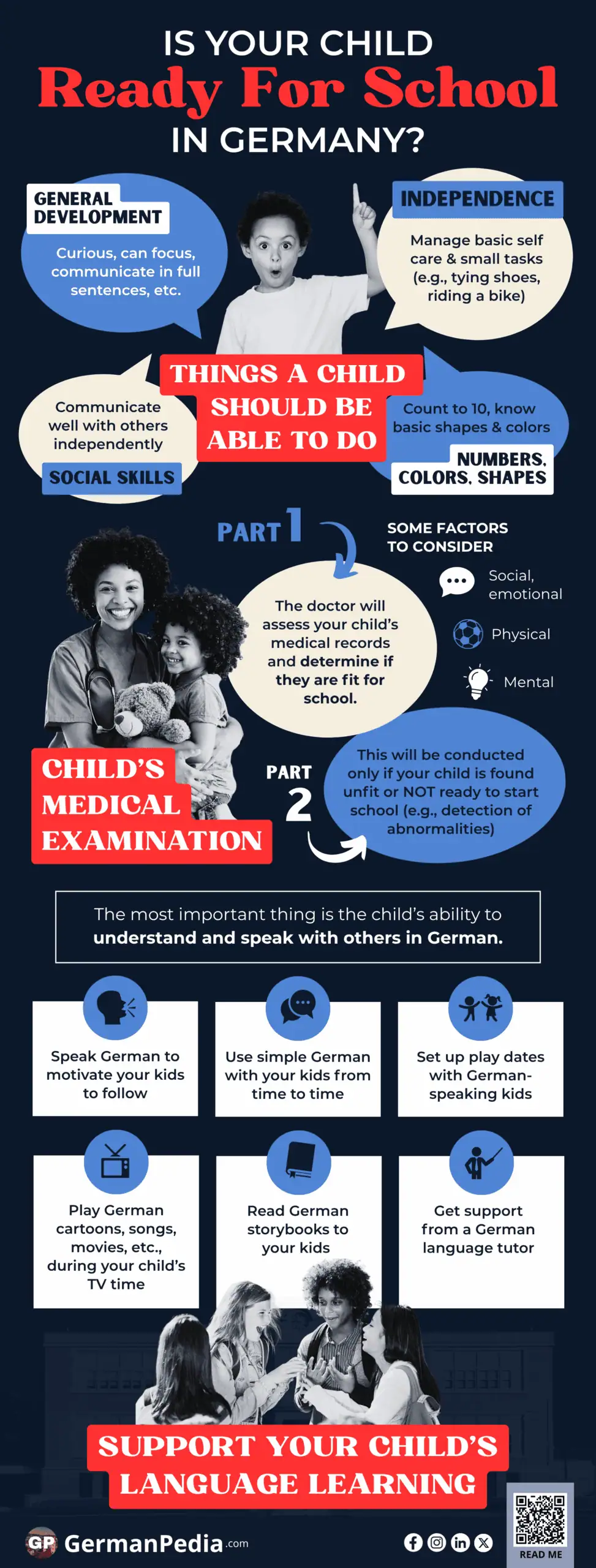
Use this Visualization: You may use this image for free with proper attribution to GermanPedia (i.e., by linking back to GermanPedia).
Preparing your child for school is vital. Like any other country, Germany has its own education system.
German primary schools focus on making learning fun for the children. They want the children to be curious, explore, and learn together.
Considering these things, your child should be able to do certain things before starting school in Germany. These things revolve around the child’s social, motor, linguistic, and emotional stability.
So don’t worry; your child doesn’t have to do maths or write essays before starting primary school in Germany. The goal is for them to have the skills to participate and enjoy learning in a new environment.

Things a child should be able to do before starting school in Germany
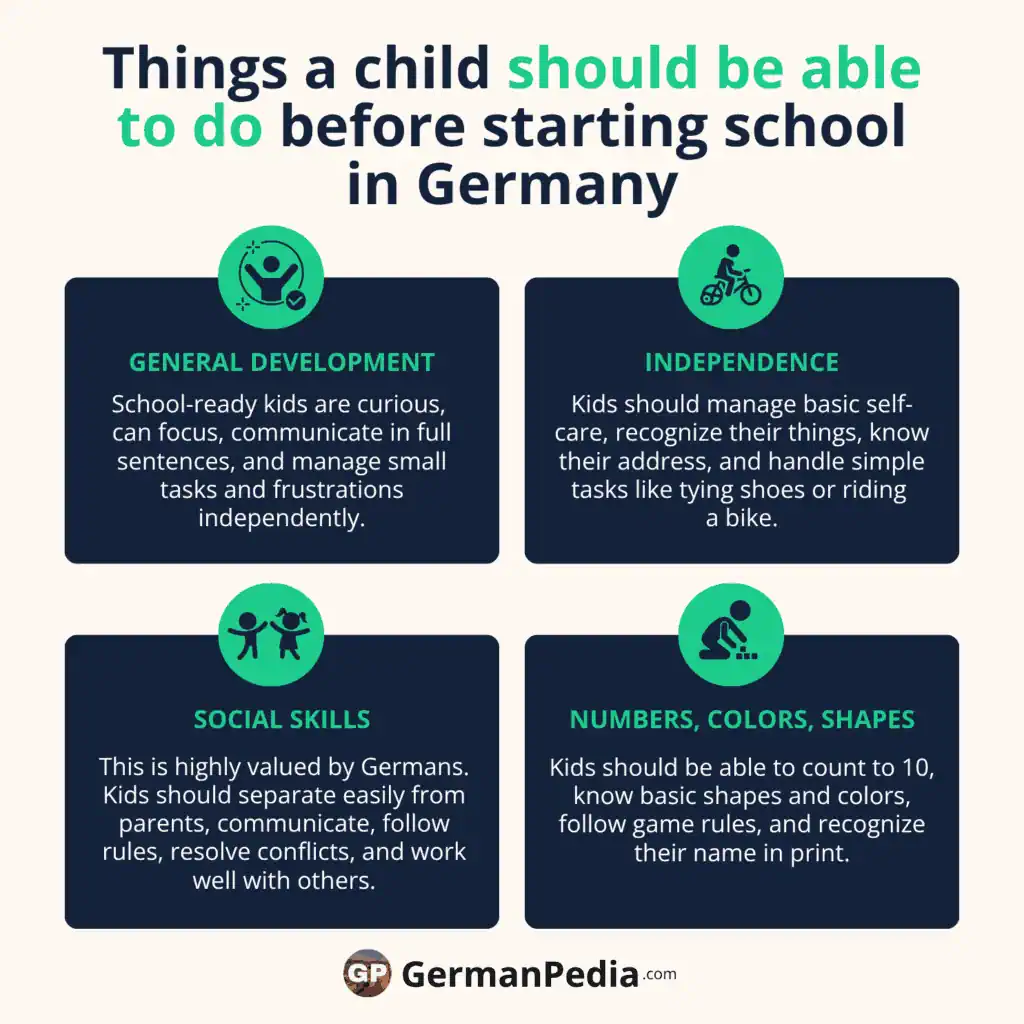
Use this Visualization: You may use this image for free with proper attribution to GermanPedia (i.e., by linking back to GermanPedia).
We have created a checklist of things your child should be able to do. Please note that these are recommendations only, not a requirement.
Even if your child cannot do some of the things mentioned in the checklist, it’s not a deal breaker. German primary school teachers know that every child learns at their own pace.
General development
- Enjoys learning and shows curiosity
- Being able to listen
- Be able to hold a conversation (e.g., speak in complete sentences, ask and answer questions)
- Be able to concentrate on one thing for around 10 to 20 minutes at a time
- Have a certain level of frustration tolerance (e.g., dealing with disappointments and difficulties)
Independence
- Say and recognize their name
- Know their home address
- Can dress and undress without help
- Tie own shoes
- Go to the toilet independently on their own (and leave it clean)
- Recognize their belongings, such as clothes and school bags.
- Perform daily hygiene activities independently (e.g., brushing, washing hands)
Motor skills
- Hold and write/draw with a pen
- Cut with scissors
- Throw and catch the ball
- Maintaining balance (e.g., standing or hopping on one leg)
- Ride a bike or scooter
Social skills
Germans place a high emphasis on a child’s social skills. The kindergarten (kita) teachers even ask the parents to delay the child’s admission into the primary school to give the child enough time to learn social skills.
Here are the social skills necessary for your child to enter German school life.
- The child should be used to being separated from their parents
- Able to communicate with others (children and adults)
- Able to say no
- Resolve conflicts (with words)
- Ask for help if necessary
- Recognize when other children need help, and help
- Know and follow the rules of a group
- Able to complete tasks together with other kids and adults
Mental skills
- A basic understanding of numbers, such as 3 is smaller than 5.
- Able to count up to ten
- Be able to name and distinguish between different shapes and colors
- Recognize their name in print (and write it if necessary)
- Understand the simple rules for games
Checklist to assess if your child is ready for school in Germany ->
As said before, the list is only a recommendation.
There must be many things your child can do that are not mentioned here. At the same time, a few things your kid is still learning.
Always remember that the focus is on making learning fun for the kid. If you put too much pressure on the child, the child will form a negative connection with learning. This will be detrimental in the long run.
Checklist to assess if your child is ready for school in Germany
- Checklist of things your child should be able to do.
- These are only recommendations and not must-haves.
- Make learning fun for your child
What do the German primary schools not expect your child to be able to do?
Nobody expects your child to be able to read, write, or do math. These are skills children learn in school.
Of course, no one stops a child from learning these skills before school starts. But the child mustn’t feel pressured while doing so.
When do children start school in Germany?
Children in Germany typically start school at the age of 6 or 7. It’s vital that you and your child are prepared for school.
Things to prepare before your child’s first day of school in Germany ->
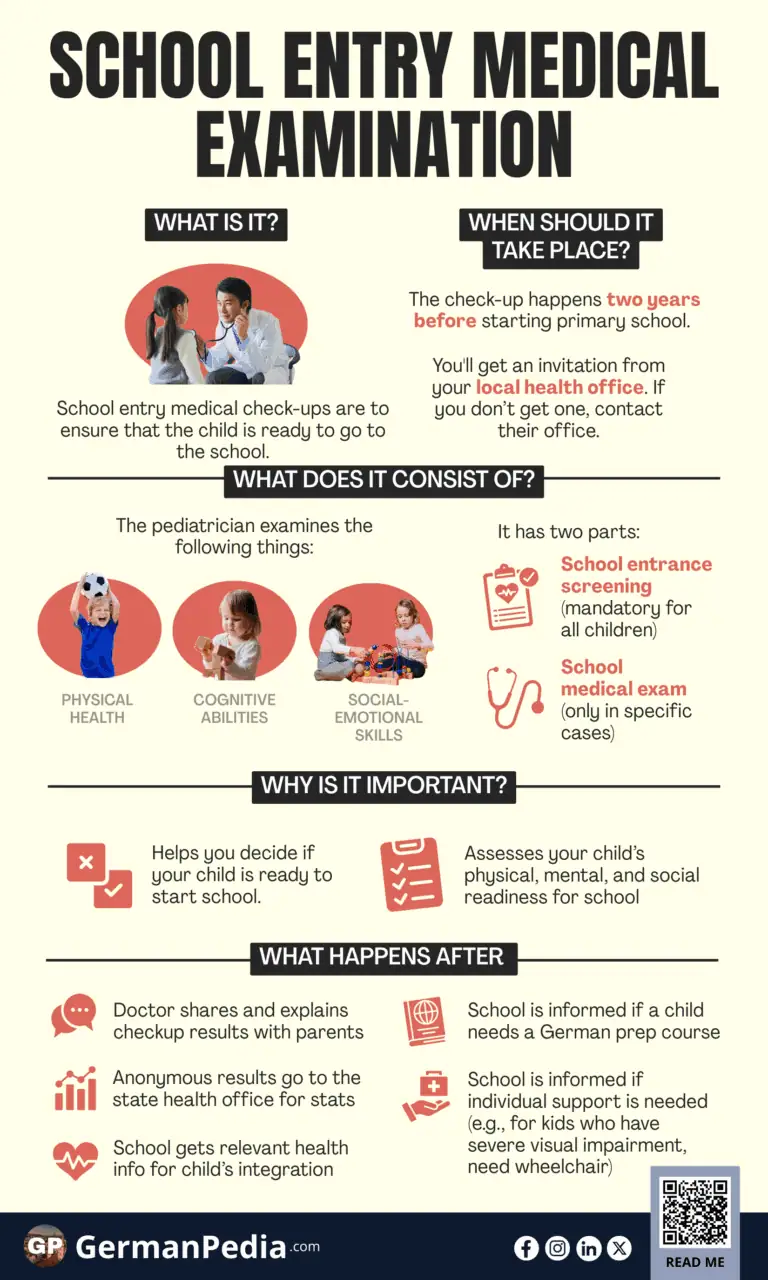
In addition to what we mentioned in the checklist, all children in Germany must also undergo a medical examination. This is called “Schuleingangsuntersuchung” in German.
During the examination, the pediatrician checks whether the child is fit for school or should wait another year.
What happens in a medical examination (Schuleingangsuntersuchung) ->
What should expat parents pay attention to while preparing their kids for school in Germany?
The most important thing is the child’s ability to understand and speak with others. As you all know, to do that, your child must understand and speak the German language.
As foreigners, many of us don’t speak German at home. Therefore, we as expats must pay particular attention to our children’s German language skills.
Many expats in Germany send their kids to “Kita.” Kita is a daycare center where children can play and learn with other kids, including learning the German language.
If you feel your kid is struggling with the German language, you should take action.
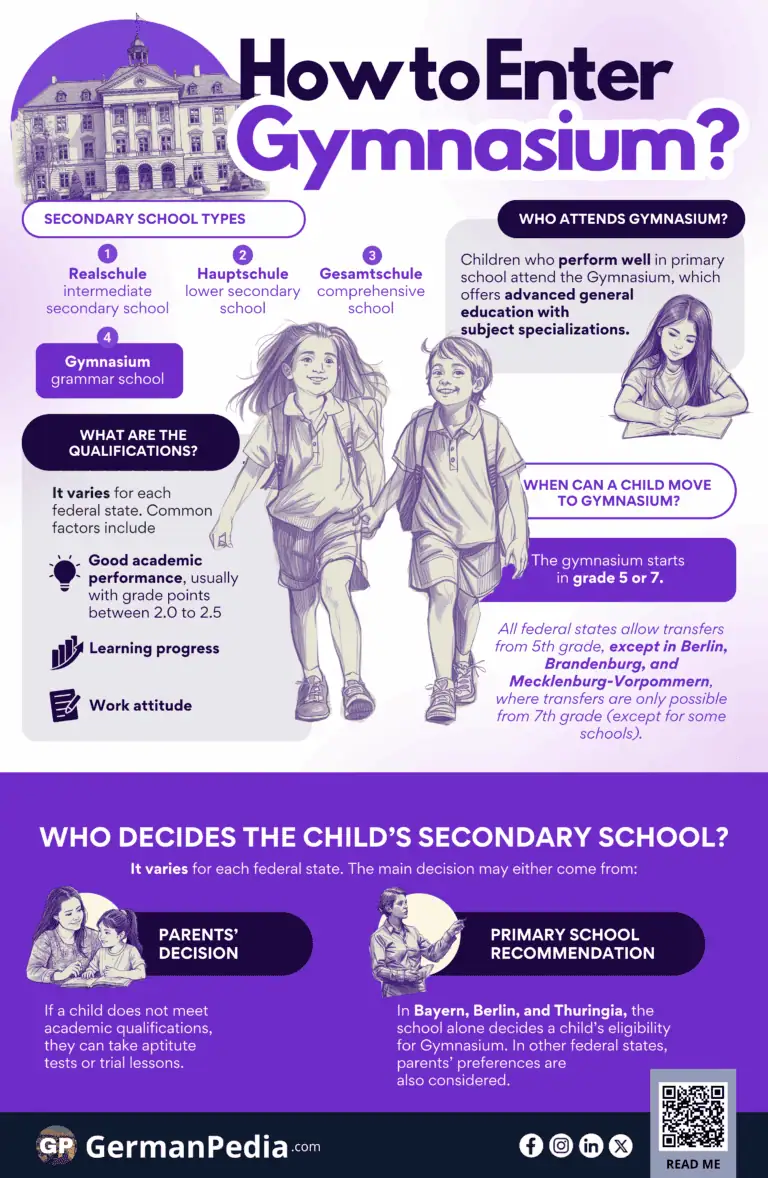
NOTE: German language skills are one of the core subjects that determine which secondary school your kid will attend.
How can you support your child’s German language skills?
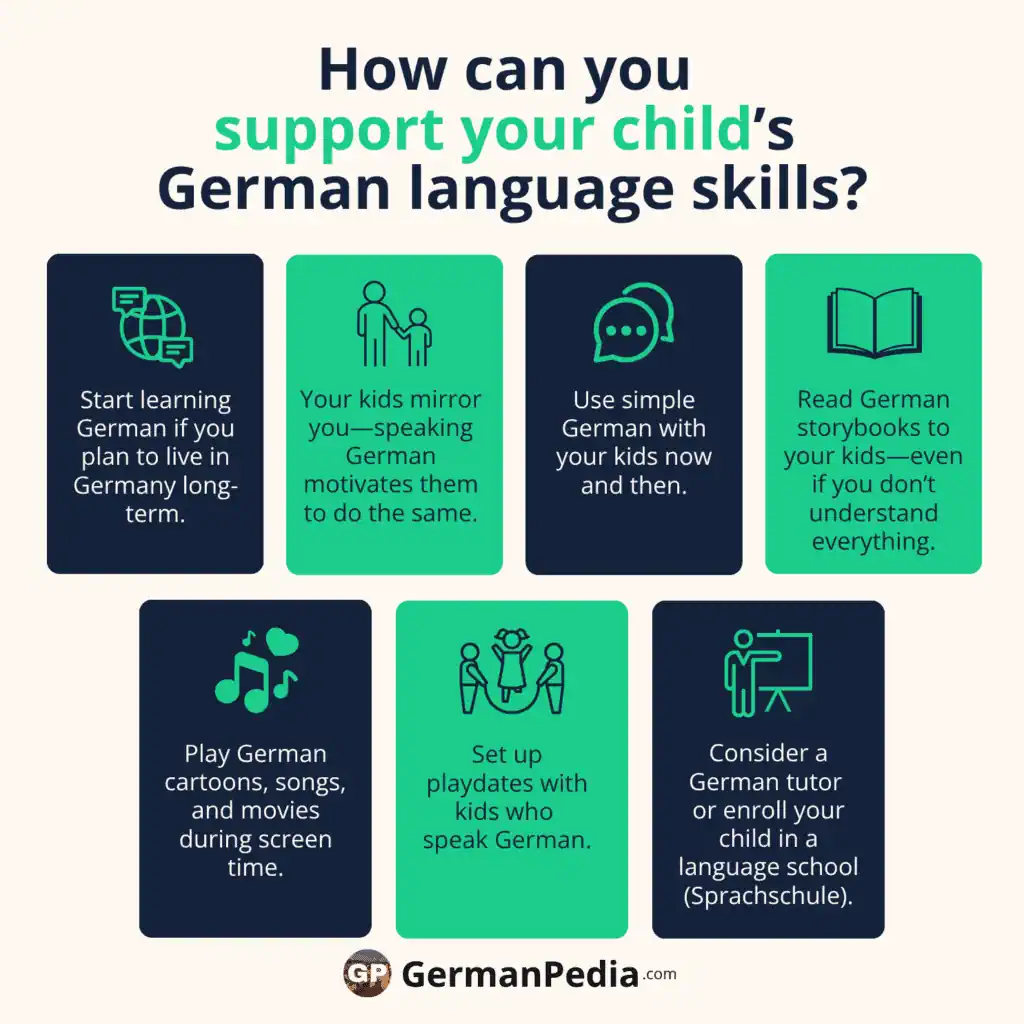
Use this Visualization: You may use this image for free with proper attribution to GermanPedia (i.e., by linking back to GermanPedia).
- If you plan to make Germany your home, you must start learning German.
German language schools and online courses for adults ->
- Kids look up to their parents the most. So, when you start speaking in German, it motivates the kids to speak German themselves.
- Start speaking in German with your kids from time to time.
- Read German storybooks to your kids. Even if you don’t understand a word, don’t assume your child doesn’t, either. The same goes for storybooks in your native language. You read them, assuming that your child understands them. You can get books from your local library, physical stores, or online.
- Play German cartoons, songs, movies, etc., during your child’s television time.
- Kids learn the most from one another. So, have as many play dates as possible with other German parents.
- Get support from a German language tutor.
NOTE: A child growing up in an environment where they hear and speak multiple languages usually takes longer to develop their language skills than kids learning only one language.
Thus, don’t worry if your child’s communication skills are not as good as those of other kids of their age.
Websites where you can find tutors in Germany
Here are some websites where you can find tutors near you or have online classes for your child.
- GoStudent
- Learnigo
- Optimalnachhilfe
- Studienkreis
You can also post an ad on Ebay-kleinanzeige regarding the tutor. Many locals find cost-effective tutors near them this way.
Essential German vocabulary for you. Private tuitions are referred to as “Nachhilfe” in Germany.
Are there any first-day-of-school traditions in Germany?

Yes, Germans celebrate the first day of school and are very specific about how they do it.
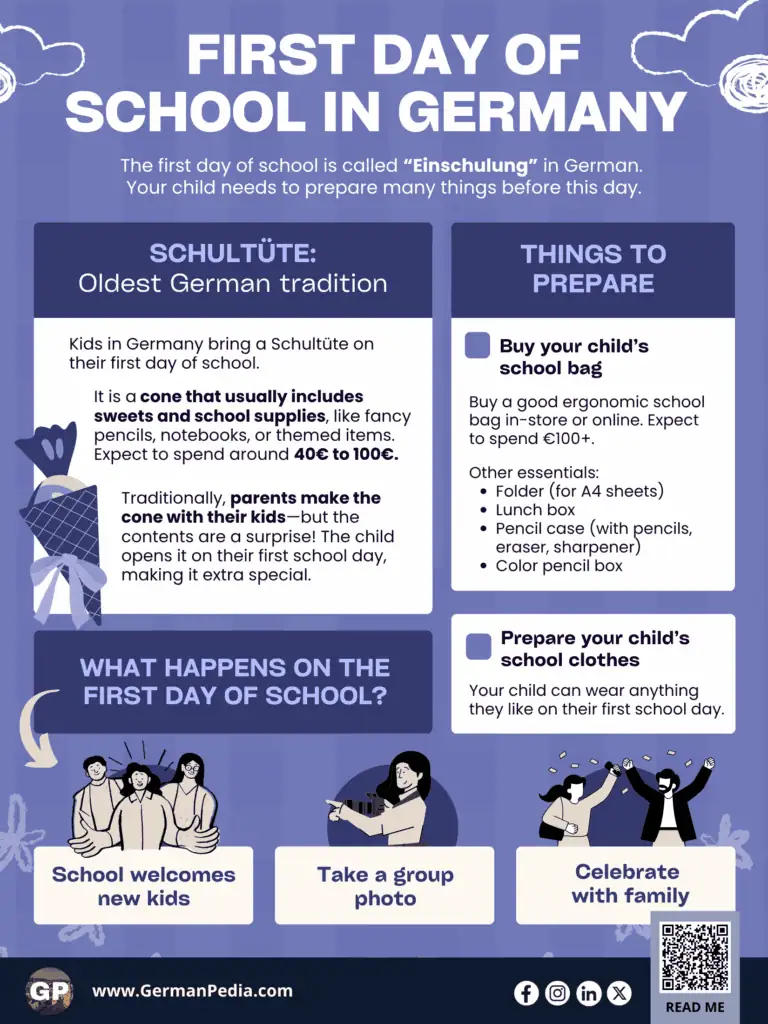
The best part is preparing for the first day of school. Every child in Germany brings these two things
- A big cone (Schultüte): Some make them at home, and others buy them on Amazon*. The cone is filled with a surprise for the kids: fancy school supplies and a ton of candy.
- School bag with all the school supplies: You’ll be surprised by how many types of school bags are available in Germany. Be prepared to spend over €100 on the school bag and school supplies.
Finally, the first day of school comes. Here’s what the big day typically looks like.
The children come to the school with their parents and extended relatives. The school organizes a welcome event for all the new students.
The 2nd-grade students perform and welcome the 1st-graders. The parents can mingle and snap some memories throughout the day.
The newcomers are given a tour of the school. The children are led to their classrooms to get to know and have fun with their classmates.
The day usually lasts around three hours. Families go out afterwards and end the day with a celebratory cake.
FAQ
Yes, it is usually possible for your child to start during the school year. Contact the school administration near you. You can email or call them and discuss your situation.
Yes, your child can start school in Germany regardless of their language skills. The reason is that schooling is mandatory in Germany.
Depending on the school and the federal state, your child will attend special classes to learn the German language.
You need the following documents:
– registration form,
– proof of identity or birth certificate,
– vaccination record, and
– school-entry health check certificate.
You may need further documents depending on your situation.
Every child learns and copes at their own pace. However, children are usually quick to adjust and make friends.
You can expect a period of adjustment of up to six months. You should give your child time to adjust and be patient.
Municipalities assign children to a school near their home. Thus, children usually walk or ride their bicycles to school.
Some parents drop their children off in the morning, and kids come back home independently. This ensures that the child reaches school on time. Moreover, if the child doesn’t return home on time, parents can take action.
Public transport in Germany is good. Many children use public transport to go to school.
Schultüte is a 100-year-old tradition still followed by parents in Germany. It’s not legally mandatory. However, your child will feel like they are missing out if they are the only one without a school cone.
So, we highly recommend building a school cone together with your child to celebrate their new phase in life.
Your local health authority (Gesundheitsamt) will send you an invitation for your child’s medical examination. If you don’t receive this invitation, contact your local health office directly.
Once you receive the invitation, follow the instructions to book an appointment for the exact date and time of examination. Some municipalities may require you to register by phone or via online registration instead.
The doctor will suggest possible support measures on how you can prepare your child better for school. This might include:
– Ergotherapy for children having difficulties with movement and coordination
– Speech therapy for children with speech or language difficulties.
In some cases, parents can choose to postpone enrollment after consulting with the pediatrician and the school.
Remember, the health checkup is not a pass-or-fail test. It is an assessment of your child’s school readiness. The goal is to identify areas where your child may need extra support, not to discourage them from schooling.
More topics