The independent commission that checks the finances of ARD, ZDF and Deutschlandradio has recommended a small rise in the broadcasting fee (Rundfunkbeitrag), often called the radio tax by expats.
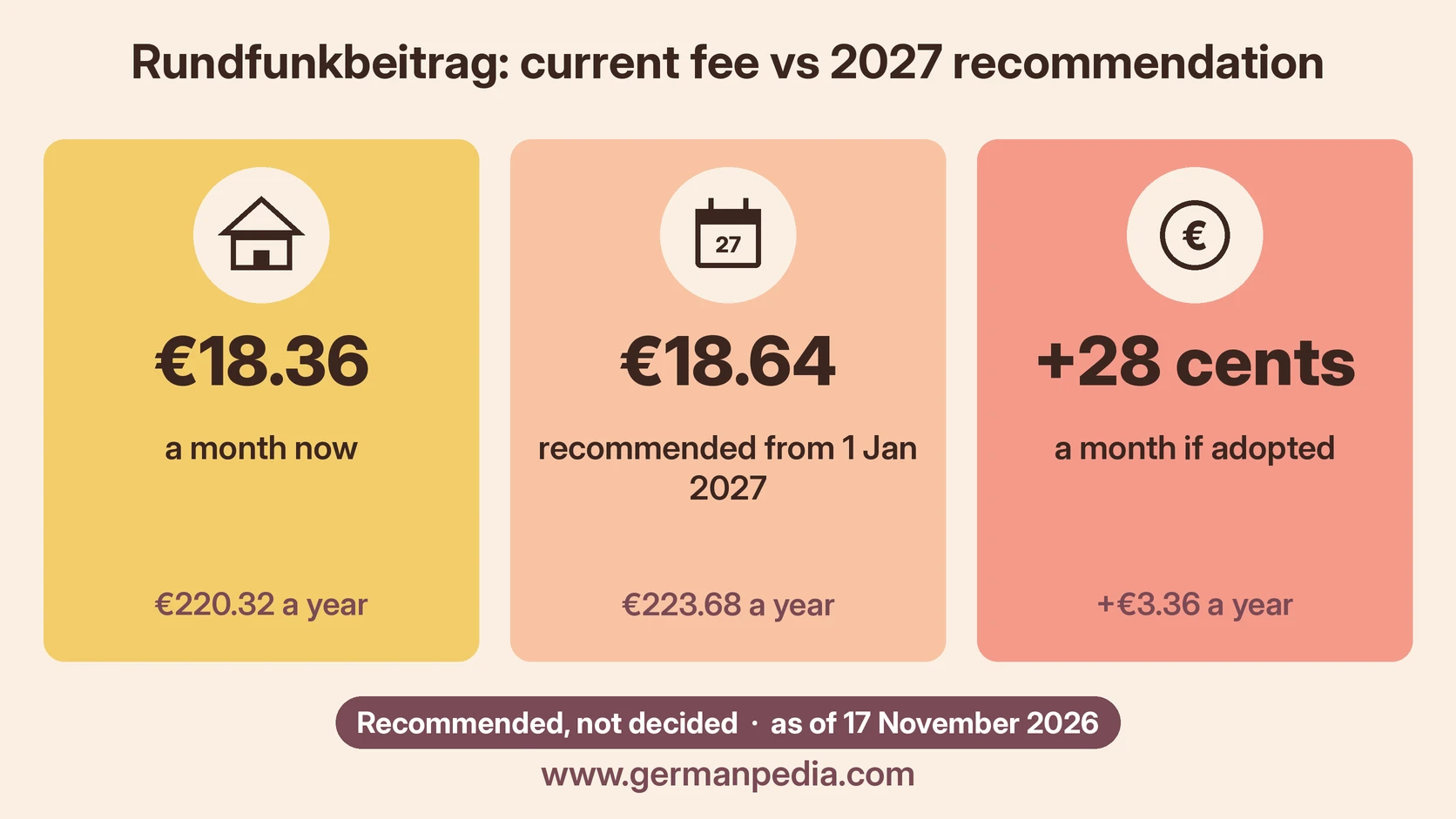
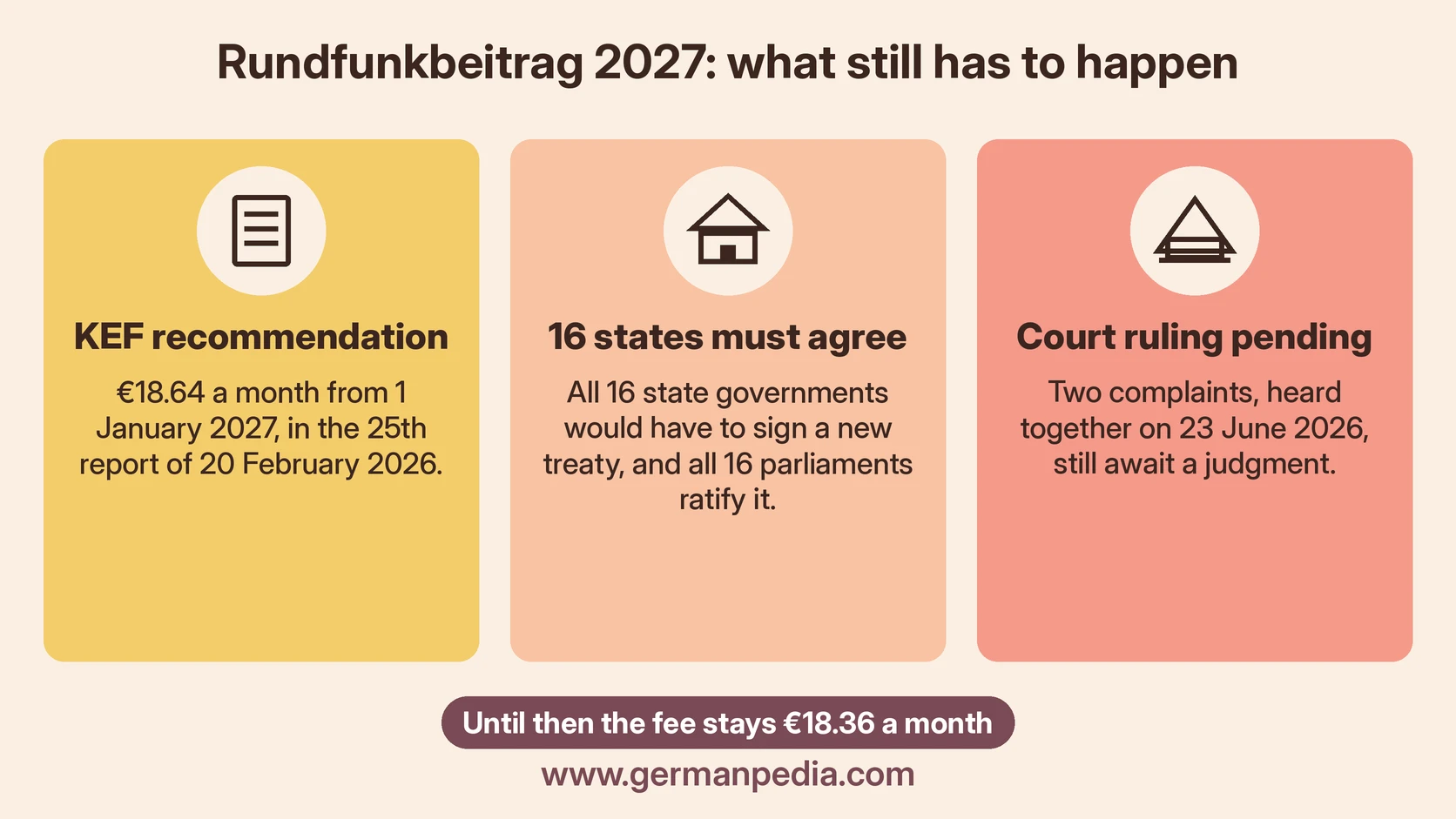
In its 25th report, handed to the states on 20 February 2026, the KEF (Kommission zur Ermittlung des Finanzbedarfs der Rundfunkanstalten) proposed raising the monthly fee from €18.36 to €18.64 from 1 January 2027.
That figure is recommended, but not decided.
All 16 state governments would have to sign a new interstate treaty (Staatsvertrag), and all 16 state parliaments would have to ratify it, before the amount changes.
Until they do, the Beitragsservice still collects €18.36 a month per home.
A related case at the Federal Constitutional Court, heard on 23 June 2026, is still waiting for a judgment.
Key Takeaways
- Recommended amount: €18.64 a month from 1 January 2027, up 28 cents from today’s €18.36 (€223.68 a year, up from €220.32).
- Not decided: all 16 state governments would have to sign a new state treaty, and all 16 state parliaments would have to ratify it, before the fee changes.
- Until then: the legal fee stays €18.36 a month per private household.
- Court case: two constitutional complaints, heard together on 23 June 2026, still await a judgment.
- December letters from the Beitragsservice are about the registration-data check, not a 2027 price rise.
[ez-toc]
What Would Change
The KEF recommendation is a rise of 28 cents a month, or €3.36 a year, for a private household that pays the full fee.
| 2025 and 2026 (current) | If the 2027 recommendation is adopted | |
|---|---|---|
| Per month | €18.36 | €18.64 |
| Per quarter | €55.08 | €55.92 |
| Per year | €220.32 | €223.68 |
The current amounts are those published by the Beitragsservice. The 2027 column is simply 12 times, or 3 times, the recommended monthly figure of €18.64.
It would apply from 1 January 2027 only if the states put it into a state treaty.
This is already lower than an earlier proposal. In its 24th report the KEF had recommended €18.94 a month from 1 January 2025. The states did not implement that rise.
The 25th report, an interim review of the same 2025 to 2028 period, lowered the remaining recommendation to €18.64 from January 2027.
Who Is Affected
In the private sphere, the fee is charged once per dwelling (Wohnung), not per person and not per radio or television.
It does not matter how many adults live in the flat, and it does not matter whether you own a TV. One person in the household pays.
If it comes, the change would affect almost every registered household in Germany, including expats in a rented flat, a shared flat (WG) and many student rooms.
People who are exempt, or who pay a reduced fee, would continue under those rules, which you have to apply for.
Companies and other non-private premises have a different tariff; our Rundfunkbeitrag guide covers both systems.
A letter from the Beitragsservice this winter is a separate matter.
From about 14 December 2026 the agency is due to write to adults it could not match to a paying household in its nationwide registration-data check (Meldedatenabgleich).
That letter is not a notice that the fee is going up, and it is not automatically a second bill.
What to do if you get a Beitragsservice letter walks through the reply.
Has the Rise Been Decided?
No. The KEF only recommends the amount.
All 16 state governments would have to sign a new interstate treaty, and all 16 state parliaments would have to ratify it, before the amount changes.
The commission itself notes that any departure from its recommendation is allowed only in narrow, exceptional cases, and only if all of the Länder agree and give reasons that can be checked.
In December 2024, the heads of the state governments decided to keep the fee at €18.36 for two years.
That is why 2025 and 2026 stayed at the current amount, even though the 24th report had recommended €18.94.
As of 17 November 2026, the official Beitragsservice pages still state a private fee of €18.36 a month.
There is no published state treaty that sets €18.64, or any other new amount, from 1 January 2027.
Our article on New Rules in Germany December 2026 already noted that a rise to €18.64 has been recommended but not decided.
What the Constitutional Court Case Means
In November 2024, ZDF and the ARD broadcasters filed two constitutional complaints (1 BvR 2524/24 and 1 BvR 2525/24), heard together, against the states’ failure to raise the fee from 1 January 2025.
They argue that this violates broadcasting freedom under Article 5(1) sentence 2 of the Basic Law.
The First Senate of the Federal Constitutional Court held a hearing on 23 June 2026.
As of 17 November 2026, the court has not published a judgment and has not announced a date for one. This article does not predict the outcome.
The case is about the 2025 non-increase. A ruling could still affect how the states handle the newer €18.64 recommendation, but that has not been decided either.
Exemptions and Reductions
A full exemption or a lower fee is not granted automatically. You have to apply and send proof.
Typical grounds for a full exemption include Grundsicherungsgeld (formerly Bürgergeld), means-tested basic income in old age or in case of reduced earning capacity, assistance for living expenses, benefits under the Asylum Seekers’ Benefits Act, or BAföG if you do not live with your parents.
A hardship exemption can apply if your income exceeds the social-benefit threshold by less than the monthly fee.
People with the “RF” mark on a severely disabled person’s pass (Schwerbehindertenausweis) can apply for a reduction to one third of the regular fee.
You can usually apply for past periods of up to three years if you already met the conditions then.
The full list, the documents to send, and the rules for student halls and second homes are in our Rundfunkbeitrag: Radio Tax Germany guide and on the official Beitragsservice pages.
What You Should Do
You do not need to change your payment now. Unless the states adopt a new treaty, or a court order says otherwise, the legal fee remains €18.36 a month.
If you think you qualify for an exemption or a reduction, apply on the Beitragsservice site and keep the proof.
Answering a data-check letter and applying for an exemption are two different steps.
If a letter arrives from mid-December, reply on the official form, even if someone in your household already pays. That process is explained in our Beitragsservice letter article.
It is not a 2027 price change.
Watch for a state treaty ratified by all 16 parliaments, and for a judgment or announcement date from the Federal Constitutional Court.
We will update this article, and the Germany 2027 changes overview, when either arrives.
What Happens If There Is No Decision
If no new state treaty is in force on 1 January 2027, the fee does not rise by itself.
The Beitragsservice would continue to collect €18.36 a month per private household.
The KEF calculated €18.64 on the assumption that the states would implement the recommendation on that date, for the remaining two years of the 2025 to 2028 period.
That assumption does not change the legal amount if the states do not act, or act later.
A later court ruling on the 2025 dispute could still require the states to act. Until a judgment is published, that remains open.
This article gives general information, not legal advice. If you are unsure about your household or an exemption, check the official Beitragsservice pages or get advice.
Sources
- KEF press release, 20 February 2026: 25th report recommends €18.64 a month from 1 January 2027
- KEF, 25th report (PDF), February 2026
- Federal Constitutional Court, press release no. 29/2026, 13 May 2026: hearing on “Rundfunkfinanzierung II” (1 BvR 2524/24, 1 BvR 2525/24) on 23 June 2026, including the KEF €18.64 recommendation and the December 2024 decision to keep €18.36 for two years
- Beitragsservice: information for private households, current fee €18.36 a month per dwelling
- Beitragsservice homepage, current private fee €18.36
- Beitragsservice: exemptions for recipients of social benefits
- Beitragsservice: exceptions and the “RF” reduction
- Beitragsservice: apply for an exemption or reduction