
Key takeaways
- You can take time off from work to care for your sick child. You get 90% of the net loss wages from your health insurer during this time. However, child sick pay is capped at 135.63€ per day (as of 2026)
- Many employers in Germany exclude paying wages when you are on child sick leave. But you are still entitled to unpaid leave.
- Child sick pay is tax-free. But you must declare it on your tax returns. It is added to your gross income to find the right tax rate.
- Families and single parents with one child can take up to 30 days of child sick leave in a year.
This is how you do it
- Inform your employer about the absence due to a sick child.
- Get a doctor’s certificate.
- Fill out the child sickness benefit form and send it to your employer and the health insurer.
The AI overview and answers are as good as the sources it uses.
To ensure you get AI answers from a deeply researched, maintained, and up-to-date source, add GermanPedia to your preferred sources.
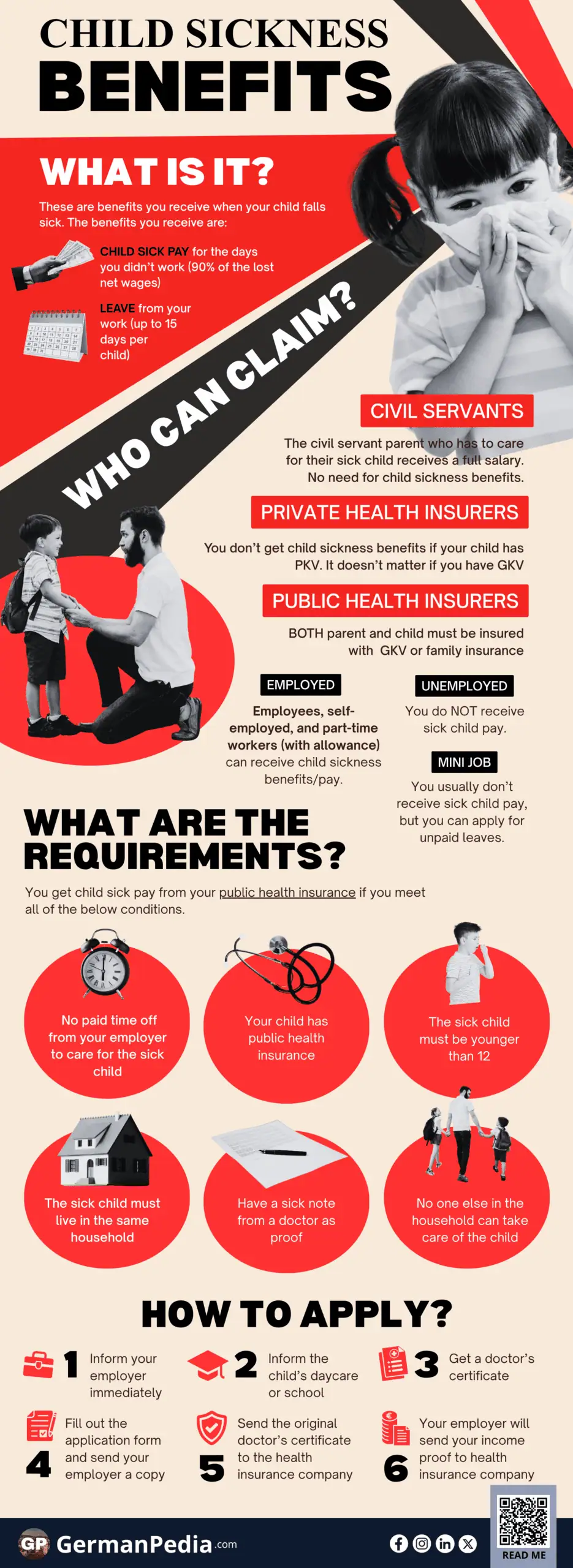
Use this Visualization: You may use this image for free with proper attribution to GermanPedia (i.e., by linking back to GermanPedia).
What is the child sickness benefit (Kinderkrankengeld) in Germany?
Child sickness benefits (Kinderkrankengeld in German) are the benefits you receive when your child falls sick. The benefits you receive are
- leave from your work: 15 days per child per parent per year. For single parents, 30 days per child per year. Parents of children with disabilities or serious illnesses can get unlimited child sick leave.
- child sick pay for the days you didn’t work (90% of the lost net wages). Suppose you received a one-off payment subject to social security contributions (such as Christmas pay) in the twelve months before your leave. In this case, you are entitled to 100% of your lost net wages. However, the child sick pay cannot exceed 70% of the daily contribution assessment ceiling. This means the maximum daily sick pay is 135.63€ per day (as of 2026).
The child sickness benefits are regulated under § 45 SGB V.
What is the legal basis for the entitlement of child sickness benefits (Kinderkrankengeld)?
Paid time off per § 616 BGB
Under the Civil Code (§ 616 BGB), employees are entitled to paid time off if they are unable to work for personal reasons. A personal reason could be caring for a sick child.
The legal definition of paid time off is that the employer continues to pay the wages when the employee is on leave.
However, many employers in Germany exclude this right to paid time off via a collective agreement or an employment contract. It is when your health insurance company steps in to cover the lost wages.
Unpaid leave and child sickness benefits per Section 45 SGB V
Even if your employer excludes the right to paid time off, you have the right to unpaid time off per Section 45 SGB V. It means you can take unpaid leave when your child is sick.
Moreover, you are entitled to receive child sick pay (Kinderkrankengeld in German) from your statutory health insurance provider. The child sickness benefit from the health insurer is also referred to as wage replacement benefits.
You don’t get child sick pay if your child has private health insurance. It doesn’t matter if you have statutory health insurance.
Best public health insurance in Germany ->

Who can claim child sickness benefits in Germany?
Whether you get child sickness benefits depends on your and your child’s health insurance and employment status.
Public health insurance
To receive child sick pay from the public insurer, both the parent and child must be insured with statutory health insurance or part of family insurance.
- Employees: Every employee insured with statutory health insurance can apply for child sick pay.
- Self-employed: The self-employed also receive child sickness benefits. The prerequisite is opting for sick pay when signing the health insurance contract. You can learn more about sick pay for the self-employed here
- Mini Job: Parents working in mini-jobs usually don’t receive sick child pay from the public insurer. However, you are entitled to unpaid leave to look after your child.
- Working part-time while receiving parental allowance: You are entitled to sick pay. Moreover, receiving child sick pay doesn’t affect your parental allowance. You’ll continue to receive the parental allowance as you did before.
- Unemployed: Unemployed people don’t receive sick child pay. Suppose you receive the “unemployment benefit I”. In this case, you can inform the Bundesagentur für Arbeit about your sick child and request a waiver of the regular appointments.
Private health insurance
You don’t get child sickness benefits if your child has private health insurance. It doesn’t matter if you have statutory health insurance.
However, you can opt for sick child pay while signing the private health insurance contract.
Suppose your current private health insurance plan doesn’t cover child sick pay. You can also change your private health insurance tariff.
We recommend getting private health insurance via an insurance broker. They are experts and can help you find the best plan for your needs. You can book a call with an insurance broker we recommend here.
Civil Servants
Child sickness benefits don’t apply to civil servants as the state supports them. The civil servant parent who has to care for their sick child receives a full salary.
What requirements must you fulfill to receive child sick pay (Kinderkrankengeld)?
You get child sick pay from your public health insurance if you meet all of the following conditions.
- You don’t get paid time off from your employer to care for a sick child.
- You and your child have public health insurance.
- The child for whom you are claiming sickness benefits must be younger than 12. Children with disabilities have no age limits.
- The child must live in the same household. Of course, this rule doesn’t apply if the child is seriously ill and must be hospitalized.
- You need a sick note (Muster 21 (Ärztliche Bescheinigung)) from a doctor to prove your child is ill.
- No one else in the household can take care of the child. For example, if the child’s grandparents live in the same household, they can care for your child. In this case, you don’t receive child sick pay.
How do you apply for child sickness benefits?
Follow the following steps to apply for child sickness benefits.
- Inform your employer immediately that your child is sick and you are unable to work as you must take care of the child at home.
- You should also inform the child’s daycare or school.
- Get a doctor’s certificate, also called “Muster 21 (Ärztliche Bescheinigung).”
- The sick note also contains the application form for child sickness benefits. It’s usually on the back of the sick note or down below.
- Fill out the application form. Sign it and send a copy to your employer.
- You must send the original doctor’s certificate to the health insurance company. You can also submit the doctor’s certificate online on your health insurer’s website or mobile app.
- You need to fill out the following information on the form.
- Your bank details
- Whether you’ll receive wages from your employer
- Are you a single parent?
- Number of child sick days you have already taken in the current year.
- The health insurance company also needs proof of income to calculate the sick pay. Your employer will send it directly to your health insurer. So, you don’t have to do anything here. For self-employed individuals, health insurance will consider the same income it used to calculate the premiums. So, you don’t have to send any new document.
Health insurance for self-employed in Germany ->
Since 18 December 2023, you can get a sick note for your child on the phone. Hence saving you the visit to the doctor with a sick child.
However, there are some limitations to getting the doctor’s certificate by phone.
- The maximum number of sick days you can get on the telephone is five.
- Your child must be registered with the doctor’s practice.
The doctor’s office emails you the sick note or asks you to pick it up from the practice.
How many days of child sickness benefits can you receive?
Since 2024, the number of days parents can take time off work to care for a sick child has increased.
Number of child sick days in 2026
Families with two parents
- Families with one or two children can take 15 working days off per child and parent in a year.
- One child: up to 30 days off per year as a family (15 days per parent).
- Two children: up to 60 days off per year as a family.
- Families with more than two children can take up to 35 working days off per parent.
- More than two children: up to 70 working days in a year as a family.
Single parents
- One child: up to 30 working days off in a year.
- Two children: up to 60 working days off in a year.
- More than two children: up to 70 working days off in a year.
| Number of paid sick days (as of 2026) | ||
| Number of children | Couples | Single parent |
| One child | 15 days per parent per child = 30 days | 30 days |
|---|---|---|
| Two children | 15 days per parent per child = 60 days | 60 days |
| More than two children | 35 days per parent = 70 days | 70 days |
| Seriously ill children | unlimited | unlimited |
How much is the child sick pay (Kinderkrankengeld)?
- As per Section 45 Para. 2 SGB V, you receive 90 percent of your lost net salary as gross child sickness benefit.
- There is a cap on the maximum child sick pay one can receive. The child sick pay cannot exceed 70% of the daily contribution assessment ceiling. This means, the maximum child sick pay is 135.63€ per day (as of 2026).
- You must also pay the social security contributions (pension, unemployment insurance, etc.) on your child sick pay. The social security contribution is 12.3% for employees with one child.
- The health insurer deducts social security contributions from child sickness benefits and pays the remaining amount.
Sickness benefits in case your child met with an accident.
Suppose your child met with an accident in kindergarten, after-school care, at school, or on the way to school or home. In this case, the statutory accident insurance pays the sickness benefit.
The child sick pay or injury benefit is 80% of your net salary. You apply for the injury benefit via your health insurance company.
Do you get child sickness benefits if the child is admitted to the hospital?
Yes, you’ll receive child sickness benefits if your child is admitted to the hospital and you must accompany your sick child (§ 45 SGB V).
The health insurer will pay you the child sickness benefits as long as you are in the hospital. There is no maximum number of child sick days in this scenario (§ 45 (1a) SGB V). Moreover, the days in the hospital don’t count towards the regular child sick days.
To be eligible for these benefits, you must fulfill the following conditions.
- The admission to the hospital is medically necessary. If the child is up to 8 years old, it’s assumed that admission is medically necessary.
- Your child is under 12 years old or has a disability.
- You are insured with the right to sick pay.
- You cannot work, thus suffering a loss of income.
- You and your child has public health insurance.
- The hospital confirms that it is necessary for you to accompany the child.
The hospital or the inpatient facility certifies that the hospital admission was medically necessary and for how long.
How do you apply for child sick pay when you accompany your child for inpatient treatment?
Applying for child sickness benefits is straightforward. Your health insurer requires two documents.
- Certificate from the hospital or rehabilitation facility stating that an accompaniment is necessary.
- Child sick pay application form. You can download the form from your health insurer’s website. Here is the application form from TK. Search the term “Antrag auf Kinderkrankengeld bei Begleitung Ihres Kindes zur stationären Behandlung” to find the form.
You can submit the documents via post or insurers website/mobile app.
What applies if your child is terminally ill?
Suppose your child has a progressive, incurable and life‑threatening illness with only weeks or a few months expected life expectancy. In this case, you receive child sickness benefit (Kinderkrankengeld) for an unlimited period as long as the medical necessity exists (§ 45 Abs. 4 SGB V)
You need a medical certificate from the treating physician confirming the child’s prognosis and the necessity of parental care or accompaniment.
Do you have to declare child sick pay in the income tax returns?
Yes, you must declare the child sick pay you received during the year in the income tax return. Child sick pay is considered a wage replacement benefit. If your wage replacement benefit exceeds 410 € (as of 2025), you are legally required to file an income tax return.
Child sick pay is tax-free but subject to the progression clause (Progressionsvorbehalt). This means, it’s added to your gross income to find the right tax rate (§ 32b EStG). This may increase your tax rate and hence the tax burden.
Your health insurance company sends you a letter stating the total child sickness benefits you received in the year for tax purposes.
Learn how to save taxes in Germany here ->
More topics
- Sick pay in Germany
- Health insurance for children
- Best public health insurance in Germany
- Best private health insurance as per top rating agencies
- Health insurance finder
- German healthcare explained
- Minimum coverage your private health insurance plan should offer
- Private health insurance costs in Germany
- Is private health insurance worth it?
- Private health insurance cost in old age
References
- https://www.finanztip.de/gkv/kinderkrankengeld/
- https://www.tk.de/firmenkunden/service/fachthemen/jahreswechsel/2024-2025-neuregelungen-kinderkrankengeld-2160374
- https://www.bundesgesundheitsministerium.de/themen/praevention/kindergesundheit/faq-kinderkrankengeld
- https://www.kindergesundheit-info.de/themen/krankes-kind/recht/berufstaetigkeit/
- https://www.gew.de/gesundheit/freistellung-bei-erkrankung-eines-kindes
- https://www.tk.de/techniker/versicherung/tk-leistungen/arzt-und-krankenhausbesuch/krankmeldung/kinderkrankengeld-begleitung-kind-krankenhaus-reha-2163192
- https://www.tk.de/firmenkunden/service/fachthemen/jahreswechsel/kinderkrankengeld-2024-und-2025-2160374
- https://www.tk.de/firmenkunden/versicherung/versicherung-faq/kinderkrankengeld/wie-viel-kinderkrankengeld-wird-ausbezahlt-2099512
![Number of People Insured in Public Health Insurance in Germany [2000-2025]](https://germanpedia.com/wp-content/uploads/2025/03/number-of-people-insured-in-gkv-and-pkv-768x1152.webp)
![Number of People Insured in Public & Private Health Insurance in Germany [2025]](https://germanpedia.com/wp-content/uploads/2025/03/number-of-people-insured-in-gkv-and-breakdown-768x1152.webp)