
Key takeaways
- In certain cases, you can return from private to public health insurance (Gesetzliche Krankenversicherung (GKV) in German).
- Employed people with a gross income below 77,400€ (as of 2026) can switch from private health insurance to public (§ 2 SVBezGrV).
- Self-employed individuals must switch to an employment relationship or shut down their business to return to public health insurance.
- Your chances of changing from private to public health insurance diminish with age. It’s almost impossible for people older than 55 to move to public health insurance (§ 6 SGB V).
This is how you do it
- The easiest way to move back to the public German health insurance system is by reducing your income. There are various options to reduce your salary. For example, working part-time, paying into a company pension scheme, etc.
- If your spouse has statutory health insurance, they can get you back into the public system via a family health insurance scheme.
- The last resort is registering as unemployed or taking out health insurance in another European country.
- If none of the methods work for you, consider changing your private health insurance provider and plan. Your insurance broker, who helped you find the plan, can provide support.
Table of contents
Many expats opt for private health insurance when they are young and healthy, as it is often more affordable and offers better services. However, they usually don’t consider the long-term view, such as family, income, etc.
As your life situation changes, private health insurance may no longer be affordable. For example, you may have married, and your spouse no longer works, or you may have decided to have children.
In such situations, the monthly private health insurance contribution sometimes becomes so high that people try to return to the public system.
However, leaving private health insurance is tough and possible only in certain cases.
What can you do if the private health insurance no longer fits your situation?
You have three options if private insurance is no longer affordable.
- Cancel your private health insurance contract within 14 days of receiving it. This is known as Widerrufsrecht in German (§ 8 VVG)
- Reduce the cost of your private health insurance by
- Moving to a cheaper private health insurance tariff.
- Changing your private health insurance provider (not recommended).
- Switch to public health insurance.
The first option is usually not relevant because of two reasons
- The cost of private health insurance tends to increase after a few years. According to the PKV Association, the annual increase in monthly PKV contributions was 3.9% per annum between 2015 and 2025.
- Your life situation won’t change in 14 days, but after a few years.
This guide focuses on switching from a private insurance plan to public health insurance. If you want to learn how to reduce your private health insurance costs, read our guide here.
There are different ways to return to public health insurance, depending on whether you are an employee or self-employed. But first, let’s check how employees can switch to public insurance.

How can employees switch from private to public health insurance in Germany?
The best way for employees to return to public insurance is to reduce their salary below the annual limit (Jahresarbeitsentgeltgrenze in Germany) of 77,400€ (as of 2026) (§ 6 SGB V).
As soon as you earn below the annual limit, you are required to take the health insurance again. This is your chance to switch to public health insurance.
Employees who opted for private health insurance before 31 December 2002 (the so-called “Altfall”) have a lower income threshold. The income threshold is equal to the contribution assessment ceiling (Beitragsbemessungsgrenze), which is 5812.5€ per month (as of 2026).
Things to keep in mind while moving to the German public health system
- The reduction in your salary should not be “of short duration.” How long the “short duration” is – is not specified under German law. However, your earnings should remain below the annual limit for over three months.
- You should switch to public health insurance within two weeks after starting to earn below the annual limit.
- You can choose any public health insurance. We find TK to be the best public health insurance provider for expats in Germany.
Best public health insurance in Germany ->
Register with TK

- Biggest public health insurance company in Germany based on number of members.
- Enjoy low premiums
- Get English customer support, website, and mobile app.
- Complete the application process in English.
Things to know after you move to public health insurance
- Once you switch to a public health insurer, you can remain in the German public health insurance system even if your salary rises above the annual income limit again.
- The rule that you must be a member of public health insurance for twelve months during your low salary does not exist anymore (§ 188 Para. 4 SGB V.) Hence, you can stay in public health insurance even if your salary increases within twelve months.
How to reduce your salary to switch from private health insurance to public health insurance in Germany?
Reducing your annual income is the easiest way to return to public health insurance in Germany.
Here are the three ways to reduce your income.
#1 Reduce income temporarily
You can reduce your annual income by
- working part-time
- taking a sabbatical
- using a work-time account.
What is a work-time account?
Many companies offer work-time accounts. The work-time account adds part of your working hours to a separate account.
You don’t get paid for these hours. Instead, you can use these hours afterward to take long paid leave.
With reduced numbers of paid hours, your annual income also reduces.
Once your salary goes below the annual limit of 77,400€ (as of 2026), you can enroll in German public health insurance (§ 6 SGB V).
#2 Reduce income by using “bridge part-time” work.
A good way of returning to the statutory health insurance scheme is to use “bridge part-time” work (Brückenteilzeit in German).
In 2019, German regulators introduced a law allowing workers to reduce their working hours for a period. Once the period is over, they can return to their original working hours (§9 TzBfG).
For example, suppose you have a 40-hour-per-week contract and your salary exceeds the annual limit. In this case, you can reduce your working time to 30 hours/week for one year to bring your salary below the annual limit.
After one year, you have the right to return to your earlier working time, i.e., 40 hours/week.
So, the option to reduce your hours and the right to return to your original hours is “bridge part-time” work.
Prerequisites
You must fulfill the following conditions to qualify for “bridge-part-time” work.
- You are working for a company with more than 45 employees.
- You have been working in this company for at least six months.
Things to keep in mind
- You must apply for “bridge part-time” work (Brückenteilzeit in German) for at least one year and at most five years (§9 TzBfG).
- The closer your salary is to the annual limit of 77,400€ (as of 2026), the more worthwhile it is to use “bridge part-time” work.
- However, the higher the income, the more difficult it is to say whether this step will pay off, given the drop in salary. Thus, a tariff change might make more sense for high earners.
#3 Reduce income by contributing to the company’s pension scheme
Anyone who earns less than 81,264 euros gross in 2026 can switch to a public health insurer by contributing to company pension schemes (Betrieblicher Altersvorsorge in German (bAV)).
Every employee has a legal right to Entgeltumwandlung (deferred compensation) under § 1a BetrAVG. Deferred compensation means you contribute part of your salary to certain schemes and get paid later.
In short, you are deferring your compensation to a later date. This way, you can reduce your gross income considered for public health insurance.
One of the schemes you can contribute to is the company pension scheme.
You can pay up to 3,864 € per year (as of 2026) from your gross income into a company pension scheme free of social security contributions (§ 3 Nr. 63 EStG).
Contributing part of your salary to the company’s pension scheme reduces your annual income relevant for health insurance contributions. Hence, getting your salary below the yearly limit of 77,400€ (as of 2026).
The best part is that your income is not lost, instead saved for your older self.
You only have to contribute to the company pension scheme for one year. After returning to public insurance, you can reduce or suspend the contribution.
Example
A 35-year-old employee, Sarah, earns EUR 80,000 gross per year. She wants public health insurance again.
Instead of forgoing income by doing temporary part-time work, Sarah contributes 3000€ to her company pension scheme. This reduces her gross income below the income threshold. Thus, her employer issues a written confirmation that she is subject to compulsory public insurance.
With written confirmation from the employer, Sarah can terminate the private health insurance without notice and register with a public health insurance provider.
NOTE: To cancel private health insurance, you must first have the public health insurance contract.
How to cancel a private health insurance policy? ->
Best public health insurance in Germany ->
How can you stay with private health insurance even if you earn below the income threshold?
Suppose you want to stay with private health insurance even if your income drops below the income threshold. In this case, you can apply for an exemption to compulsory public health insurance (§ 6 SGB V).
You must apply for an exemption via any public health insurer within three months. Here is the exemption form from TK.
NOTE: If you apply for an exemption you can no longer return to public health insurance even if you take on a new job subject to compulsory public health insurance coverage.
You can return to the public system only if the insurance obligation occurs for a reason other than earning below the income threshold in a job.
What can you do if you are exempt from the compulsory public health insurance?
Suppose you have applied for an exemption (Befreiung) from statutory health insurance. In this case, you cannot simply revoke it and switch to public insurance (§ 8 SGB V).
You can return to the public system only if the insurance obligation occurs for reasons other than what you gave when applying for the exemption.
Here are the reasons when you can get compulsory public health insurance:
- Becoming entitled to unemployment benefit I (Arbeitslosengeld I) (§ 5 SGB V).
- Taking up employment where your salary is below the income threshold (§ 6 SGB V).
Examples:
- Sarah switched jobs and earned below the income threshold in 2022. However, she wanted to stay with private health insurance and applied for an exemption in 2022. In 2026, she decided to return to public insurance. In this case, Sarah’s lower income won’t allow her to make the switch. Sarah can, however, return to private health insurance if she becomes unemployed for at least one month and is entitled to “unemployment benefit I.”
- Adam became unemployed in 2023. He was eligible to return to the public system. However, he opted to stay in private health insurance. In 2026, Adam wants to switch to public health insurance. In this case, Adam cannot use his unemployment status to return to public insurance. He can, however, get a job with a salary lower than the income threshold to return to the public system.
NOTE: Pensioners exempt from the compulsory state insurance scheme cannot return to the public healthcare system for the rest of their lives.
Suppose you are unsure about why you are exempt from public health insurance. In this case, you can do the following.
- Contact your previous public health insurer (if any) or any public insurer. Ask them to provide you with the written reason for any past exemption.
- Get advice from an insurance broker, a lawyer specialized in Sozialrechts, or the Verbraucherzentrale.
German Healthcare Demystified – Free eBook
- The German healthcare system is complex. This is why we wrote this book to help you navigate it.
- Choosing health insurance is a life-long decision. If you pick the wrong plan, it may cost you dearly in the future.
- Learn what is covered in public and private health insurance and what is not.
- What supplement health insurance plans must you get based on your personal situation?
How can a self-employed individual switch from a private to a public health insurance provider?
The switch from private to public health insurance is more difficult for the self-employed. The problem is that you can’t just lower your income to enter the public healthcare system.
But you have the following options:
#1 You get a full-time job
Transitioning from self-employment to employment is the easiest way for the self-employed to return to public health insurance.
Things to keep in mind
- Your earnings in the new job must be more than the mini-job limit (i.e., 603 euros per month (as of 2026)).
- Your income must not exceed the annual limit of 77,400€ (as of 2026).
Social security contribution limits in Germany ->
Benefits of opting for this method
- You don’t have to give up your self-employment to be employed elsewhere.
- You can continue to do your business part-time alongside your full-time employment.
Conditions to continue your business with your job
- You should be working more than 20 hours per week on the job.
- The gross income from your job should be more than half the reference value for social security (Bezugsgröße für die Sozialversicherung). The reference value for social security is 3,955€ (as of 2026). So, your income should be higher than 1,977.5€ (as of 2026) (3,955€ (as of 2026) / 2).
NOTE: The public health insurers check whether the employment is genuine. Hence, it is not sufficient to appear to be employed by relatives.
#2 Business Abandonment and Family Insurance
Another option is to shut down your business and enroll in your spouse’s public health insurance plan for free.
However, you can opt for free family health insurance if you earn less than 565€ per month (as of 2026) in a job subject to social security contributions. For income from a mini-job, the limit is 603 euros per month (as of 2026) (§ 10 SGB V).
State long-term care insurance
Suppose you switch to public health insurance via family insurance. In that case, you automatically become a member of statutory long-term care insurance.
However, you are eligible for benefits from long-term care insurance after a pre-insurance period of two years.
But the good news is, since January 2019, public insurers have considered the time you were part of private insurance ( § 33 Para. 3 SGB XI ) in the pre-insurance period. As a result, most insured persons are continually covered by long-term care insurance.
Two options to return to public health insurance in emergencies
If none of the above methods work for you to switch from private insurance to public, you still have two options.
Both employed and self-employed can take advantage of these options.
#1 You register as unemployed
Anyone who receives unemployment benefits-I can take out public insurance again (§ 5 Abs. 1 Nr. 2 SGB V). But unfortunately, people aged 55 years or older still cannot switch to state health insurance.
As per German law, it’s enough to draw unemployment benefits-I for one month to enter the public healthcare system.
Once you are part of German health insurance, you can stay in it even if you get a well-paid job afterward (§ 188 Para . 4 SGB V).
#2 You insure yourself in another European country
The second emergency solution is to take out public health insurance in another European country. Countries other than Germany that have health insurance obligations are the Netherlands, Sweden, and Switzerland.
So, you have to move to one of these countries or take a job there to get into public insurance. This way you can get German statutory health insurance again when you return to Germany.
Good to know
- You must be part of public insurance in these countries for at least twelve months. Hence, you must cancel your private health insurance in good time.
- If you return to Germany, you can become a member of public insurance within three months ( § 9 Para. 2 No. 1 SGB V ).
NOTE: You must check with a consumer advice center or independent patient advice service about the regulations that apply in your case.
How can students return to public health insurance in Germany?
Here are the options for students to return to public health insurance.
- If you recently signed a private health insurance contract, you can cancel it within 14 days of signing up (VVG § 8).
- You can return to the public healthcare system when you get full-time employment for the first time after graduation. However, your income must be less than the income threshold.
Best public health insurance in Germany -> - Suppose you become self-employed immediately after graduating. Then, you must remain privately insured. How much you earn doesn’t matter in this situation.
How to choose health insurance as a self-employed in Germany? -> - You have a special right to terminate your private health insurance contract if your insurer increases the monthly premiums or reduces benefits. However, this only allows you to change your private health insurance company. It doens’t allow you to move to public health insurance. Learn more about canceling private health insurance in Germany here.
- You should consult your university’s student help center, insurance broker, fee-based broker, or consumer advice centers (Verbraucherzentrale in German) for personalized advice.
Which health insurance can you get as a student in Germany ->
Anyone older than 55 years can hardly switch to public health insurance in Germany
People who have private health insurance and are 55 or older find it difficult to insure themselves with a public insurer (§ 6 SGB V).
The legislature restricted older people’s options to switch from private to public insurance.
Even if they enter an employment relationship that subjects them to compulsory state insurance, they cannot return to the public healthcare system.
Why is it tough for older people to return to the public healthcare system?
The German government wanted to prevent citizens from benefiting from the low premiums of private health insurance when they were young and returning to the public system when they were old.
Hence, the German legislature put this restriction in place to avoid burdening the public healthcare system, with many people moving into it during their old age.
Thus, the only option is to stay with your existing private insurer and change the insurance plan or switch to a different private health insurance provider. The insurance broker who helped you get the private insurance can support you here.
As you can see taking private health insurance is a lifelong decision. This is why it’s vital that you consult an insurance broker before getting one.
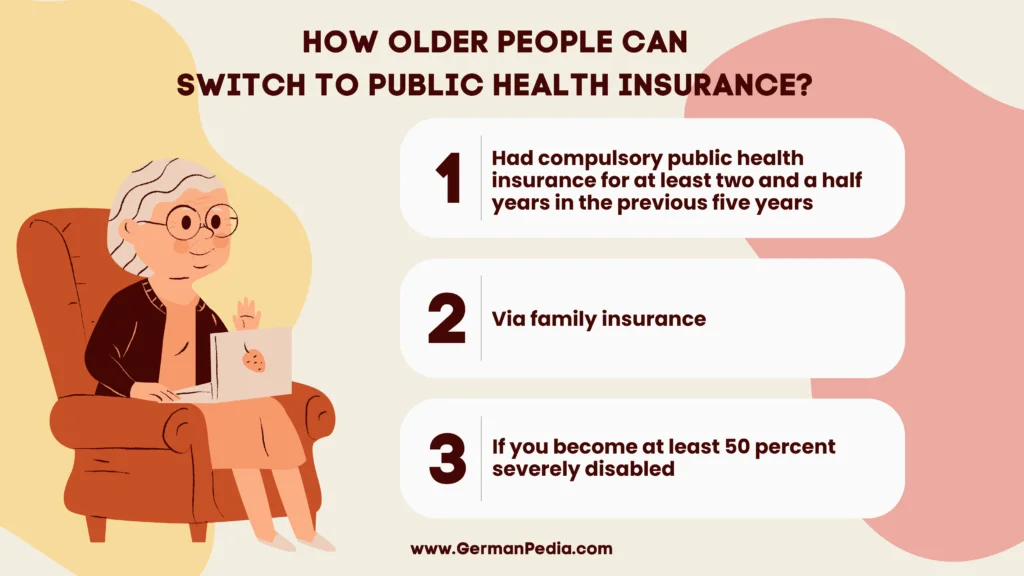
3 ways older people can switch from private insurance to public insurance
Option 1
You can switch if you had compulsory public health insurance for at least two and a half years in the previous five years (§ 9 SGB V).
Unfortunately, that is a very rare case.
Option 2
You can move to public health insurance via family insurance. But, you must fulfill certain requirements (§ 10 SGB V).
- Your spouse or life partner must be insured by law.
- Your income from a job subject to social security contributions may not exceed 565€ per month (as of 2026). If you do mini-jobs, the limit is 603 euros per month (as of 2026).
Option 3
You can switch from private healthcare to public if you become at least 50 percent severely disabled. The deadline to apply for public health insurance is three months after doctors determine the disability.
In this case also, you or your spouse or one of your parents must fulfill certain pre-insurance periods (§ 9 Para. 1 No. 4 SGB V).
Unfortunately, in practice, the probability of switching from private insurance to public is very low. Health insurance companies have the right to limit the maximum age for admission. And most insurers set the age limit at 45 years.
What to do if public health insurance providers reject your application?
First things first, never cheat your way back into statutory health insurance.
Suppose the health insurance company finds out you have intentionally given false information. In that case, they can revoke your health insurance retrospectively.
Here is what you can do if you think the health insurance company wrongly refused your admission application.
- You can object to the refusal in writing within one month (counting from the date the decision reaches you) (§ 84 SGG).
- If the insurance company rejects the objection, you can file a complaint in the social court.
NOTE: Under Section 44 of Social Security Code X, you can file an objection even after the objection period. However, you must meet certain requirements to object after the 1 month objection period. It’s best to consult a lawyer in such situations.
We recommend seeking advice before taking any legal action. You can contact one of the following for advice.
- Consumer advice center
- A lawyer with a specialization in Social law
- Independent patient advice service (UPD)
Sometimes, it also helps to file a complaint to the Federal Social Security Office.
Convert private health insurance into supplementary insurance
When you switch from private to public health insurance, you can convert your private health insurance contract into private supplementary health insurance.
It has the following advantages:
- You can use your saved retirement provisions to pay for the supplementary insurance. This way, you don’t lose your retirement provisions.
- You get the benefits of private health insurance, such as getting treatment in private hospitals, dental care, etc., while being insured by public insurance.
Dental coverage in public health insurance in Germany ->
Moreover, taking out supplementary health insurance is quick and easy. You don’t need a health check and have no waiting period before you can claim benefits.
FAQs
Here are the typical life situations when you can switch from private to public health insurance in Germany.
– Your salary falls below the income threshold (77,400€ (as of 2026))
– You become unemployed and receive unemployment benefit I.
Yes, you can return to the public system in the following situations.
– You get a job and earn below the income threshold.
– You shut down your business and become unemployed.
– You shut down your business and insure yourself under your spouse’s public health insurance (family insurance).
Yes. If you are over 55, you usually cannot switch back to public health insurance. There are some exceptions.
No medical exams are required. Public insurers (GKV) accept you based on eligibility alone. You pay income-based contributions with no risk surcharges.
Best public health insurance in Germany ->
If you are eligible to move to public health insurance, it takes between 2 and 4 weeks to make the switch. After you apply, the public health insurer verifies your eligibility and sends a confirmation. You keep your private insurance cover until you get the public insurance.
Once you are in the public system, the normal rules apply again. This means you can insure your non-working spouse and children for free in family insurance.
More topics
- Best public health insurance in Germany
- How can you reduce private health insurance costs?
- Best private health insurance as per top rating agencies
- Private health insurance costs in Germany
- Private vs public health insurance
- Private health insurance costs in old age
- Why is private health insurance cheaper than public health insurance?
- Employer’s contribution to private health insurance
- Private health insurance for self-employed
- Health insurance for students
- Health insurance for children
- Healthcare in Germany
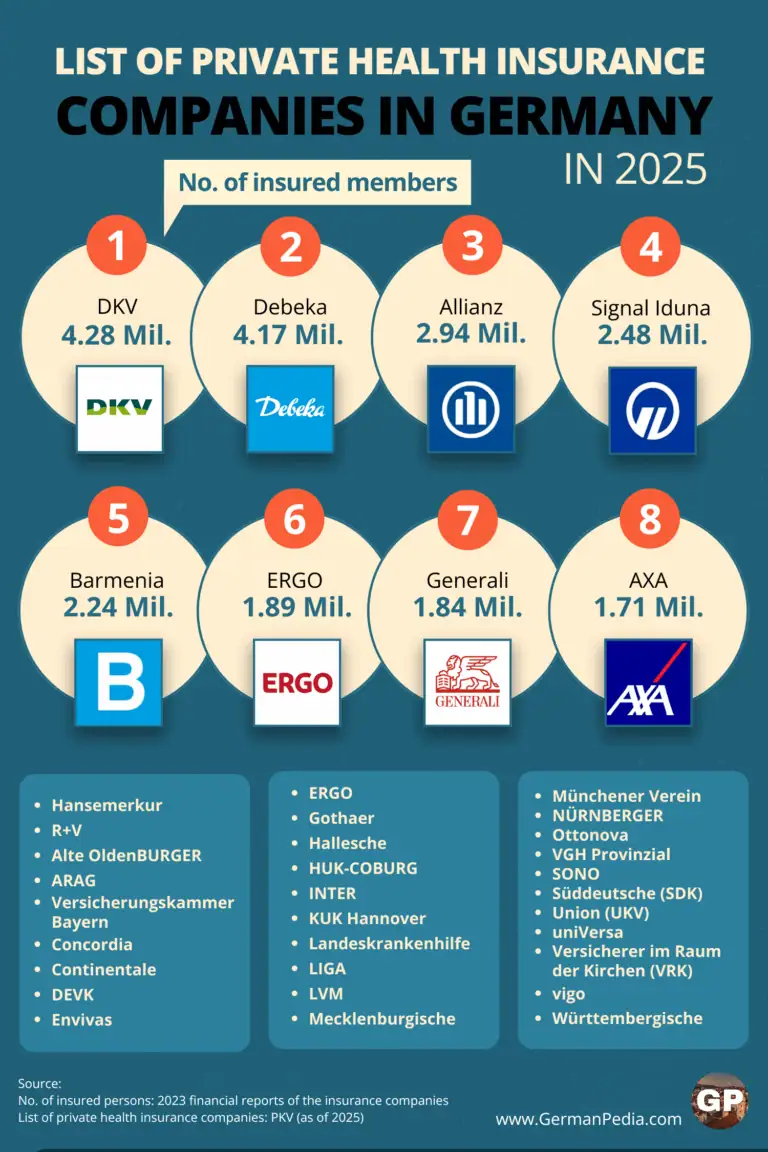
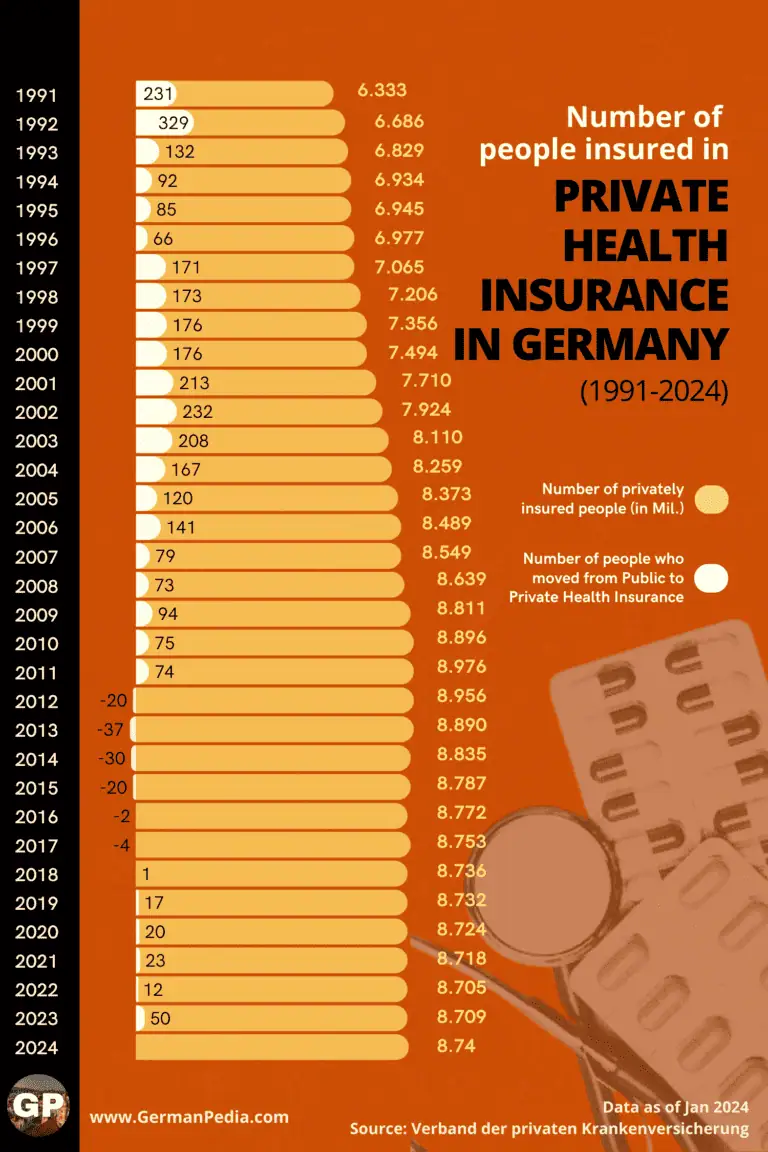
![Number of People Insured in Public Health Insurance in Germany [2000-2025]](https://germanpedia.com/wp-content/uploads/2025/03/number-of-people-insured-in-gkv-and-pkv-768x1152.webp)
![Number of People Insured in Public & Private Health Insurance in Germany [2025]](https://germanpedia.com/wp-content/uploads/2025/03/number-of-people-insured-in-gkv-and-breakdown-768x1152.webp)