Germany’s governing coalition agreed on November 18, 2026 to cut the electricity tax (Stromsteuer) for private households and for many businesses that do not already get a reduction. From January 1, 2027, the tax would fall from 2.05 cents to 0.1 cents per kilowatt hour — the European minimum rate — according to the Federal Government.
The same announcement also plans a temporary cap on fuel prices for three months. A cabinet decision is still to follow. Neither measure is law yet, and the current electricity tax of 2.05 cents per kilowatt hour still applies until a change is passed and enters into force.
Stromsteuer 2027: Key Takeaways
- The electricity tax would fall from 2.05 cents to 0.1 cents per kilowatt hour from January 1, 2027, for private households and for many businesses that are not already relieved.
- Chancellor Friedrich Merz said the cut would mean an extra €5 billion in relief for electricity customers in Germany.
- The cut would first run until December 31, 2027. The government wants to continue it, but the 2028 budget would have to cover the cost.
- In 2027, unused funds from the Renewable Energy Act (EEG) would pay for the cut.
- A three-month fuel price cap is also planned, using a formula tied to international market prices. The official announcement does not give a start date. A cabinet decision is still to come.
- This is a coalition agreement, not a statute. The electricity tax change would still have to go through the Bundestag and Bundesrat.
What the Electricity Tax Cut to 0.1 Cents in 2027 Would Mean
If the plan becomes law as described, households would pay 0.1 cents of electricity tax on each kilowatt hour instead of 2.05 cents. The same 0.1-cent rate would also apply to businesses that have not so far received a reduction. The Federal Government says a typical hair salon would save several hundred euros a year on its electricity bill, and a supermarket several thousand euros a year.
The announcement does not give a ready-made euro figure for a typical apartment. The official facts are the two tax rates, the January 1, 2027 start, and the €5 billion of extra relief that the chancellor attributed to electricity customers as a whole. Any saving on a household bill would also depend on how much electricity you use and on the other charges that make up the price, which this tax cut does not change. For background on how household electricity prices are built up, see our earlier guide to electricity prices in Germany.
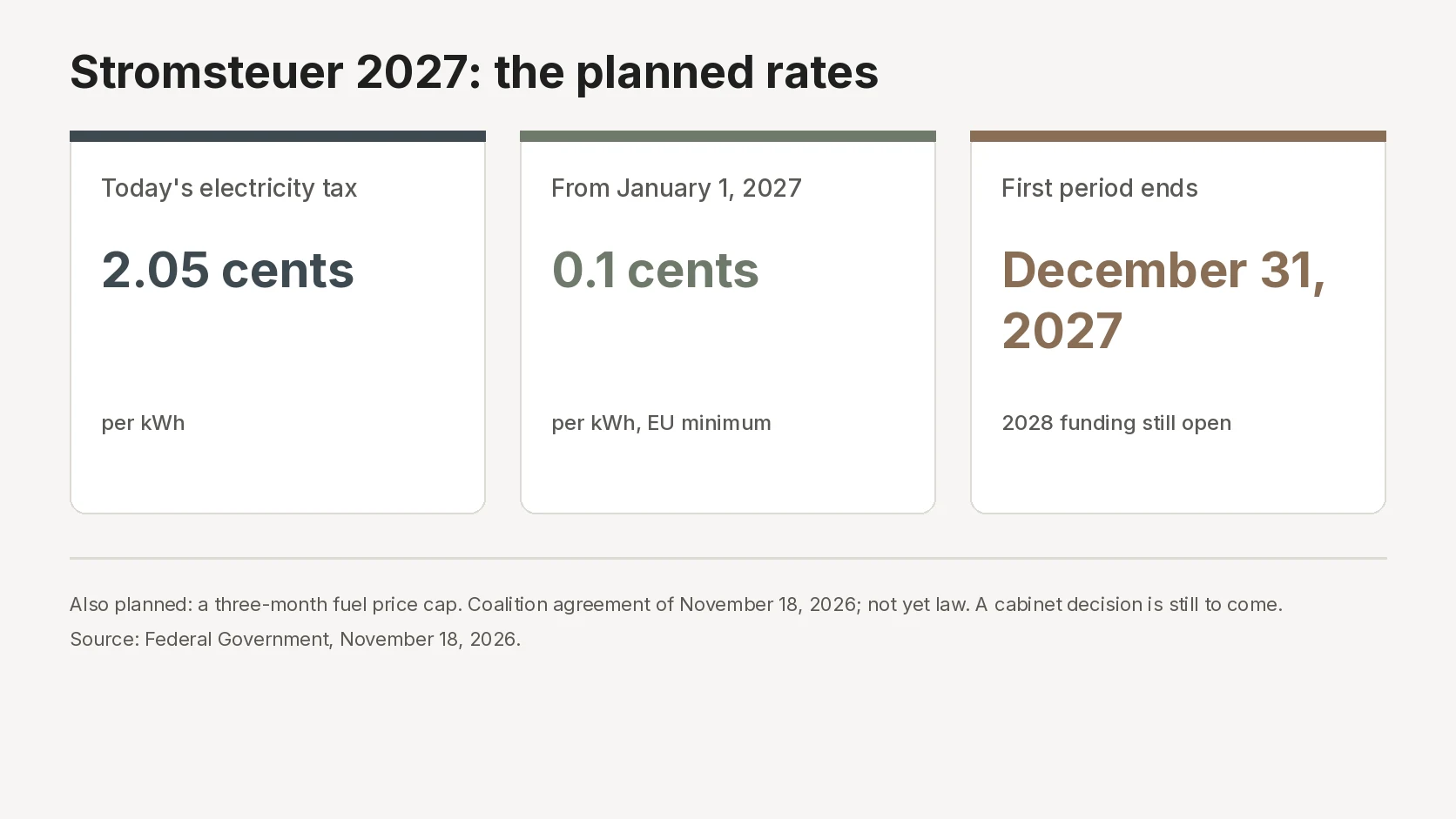
The government would pay for the 2027 cut with unused funds from the Renewable Energy Act (EEG). The reduction would first run until December 31, 2027. Officials say the aim is to continue it after that, provided the 2028 federal budget can finance it.
Has the Stromsteuer 2027 Cut Been Decided?
No. The Federal Government’s announcement of November 18, 2026 records a coalition agreement after talks at the Chancellery. It is not a cabinet bill, and it has not been passed by the Bundestag or the Bundesrat. Changing the electricity tax requires a statute. Until that statute is in force, the current rate of 2.05 cents per kilowatt hour remains in place.
The official text says a corresponding cabinet decision will follow shortly. That sentence comes just after the fuel-price plan, but both measures still have to go through the formal government and parliamentary steps. We will update our Germany 2027 changes list once a draft is published or the cut is enacted.
The Planned Three-Month Fuel Price Cap (Spritpreisdeckel)
The coalition also plans to cap pump prices for three months. According to the Federal Government, fuel prices have risen because of the situation in the Persian Gulf, and the cap is meant to stop abusive mark-ups. The permitted maximum prices would be set with a transparent formula based on international market prices.
The official announcement describes a regulation that would last three months and is not intended as a permanent measure. Security of supply must not be put at risk, and regional exceptions are possible. It would be implemented in close coordination with the oil industry and the federal states. The government has not published a start date, a maximum price, or the formula itself.
This plan is separate from the temporary fuel tax cut (Tankrabatt) that applies from October 1 to December 31, 2026, which we covered in Germany’s fuel tax cut of October 2026. That measure lowered the energy tax on fuel. The new plan is a price cap, and it is not yet in force.
What You Should Do About the Electricity Tax Now
You do not need to change electricity supplier because of this announcement alone, and you should not assume that a January 2027 bill will already show 0.1 cents of tax. Watch for a cabinet draft and for a vote in the Bundestag and Bundesrat. Keep your usual contract and meter readings. If you drive, no official start date or cap amount has been published yet for the fuel-price plan.
As of November 18, 2026, both measures are coalition plans. They become binding only once they are enacted.
Sources
- Federal Government / Federal Chancellor, “Stromsteuer sinkt – Spritpreisdeckel kommt,” November 18, 2026: bundesregierung.de (same text on bundeskanzler.de). All figures in this article are taken from that announcement. Status: coalition agreement; a cabinet decision is still to follow; not yet law.