A minijob is a popular side job in Germany. Students, spouses, pensioners and people with a main job use it to earn a little extra, often without deductions.
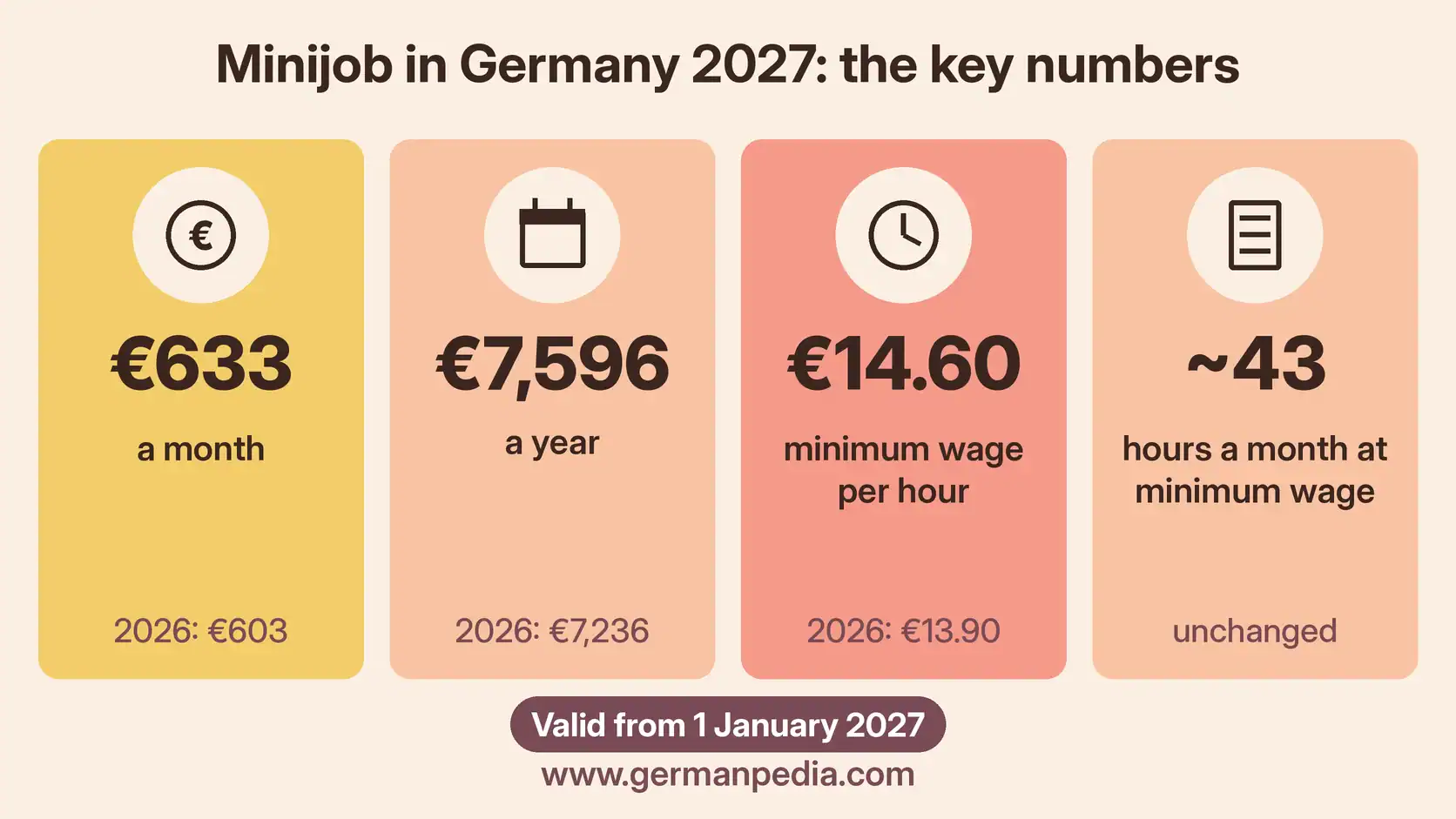
From 1 January 2027 the minijob limit rises to €633 a month. Employers of commercial minijobs will also pay a higher health contribution, and more changes are planned.
Here is what the minijob rules in Germany mean for you in 2027, checked against official sources as of 17 November 2026.
Key Takeaways
- Minijob limit 2027: €633 a month (2026: €603), or €7,596 a year, because the minimum wage rises to €14.60 an hour.
- Hours stay the same: at minimum wage you can still work about 43 hours a month.
- Decided: employers pay a higher flat health insurance contribution of 17.5% instead of 13% for commercial minijobs from January 2027.
- Planned, not yet law: the flat tax on minijobs is to rise from 2% to 5% in 2027, and a care insurance contribution is planned from 2028.
- For expats: a minijob does not give you health insurance, and international students and Opportunity Card holders must respect their own work limits.
What Is a Minijob in Germany?
A minijob (geringfügige Beschäftigung) is a job with low pay. People often call it a “€603 job” after the 2026 limit; from 2027 it becomes a “€633 job”.
For you as the employee, a minijob is usually tax-free and free of health, care and unemployment insurance contributions.
Your employer pays flat-rate contributions to the Minijob-Zentrale instead (§ 8 SGB IV).
You only pay a small pension contribution, and you can opt out of it. That is why your net pay is often the same as your gross pay.
Minijob 2026 vs 2027 at a Glance
| Rule | 2026 | 2027 |
|---|---|---|
| Monthly minijob limit | €603 | €633 |
| Yearly minijob limit | €7,236 | €7,596 |
| Minimum wage per hour | €13.90 | €14.60 |
| Hours a month at minimum wage | about 43 | about 43 |
| Employer flat health contribution (commercial minijob) | 13% | 17.5% |
| Flat tax (paid by the employer unless agreed otherwise) | 2% | 5% planned, not yet law |
Minijob Limit 2027: How the €633 Is Calculated
The minijob limit is tied to the minimum wage. It is based on 10 hours a week at minimum wage (Minijob-Zentrale).
The formula is: minimum wage × 130 ÷ 3, rounded up to a full euro. For 2027: €14.60 × 130 ÷ 3 = €632.67, so the limit is €633.
So every time the minimum wage goes up, the minijob limit goes up too. Our article on the minimum wage in 2027 explains the €14.60 rate.
Practical rule: If your hourly pay rises in January but your hours stay the same, check your monthly total. If you earn more than minimum wage, you can work fewer than 43 hours.
Can You Earn More Than €633 in a Minijob?
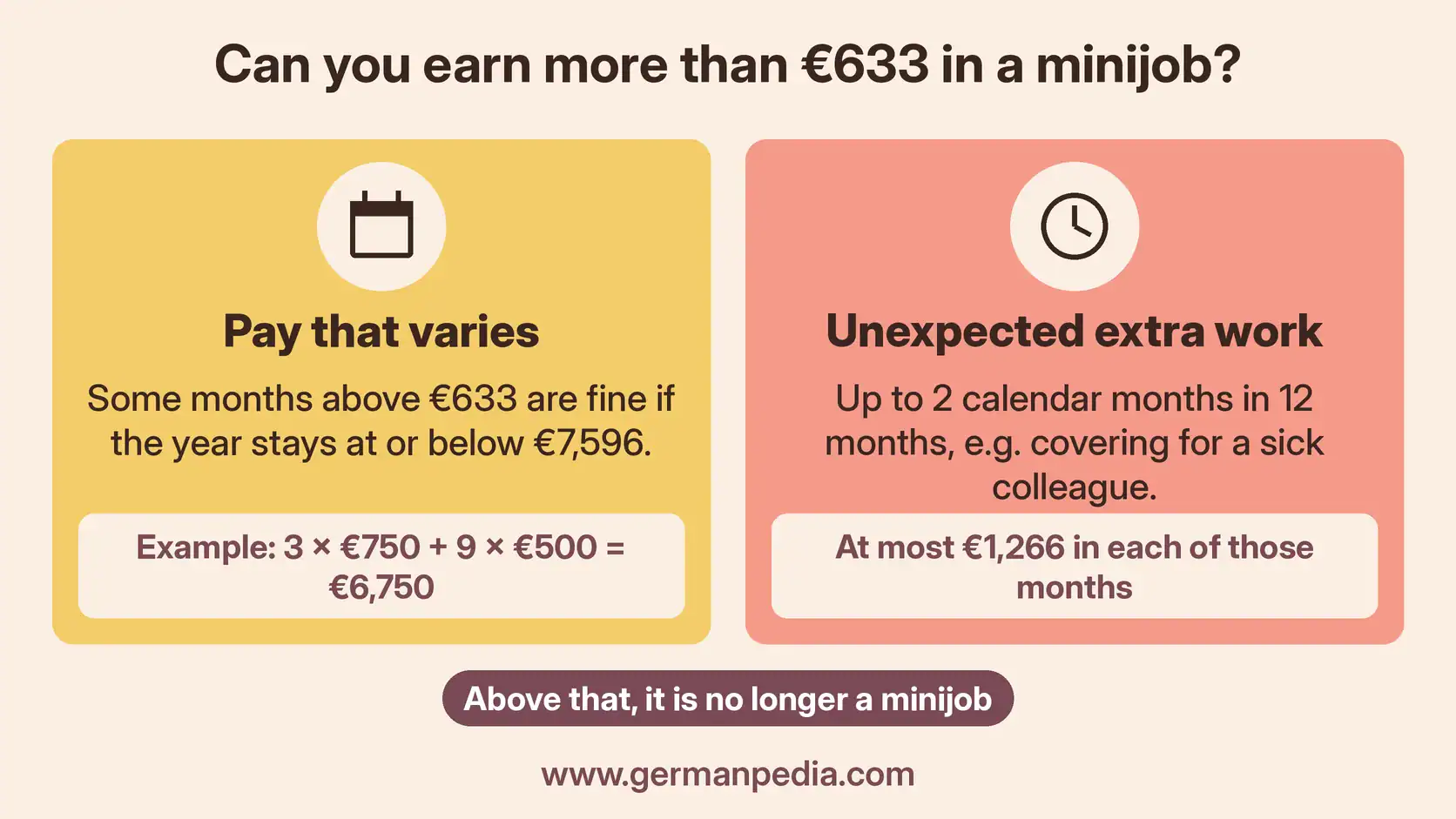
Yes, within limits. Your pay can vary from month to month, as long as your total for the year stays at or below €7,596.
Example from the Minijob-Zentrale: €750 in June, July and August, and €500 in the other nine months, makes €6,750 a year. That is still a minijob.
There is one more exception. If you go over the limit unexpectedly and only occasionally, for example to cover for a sick colleague, it stays a minijob.
This applies for up to two calendar months in 12 months, with at most €1,266 in each of those months.
Minijob Taxes and Contributions: What Changes in 2027
Most minijob changes in 2027 hit the employer, not your pay slip. But higher costs can mean fewer minijobs, or pressure to cut hours.
Higher Minijob Health Contribution From January 2027 (Decided)
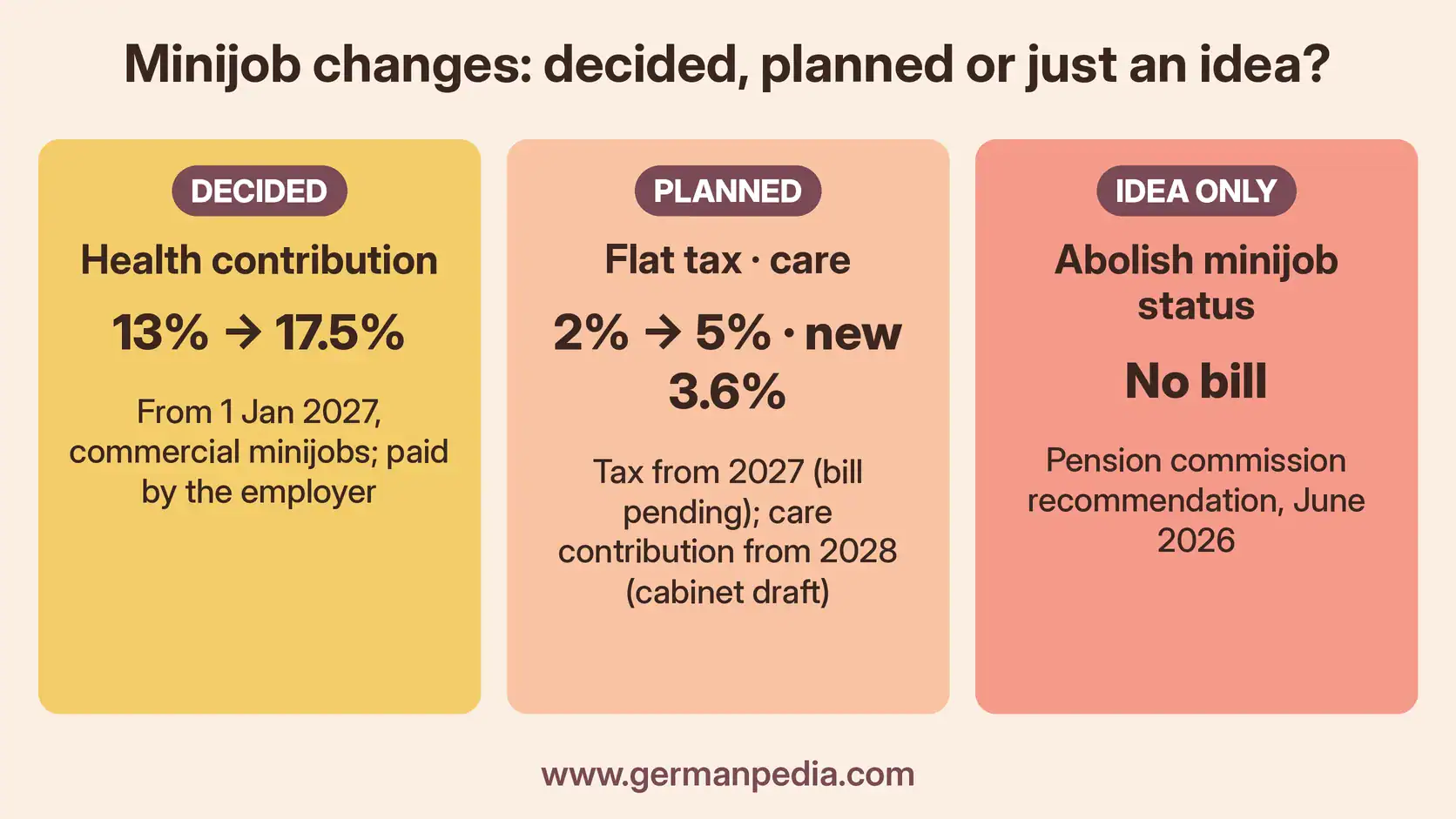
For commercial minijobs, the employer’s flat health insurance contribution rises from 13% to 17.5% on 1 January 2027. The law was published on 29 July 2026 (Minijob-Zentrale).
The employer pays this only if you have statutory health insurance, for example through family insurance or a main job. Minijobs in private households have their own, lower rates.
Minijob Flat Tax Could Rise From 2% to 5% (Planned)
The government’s Income Tax Reform Act 2027 (Einkommensteuerreformgesetz 2027) would raise the flat tax on minijobs from 2% to 5% from 1 January 2027 (government draft).
As of 17 November 2026, the Bundestag has not yet passed it (Haufe Gesetzesradar). The same bill also contains the higher Kindergeld; see our income tax reform 2027 article.
Care Insurance Contribution for Minijobs From 2028 (Planned)
A cabinet draft of the Care Reorganisation Act (Pflegeneuordnungsgesetz) would add an employer care contribution of 3.6% for commercial minijobs and 1.5% in private households, from 1 January 2028 (Minijob-Zentrale).
NOTE: What a commercial minijob at the limit costs the employer per month: 2026 at €603 with 13% health, 15% pension and 2% tax = €180.90. 2027 at €633 with 17.5%, 15% and 5% (if the tax rise passes) = €237.38. If the flat-tax rise does not pass, it is €218.39. Both figures are before small extra levies.
Your Own Pension Contribution: 3.6% or Opt Out
As a minijobber you pay 3.6% of your pay into the state pension, on top of the employer’s 15%. At €633 that is €22.79 a month (Minijob-Zentrale).
You can ask your employer in writing to be exempted. Then you keep the full gross pay, but you collect fewer pension months.
Practical rule: Planning to stay in Germany long term? Keep the 3.6%. The months count toward pension waiting periods. If you leave Germany soon, opting out can make sense, but check first whether the months count in your next country.
Will Minijobs Be Abolished in Germany?
Not for now. In June 2026, the government’s pension commission (Alterssicherungskommission) recommended ending the special tax and contribution status of minijobs, with exceptions only for school pupils (Minijob-Zentrale).
That is a recommendation, not a bill. As of 17 November 2026, no law to abolish minijobs has been adopted, and the €633 limit applies from January 2027.
WARNING: Be careful with headlines saying “minijobs end in 2027”. The decided change for 2027 is the higher employer health contribution, and the flat-tax rise is still a bill.
Minijob for Expats: Visa, Students and Health Insurance
Can International Students Do a Minijob?
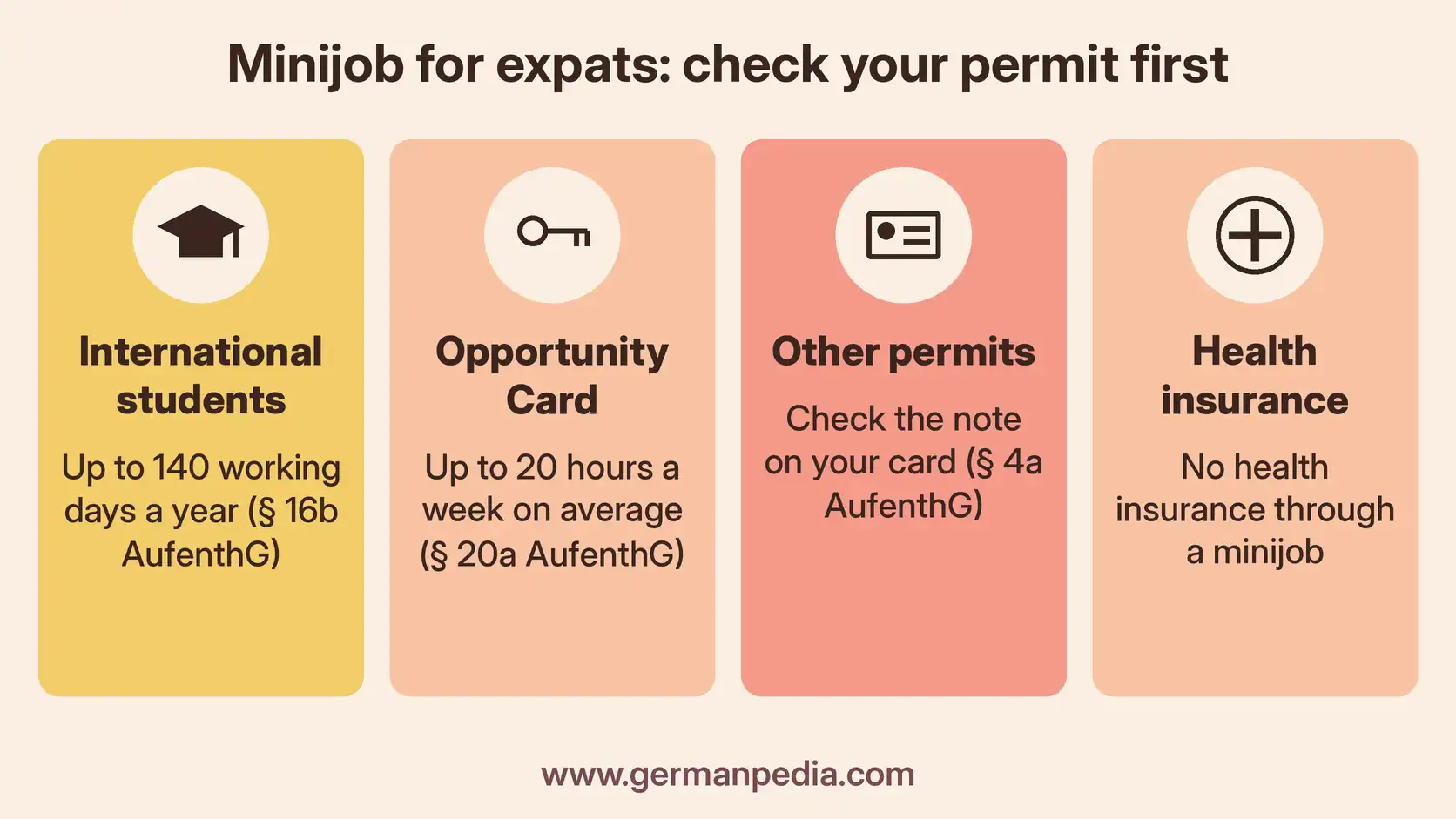
Yes, but your residence permit sets the limit, not the minijob rules. Students may work up to 140 working days a year in total (§ 16b(3) AufenthG).
A minijob counts toward those days. Student assistant jobs at your university do not. Part-time days of up to four hours can count as half days.
Minijob on the Opportunity Card (Chancenkarte)
With an Opportunity Card you may work on average up to 20 hours a week, plus trial jobs of up to two weeks (§ 20a(2) AufenthG).
A minijob fits within that. LegalWeg explains the Opportunity Card rules.
Other Residence Permits
Most residence permits allow work unless a law says otherwise (§ 4a(1) AufenthG). Check the note on your permit card or the extra sheet (Zusatzblatt) before you start.
Does a Minijob Give You Health Insurance?
No. Even when your employer pays the flat health contribution, you are not insured through the minijob. You still need your own cover.
That can be family insurance through a spouse, student health insurance or your main job. Unsure? Compare public and private health insurance, or register directly with TK*.
Minijob vs Midijob vs Second Job: Which Fits?
| Option | Monthly pay 2027 | What you pay |
|---|---|---|
| Minijob | up to €633 | Usually nothing except 3.6% pension (opt-out possible) |
| Midijob (transition zone) | €633.01 to €2,000 | Reduced social contributions that rise with pay; normal income tax |
| Second job next to a main job | any amount | The first minijob stays free; further side jobs are taxed in tax class 6 |
Your first minijob next to a main job stays a minijob. A second minijob is added to your main job and becomes subject to contributions (§ 8(2) SGB IV).
Our guide to tax classes in Germany explains tax class 6.
Who Should Take a Minijob, and Who Shouldn’t?
A minijob fits well if you are:
- a student who wants extra income within the 140-day limit
- a spouse who is covered by family insurance
- an employee who wants one small side job next to the main job
- a pensioner who wants to stay active
A minijob is a poor fit if you:
- need your own health insurance through work
- want to build a real pension in Germany
- need more than €633 a month regularly; a midijob or part-time job gives more security
How to Start a Minijob in 4 Steps
- Check your permit. Make sure your residence permit allows the work and the hours.
- Sign a written contract with hours and hourly pay of at least €14.60 from January 2027.
- Give your employer your tax ID and social security number. See tax ID and tax number.
- Decide on the pension contribution. Keep the 3.6% or hand in the written exemption request. Your employer registers the job with the Minijob-Zentrale.
FAQ: Minijob in Germany 2027
How much can I earn in a minijob in 2027?
€633 a month on average, or €7,596 a year, from 1 January 2027. In 2026 the limit is €603 a month.
How many hours can I work in a minijob in 2027?
About 43 hours a month at the €14.60 minimum wage. If you earn more per hour, the limit in hours is lower.
Do I pay tax on a minijob in Germany?
Usually not. The employer normally pays a flat tax of 2%. A rise to 5% from 2027 is planned but not yet law.
Are minijobs being abolished in 2027?
No. A commission recommended it in June 2026, but no law has been adopted. Minijobs continue in 2027 with the €633 limit.
Can I have two minijobs in Germany?
Yes, if together they stay within €633 a month. If you also have a main job, only the first minijob stays free of contributions.
Does a minijob count for my German pension?
Yes, if you pay the 3.6% contribution. If you opt out, you only get limited credit from the employer’s contribution.
Unsure how a minijob affects your tax return? Find an English-speaking tax advisor in Germany.
All 2027 changes in one place: What changes in Germany in 2027.
Sources
- Minijob-Zentrale: Minijob 2027 – Verdienstgrenze und Mindestlohn steigen (7 October 2026)
- Minijob-Zentrale: Rund um Minijobs – Chronologie der aktuellen Vorhaben (health contribution 17.5% from 2027; flat tax bill; PNOG draft; Alterssicherungskommission)
- Minijob-Zentrale: Befreiung von der Rentenversicherungspflicht
- Minijob-Zentrale: Minijob-Beiträge 2026
- Federal Ministry of Finance: Government draft Einkommensteuerreformgesetz 2027
- Haufe Gesetzesradar: Einkommensteuerreformgesetz 2027 (status: not yet promulgated)
- § 8 SGB IV (geringfügige Beschäftigung)
- § 16b AufenthG (students; 140 working days)
- § 20a AufenthG (Opportunity Card; 20 hours a week)
- § 4a AufenthG (access to employment)