
Key Takeaways
- Germany recorded 292,020 naturalizations in 2024.
- North Rhine-Westphalia, Bavaria, and Baden-Württemberg account for 161,030 naturalizations. That is more than half the national total.
- Thuringia, Saxony-Anhalt, and Brandenburg convert the largest share of residents who have lived in Germany for 10 or more years into citizens. Their realized naturalization potential is 9.25%, 9.00%, and 8.28%, respectively.
- Baden-Württemberg ranks third in raw naturalizations. Despite that, it converts the smallest share of any state among long-term residents, just 3.90%.
- A 3-year fast track for highly integrated applicants no longer exists. The Bundestag repealed it on October 8, 2025. The 5-year minimum applies again.
- The 2024 record traces directly to a citizenship law reform that took effect in June 2024. The reform cut the standard residency requirement from 8 years to 5.
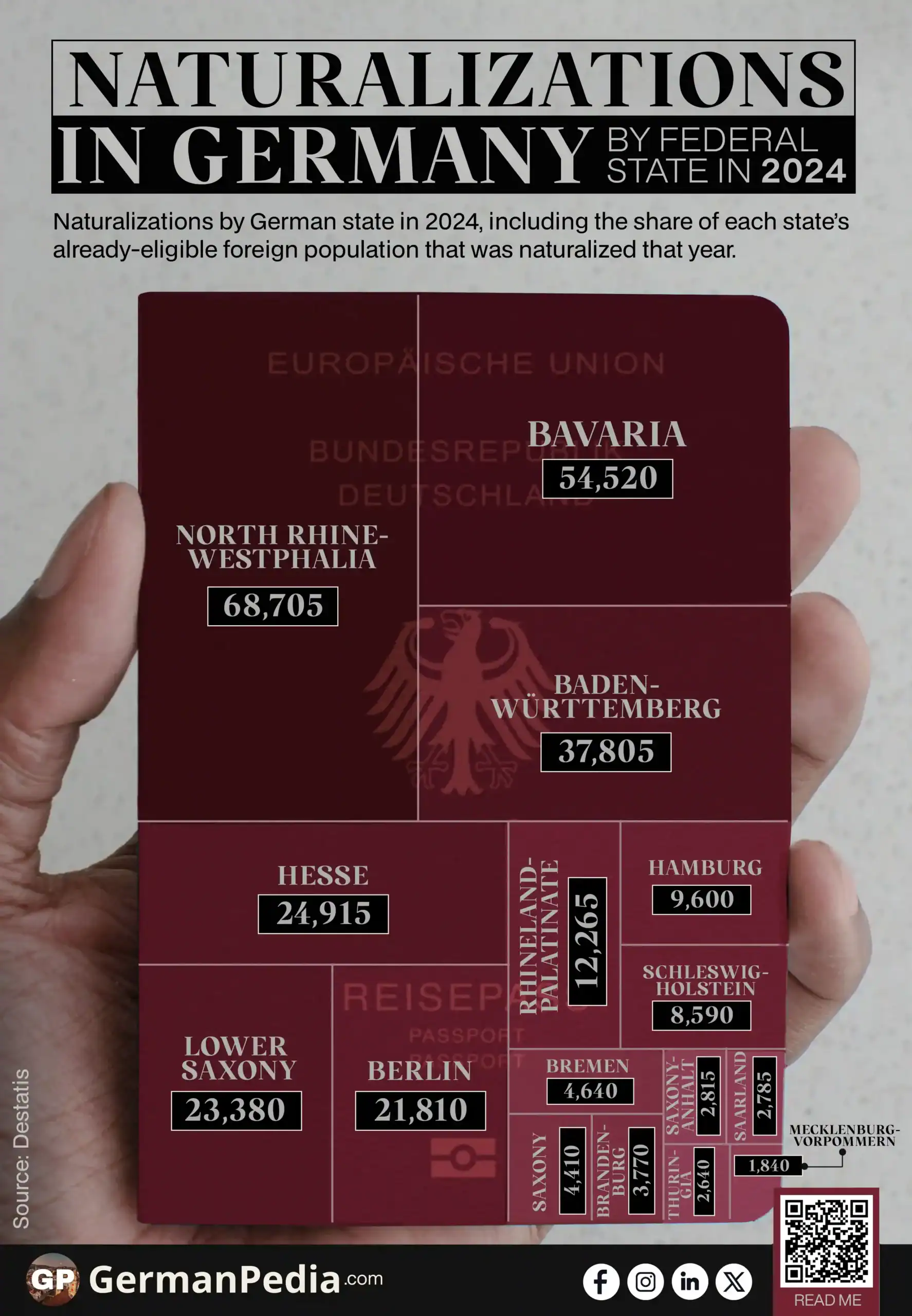
Use this Visualization: You may use this image for free with proper attribution to GermanPedia (i.e., by linking back to GermanPedia).
Need help communicating complex ideas visually? We help you turn data into your most persuasive story. Contact us to learn more.
German States Ranked by Naturalizations
| Federal State | Number of Naturalizations | Realized Naturalization Potential | |
|---|---|---|---|
| Residents of at least 10 years | Residents of at least 6 years | ||
| North Rhine-Westphalia | 68,705 | 4.75 | 3.20 |
| Bavaria | 54,520 | 5.73 | 3.81 |
| Baden-Württemberg | 37,805 | 3.90 | 2.71 |
| Hesse | 24,915 | 4.26 | 2.91 |
| Lower Saxony | 23,380 | 6.23 | 3.70 |
| Berlin | 21,810 | 5.15 | 3.45 |
| Rhineland-Palatinate | 12,265 | 5.26 | 3.33 |
| Hamburg | 9,600 | 5.70 | 3.90 |
| Schleswig-Holstein | 8,590 | 7.82 | 4.34 |
| Bremen | 4,640 | 7.64 | 4.61 |
| Saxony | 4,410 | 6.19 | 2.99 |
| Brandenburg | 3,770 | 8.28 | 3.98 |
| Saxony-Anhalt | 2,815 | 9.00 | 3.77 |
| Saarland | 2,785 | 4.46 | 2.77 |
| Thuringia | 2,640 | 9.25 | 3.68 |
| Mecklenburg-Vorpommern | 1,840 | 7.73 | 3.68 |
Source: Destatis
The percentage measures naturalizations against the foreign population that had already lived in Germany for at least 10 years, or at least 6 years, as of 31 December of the prior year. Destatis publishes both thresholds separately. They do not correspond to the current legal residency requirement for naturalization. That requirement is set independently in citizenship law. Destatis names this metric “ausgeschöpftes Einbürgerungspotential.” This guide renders it as realized naturalization potential, since Destatis has not published an official English label for this specific measure.

Germany naturalized 292,020 people in 2024, more than in any year on record. Naturalization is the legal process of becoming a German citizen after meeting residency and integration requirements.
How to get German Citizenship by Naturalization?
Three states account for most of Germany’s 2024 naturalizations:
- North Rhine-Westphalia: 68,705
- Bavaria: 54,520
- Baden-Württemberg: 37,805
The combined total (161,030) is more than half the national total of 292,020. This largely reflects population size. North Rhine-Westphalia, Bavaria, and Baden-Württemberg are Germany’s three most populous states. Naturalizations ranked by raw count mostly track where people already live, not unusual local rates.
Population in the EU over time ->
Smaller German Federal States Naturalize a Bigger Share of Eligible Residents
Each German federal state’s realized naturalization potential tells a different story from the raw count. That measure shows the share of a state’s foreign residents of at least 6 or 10 years actually naturalized that year. This is a statistical benchmark Destatis uses, not the legal residency requirement for citizenship.
Among those residents, three states convert the largest share to citizenship:
- Thuringia: 9.25%
- Saxony-Anhalt: 9.00%
- Brandenburg: 8.28%
All three are comparatively small states. A small state needs fewer additional naturalizations to shift its percentage. That makes its rate more sensitive to year-to-year swings than a large state’s rate.
Baden-Württemberg sits at the opposite end. Despite ranking third in raw naturalizations, it converts only 3.90% of its eligible population. That is the lowest rate of any German state.
The 2024 surge traces directly to a citizenship law reform that took effect on June 27 of that year. The reform cut the standard residency requirement for naturalization from 8 years to 5. It also opened a 3-year fast track for applicants who showed advanced German language skills, financial independence, and active civic engagement.
That fast track no longer exists. The Bundestag, Germany’s federal parliament, repealed it on October 8, 2025. The 5-year minimum applies again.
The 2024 figures in this guide are a snapshot of one reform. They do not describe the rules in effect today. Anyone researching German citizenship requirements now should rely on the current 5-year standard, not the 3-year option that applied when this data was collected.
Consult an Immigration Lawyer
- An immigration lawyer can help you accelerate your German citizenship application.
- The lawyer can file a lawsuit on your behalf.
- You can clarify your doubts regarding German citizenship.
Both rankings of the 2024 data are accurate. They simply measure different things. Raw counts show where naturalizations are concentrated. Realized potential shows how many eligible residents actually used the option available to them.
The reform that drove 2024’s record has already been partly rolled back. Anyone applying for citizenship today works under the 5-year standard, not the 3-year track that applied when this data was collected.
More topics
- German Citizenship by Naturalization Process
- German Citizenship by Marriage
- German Citizenship for Children Born in Germany
- German Citizenship by Declaration
- German Citizenship by Descent
- Which Countries Do Foreigners in Germany Come From?
- Failure To Act Lawsuit Against German Immigration Office
- Is It Worth Moving To Germany in 2026?
- Grocery Prices in Germany
- Which EU Countries Had the Highest Inflation Rates?
- Minimum Wages Rose Fastest in Eastern Europe
- Which EU Countries Have the Highest Unemployment?
- The Best EU Countries to Retire In
- Most Prosperous EU Countries by Prosperity Index
- Which EU Countries Attract the Most Foreign Investment?
References
- https://www.destatis.de/DE/Themen/Gesellschaft-Umwelt/Bevoelkerung/Migration-Integration/Tabellen/einbuergerungen-bundeslaender-auslaendischebevoelkerung.html
- https://www.destatis.de/DE/Presse/Pressemitteilungen/2026/06/PD26_186_125.html
- https://www.bmi.bund.de/SharedDocs/faqs/DE/themen/heimat/reform-staatsangehoerigkeitsrecht/reform-staatsangehoerigkeitsrecht-liste.html
- https://www.bundestag.de/dokumente/textarchiv/2025/kw41-de-staatsangehoerigkeit-1111756