Light heating oil in Germany cost 84.5% more in October 2026 than in October 2025. That is according to official figures the Federal Statistical Office (Destatis) published on November 19, 2026 in a heating-season press release.
The same release says that in 2025, about 4.7 million people, or 5.7% of the population, lived in households that, by their own assessment, could not adequately heat their home for financial reasons.
Household energy as a whole was 2.2% more expensive in October 2026 than a year earlier, a smaller rise than overall consumer prices, which were up 2.8%.
Compared with a year earlier:
- Electricity and natural gas were cheaper.
- Heating oil, firewood and pellets, and district heating cost more.
Heating Oil Prices in Germany: Key Takeaways
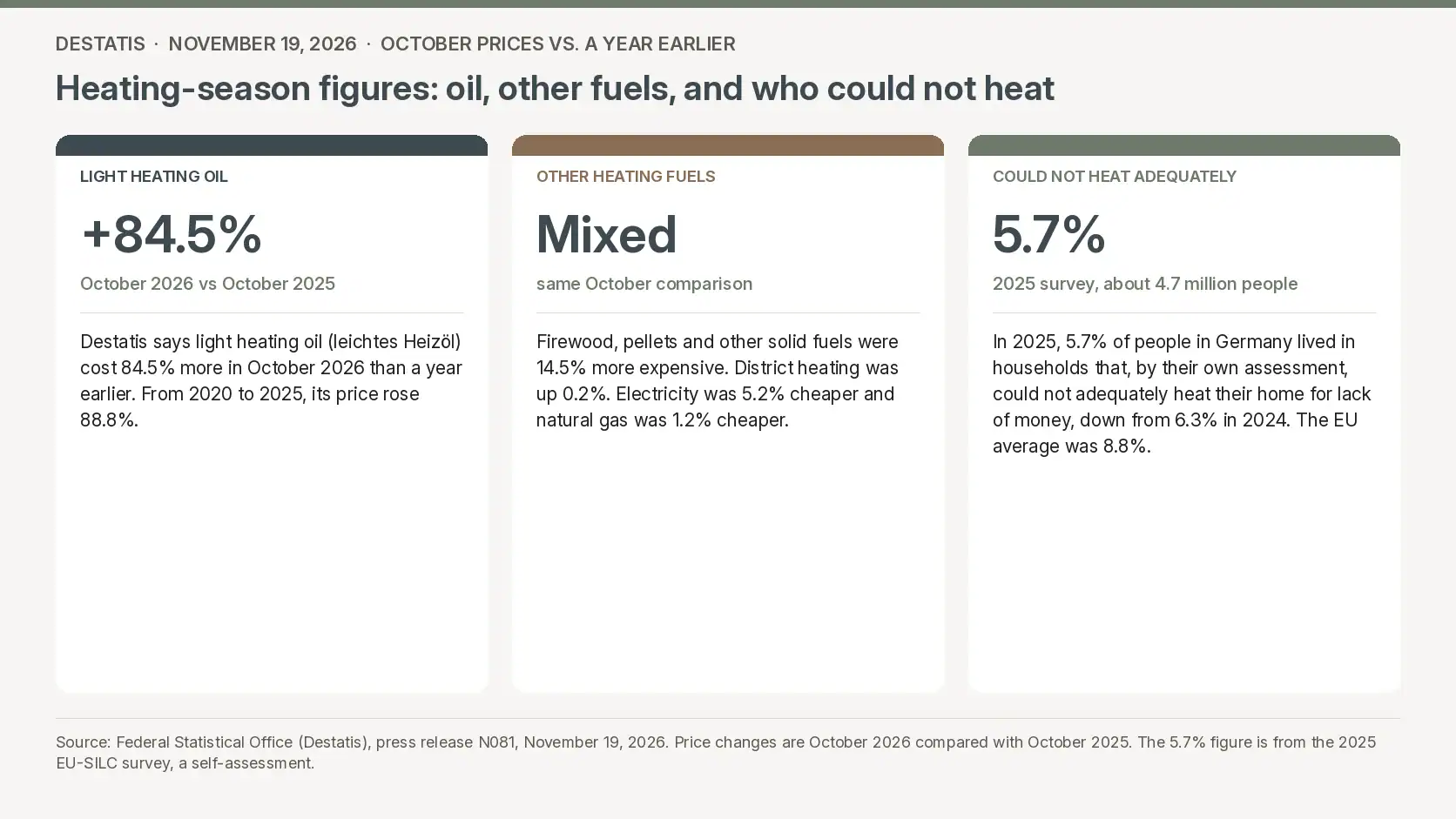
- Light heating oil cost 84.5% more in October 2026 than in October 2025, Destatis says.
- In the same comparison, firewood, wood pellets and other solid fuels were 14.5% more expensive.
- District heating was 0.2% more expensive year on year.
- Electricity was 5.2% cheaper year on year.
- Natural gas was 1.2% cheaper year on year.
- Household energy prices as a group rose 2.2% in October 2026 compared with a year earlier. Overall consumer prices rose 2.8%.
- From 2020 to 2025, household energy prices rose 46.9%, more than overall consumer prices in that period (21.9%). Prices for household energy had fallen in 2024 and 2025 compared with the year before, after a sharp rise during the energy crisis.
- In 2025, 5.7% of people in Germany, about 4.7 million, lived in households that said they could not adequately heat their home because of a lack of money. That was down from 6.3% in 2024 and below the EU average of 8.8%.
- In the 2022 census, 53.9% of existing buildings with living space were heated primarily with gas and 24.7% with heating oil.
How Much Heating Oil Prices in Germany Rose in October
The 84.5% figure is Destatis’s year-on-year change for light heating oil (leichtes Heizöl) in October 2026. Among the heating fuels Destatis lists, that was by far the largest increase.
- Firewood, wood pellets and other solid fuels were up 14.5%.
- District heating was up 0.2%.
- Electricity was down 5.2%.
- Natural gas was down 1.2%.
Destatis says the lower electricity and gas prices are due in part to federal government measures already in force since the beginning of the year. The press release does not name those measures.
Over a longer period, the picture is different. From 2020 to 2025:
- Natural gas prices rose 91.2%.
- Light heating oil rose 88.8%.
- District heating rose 78.7%.
- Firewood, pellets and other solid fuels rose 45.4%.
Electricity had the smallest increase among those heating sources, at 24.6%.
Destatis notes that household energy prices fell in 2024 and in 2025 compared with the previous year, after rising sharply during the energy crisis. It also notes that they are higher in the current heating season than a year earlier.
Who Could Not Afford Adequate Heating in Germany in 2025
The 5.7% figure comes from the 2025 European Union Statistics on Income and Living Conditions (EU-SILC) survey, which Destatis runs in Germany as part of the microcensus. It counts people living in households that, in their own judgment, could not keep their house or apartment adequately warm for financial reasons.
Destatis says that judgment is left to the respondents, and that these self-assessments are one of the official criteria used to measure material and social deprivation.
The German share fell from 6.3% in 2024. The EU average in 2025 was 8.8%, down from 9.2% in 2024.
The highest official shares in 2025 were:
- Greece (18.1%)
- Lithuania (16.7%)
- Bulgaria (16.1%)
The lowest were:
- Finland (2.6%)
- Estonia (3.1%)
- Poland (3.2%)
These are 2025 survey results, published in the November 19, 2026 release. They are not a 2026 heating-season count.
How Homes in Germany Are Heated, and Who Faces Higher Oil Prices
The building figures in the same Destatis release come from the 2022 census and describe existing buildings with living space, by primary energy source.
- More than half, 53.9%, were heated with gas.
- About a quarter, 24.7%, used heating oil.
- District heating accounted for 6.6%.
- Wood or wood pellets accounted for 5.9%.
- Solar or geothermal energy or heat pumps accounted for 4.2%.
- Electricity without heat pumps accounted for 3.4%.
- Coal (0.3%) and biomass other than wood, or biogas (0.1%), were rare.
- Destatis says 0.9% of existing buildings with living space had no heating.
The office notes that new residential buildings have a different mix, and it does not repeat those newer-building shares in this release.
Because almost one in four existing buildings still uses heating oil, the October price increase affects a large part of the housing stock. Most homes, however, are still heated with gas, which was slightly cheaper in October 2026 than a year earlier.
For how default gas tariffs compare with fixed contracts, see our earlier piece on the default gas tariff in Germany.
What These Heating Oil Prices in Germany Mean for Expats
If you rent or own a home in Germany, the heating fuel in the building determines whether these October figures work for you or against you. A property heated with light heating oil faced a much higher year-on-year price in October 2026.
A property heated with natural gas or electricity did not, at least on these official averages.
The heating type is usually clear from:
- the lease
- the service-charge statement (Betriebskostenabrechnung)
- the building’s energy documents
If you rent and pay monthly service-charge advances, higher heating costs normally show up in your next annual statement. After that statement your landlord may adjust the advances to an appropriate level (Section 560 (4) BGB).
Tenants in oil-heated buildings may want to set money aside for a possible back payment.
Destatis’s 2025 survey figure is a self-assessment of whether households could heat adequately, not a count of people who applied for a benefit. This release does not set or change any support rules.
Separately, from 2027 some tenants may be able to cut costs if their heating and hot-water meters are not remotely readable. We explained that rule in our piece on remote-readable heating meters in 2027.
Sources
- Federal Statistical Office (Destatis), press release N081, “5,7 % der Bevölkerung konnten 2025 aus Geldmangel ihre Wohnung nicht angemessen warmhalten,” November 19, 2026: destatis.de. All price changes, the 4.7 million / 5.7% figures, the EU and country comparisons, the 2020–2025 totals, the statement about federal measures already in force since the beginning of the year, the methodological notes, and the 2022 census shares for existing buildings in this article are taken from that official release.
- Destatis notes that the 2025 heating-adequacy figures come from EU-SILC (in Germany, a subsample of the microcensus), that the assessment of whether a home was adequately heated is left to the respondents, and that these self-assessments are used in the official measure of material and social deprivation. Method page: EU-SILC. Consumer price positions are from the consumer price index (GENESIS tables 61111). Building heating sources are from the 2022 census (table 3000G-1008).
- Section 560 BGB (changes to service charges): gesetze-im-internet.de.