Key Takeaways
- Turkey is Berlin’s largest foreign nationality at 108,077 residents. It is rooted in a 1961 labor pact with West Germany.
- Ukraine overtook Poland to become Berlin’s second-largest foreign nationality after Russia’s 2022 invasion.
- Syria’s community stems from the 2015 civil war. Afghanistan’s stems from the 2021 Taliban takeover.
- Vietnam’s community traces to East German contract labor. Russia’s traces to two exile waves a century apart.
- India is the only top-eight nationality built through active skilled-worker recruitment, not war or historic labor pacts.
- Every community except India’s traces back to a labor pact, a revolution, or a war, not geographic proximity.
Use this Visualization: You may use this image for free with proper attribution to GermanPedia (i.e., by linking back to GermanPedia).
Need help communicating complex ideas visually? We help you turn data into your most persuasive story. Contact us to learn more.
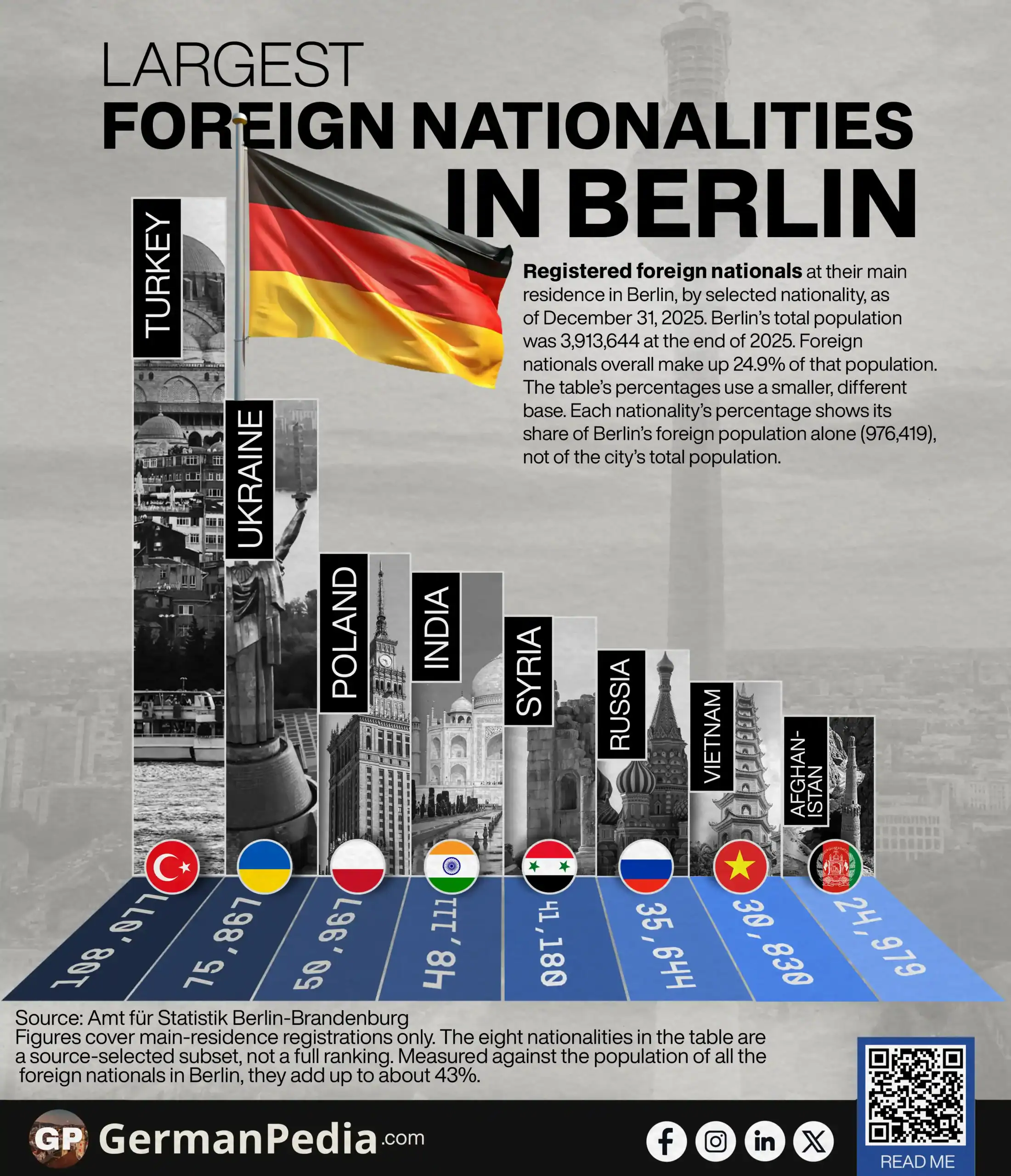
Largest Foreign Nationality Groups in Berlin
| Nationality | Residents | Share of Berlin’s Foreign Population |
|---|---|---|
| Turkey | 108,077 | 11.1% |
| Ukraine | 75,867 | 7.8% |
| Poland | 50,967 | 5.2% |
| India | 48,111 | 4.9% |
| Syria | 41,180 | 4.2% |
| Russia | 35,644 | 3.7% |
| Vietnam | 30,830 | 3.2% |
| Afghanistan | 24,979 | 2.6% |
Source: Amt für Statistik Berlin-Brandenburg
Figures cover main-residence registrations only. The eight nationalities in the table are a source-selected subset, not a full ranking. Measured against the population of all the foreign nationals in Berlin, they add up to about 43%.

Berlin’s population reached 3,913,644 at the end of 2025. That includes 976,419 registered foreign nationals. That amounts to 24.9% of total foreign nationals.
Berlin’s Turkish community is older than the Berlin Wall was when it fell. Its Ukrainian community barely existed in its current form four years ago.
Turkey’s 1961 Labor Pact Built Berlin’s Largest Foreign Community
West Germany and Turkey signed a labor recruitment agreement in October 1961. A 1964 rule change removed the original two-year residence limit. Many workers settled in Kreuzberg for its low rents. The community now numbers 108,077 in Berlin. It remains the city’s largest foreign nationality six decades after the agreement was signed.
Ukraine Overtook Poland to Become Berlin’s Second-Largest Foreign Group
Poland has sent labor migrants to Germany since the late 19th century. A second wave came after Poland joined the EU in 2004. Those decades made Poland Berlin’s second-largest foreign nationality for years. The city now counts 50,967 Polish nationals.
Russia invaded Ukraine on February 24, 2022. Germany recorded 962,000 more arrivals than departures from Ukraine that year. Ukrainian citizens became Germany’s second-largest foreign population after Turkish citizens by October 2022. Berlin’s 75,867 Ukrainian nationals now outnumber its Polish community.
Syria and Afghanistan Reflect Two Refugee Crises Six Years Apart
Syria’s civil war escalated sharply in 2015. Syrian nationals filed 159,000 first-time asylum applications in Germany that year. Berlin now counts 41,180 Syrian nationals.
Afghanistan’s community formed differently. The Taliban retook Kabul on August 16, 2021. Germany’s evacuation and admission programs brought more than 36,000 Afghans to the country by mid-2026. Berlin now counts 24,979 Afghan nationals.
Vietnam and Russia Both Trace to Political Systems That No Longer Exist
East Germany and Vietnam signed a contract-labor agreement in April 1980. Nearly 72,000 Vietnamese workers came to East Germany under it. About 16,000 stayed in Germany after the Berlin Wall fell. Berlin counts 30,830 Vietnamese nationals overall.
Russia’s community in Berlin has reappeared twice under different regimes. About 500,000 people fled the Russian Empire for Germany after the 1917 Bolshevik Revolution. Around 360,000 of them settled in Berlin. Most concentrated in Charlottenburg, a district Berliners nicknamed Charlottengrad. Most stayed only temporarily. A century later, opposition to the war in Ukraine triggered a new exodus. Germany recorded 31,520 arrivals from Russia in 2022. Berlin’s Russian nationals now number 35,644.
India Is Growing for a Completely Different Reason
None of Berlin’s other large foreign nationalities formed through economic recruitment alone. India’s did. Germany’s cabinet adopted a skilled-worker strategy for India in October 2024. The strategy raised the annual visa quota for Indian professionals from 20,000 to 90,000. The change responds to Germany’s aging workforce and shortage of skilled labor. Berlin’s Indian population reflects that policy shift. It now counts 48,111 residents, up sharply from a decade ago. That growth concentrates in tech and engineering roles, not a single historical rupture.
Every one of these communities, except India’s, exists in Berlin today because of a specific historical break: a labor pact, a revolution, or a war. Proximity to Germany explains very little of it. Poland is the only one of the eight that borders Germany. Even its community grew through a formal labor agreement, not geography alone. Berlin’s foreign population is less a map of Europe than a timeline of the last hundred years.
More topics
- Where Do Immigrants in Germany Come From?
- Which Countries Do Foreigners in Germany Come From?
- How many Foreign National Prisoners are in the EU?
- Which EU Countries Attract the Most Foreign Investment?
- Energy Consumption for Cooling Has Doubled in the EU
- Which Country Owns Almost a Quarter of the EU’s Wealth?
- Broadband Prices in the EU Over Time
- Bulgaria Now Has the EU’s Highest Smoking Rate
- How much parental leave do you get in the EU?
- Most Popular Degree Programs in Germany
- Which are the toughest prisons in the EU?
- Which EU Country Recycles the Most?
- Most Popular Dog Breeds in Germany
- Top Foreign Destinations for Germans
- How many Foreign National Prisoners are in the EU?
References
- https://www.destatis.de/EN/Press/2023/02/PE23_N010_12411.html
- https://www.bpb.de/themen/europa/polen-analysen/41114/analyse-die-polnisch-deutschen-migrationsbeziehungen-gegenwart-und-zukunft/
- https://www.bpb.de/themen/migration-integration/regionalprofile/deutschland/328520/osteuropaeische-arbeitskraefte-in-deutschland-vom-spaeten-19-jahrhundert-bis-in-die-gegenwart/
- https://www.bpb.de/kurz-knapp/hintergrund-aktuell/342651/vor-60-jahren-anwerbeabkommen-zwischen-der-bundesrepublik-deutschland-und-der-tuerkei/
- https://www.bamf.de/SharedDocs/Anlagen/DE/Statistik/BundesamtinZahlen/bundesamt-in-zahlen-2015.pdf
- https://www.bundestag.de/presse/hib/kurzmeldungen-1194644
- https://www.bpb.de/themen/deutschlandarchiv/548449/vertragsarbeiterinnen-in-der-ddr/
- https://www.berlin.de/ba-charlottenburg-wilmersdorf/ueber-den-bezirk/artikel.240334.php
- https://www.zois-berlin.de/forschung/forschungsschwerpunkte/gesellschaften-zwischen-stabilitaet-und-wandel/auswanderung-waehrend-des-krieges-eine-neue-generation-russischer-migrantinnen
- https://www.bmas.de/DE/Service/Presse/Pressemitteilungen/2024/kabinett-beschliesst-fachkraeftestrategie-indien.html