Key Takeaways
- Germany holds 23.9% of the EU’s household financial wealth in 2024, more than any other country. Financial wealth means accumulated savings, investments, and pensions. It does not include property.
- France ranks second in the EU at 17.9%. Italy ranks third at 14.8%. Together with the Netherlands and Spain, these five countries hold 73.1% of all EU household financial wealth.
- The Netherlands ranks fourth in the EU at 8.5%, despite a population of just 17.9 million. Mandatory pension funds hold 54.9% of their financial wealth. It is the highest share of any EU country.
- Owning the biggest total slice of wealth is different from having the richest households on average. Germany’s lead is only in total wealth held, not in income per household.
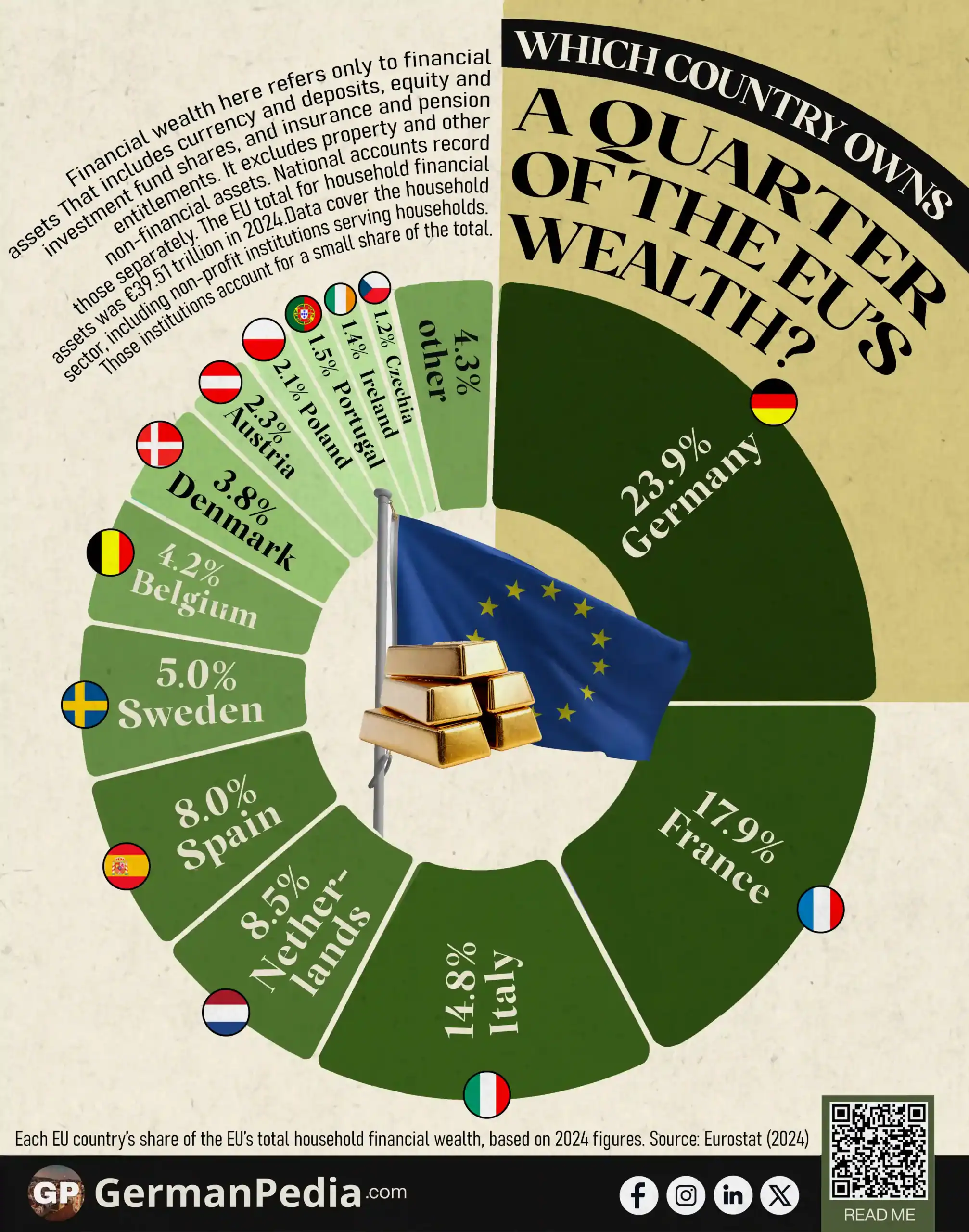
Use this Visualization: You may use this image for free with proper attribution to GermanPedia (i.e., by linking back to GermanPedia).
Need help communicating complex ideas visually? We help you turn data into your most persuasive story. Contact us to learn more.
EU Countries Ranked by Share of Household Financial Wealth
| Country | Share of EU Household Financial Wealth |
|---|---|
| Germany | 23.9% |
| France | 17.9% |
| Italy | 14.8% |
| Netherlands | 8.5% |
| Spain | 8.0% |
| Sweden | 5.0% |
| Belgium | 4.2% |
| Denmark | 3.8% |
| Austria | 2.3% |
| Poland | 2.1% |
| Portugal | 1.5% |
| Ireland | 1.4% |
| Czechia | 1.2% |
| Finland | 1.1% |
| Greece | 0.9% |
| Hungary | 0.7% |
| Romania | 0.6% |
| Bulgaria | 0.3% |
| Croatia | 0.3% |
| Luxembourg | 0.3% |
| Slovakia | 0.3% |
| Cyprus | 0.2% |
| Lithuania | 0.2% |
| Slovenia | 0.2% |
| Estonia | 0.1% |
| Latvia | 0.1% |
| Malta | 0.1% |
Source: Eurostat (2024)
Financial wealth here refers only to financial assets. That includes currency and deposits, equity and investment fund shares, and insurance and pension entitlements. It excludes property and other non-financial assets. National accounts record those separately. The EU total for household financial assets was €39.51 trillion in 2024. Data cover the household sector, including non-profit institutions serving households. Those institutions account for a small share of the total.

Germany holds more of the EU’s household wealth than any other country. It is close to a quarter of it. That sounds like Germany should be the richest country in the EU. However, it is not.
Financial wealth means money that households hold in bank accounts, stocks, investment funds, and pensions. It excludes homes and other property. Property makes up a large part of total wealth in many EU countries. Combined, EU households hold €39.51 trillion in financial wealth alone.
That figure is not a shared EU fund. It is the sum of what households in each of the 27 EU countries hold individually, added together. Each country’s percentage in this ranking is simply its slice of that combined total.
Germany’s Wealth Share Matches the Size of Its Economy
Germany holds 23.9% of the EU’s household financial wealth. It is the largest share of any country. Germany also generated 25.2% of the EU’s total household income in 2024. That was also the largest share of any country. Its wealth share sits slightly below its income share, not above it.
Germany also saves more of its income than any other EU country. Its household savings rate reached 20.0% in 2024. Czechia followed closely at 19.9%. That saving habit compounds every year, adding to Germany’s wealth faster than in most other countries.
A large economy and a high savings rate explain most of Germany’s lead. Neither points to a small group of extremely wealthy households owning a disproportionate slice. Germany’s lead reflects the size and savings habits of the country as a whole.
The Netherlands Ranks High in Household Financial Wealth Because of Pensions
The Netherlands holds 8.5% of EU household financial wealth. It is the fourth largest share in the EU. That is striking for a country with a population of just 17.9 million in January 2024. Poland has more than twice as many people but holds only 2.1% of EU financial wealth.
The reason lies in how Dutch pensions work. Most Dutch workers are enrolled in mandatory sector-wide pension funds. Once an employer’s sector signs a collective agreement, joining the fund is not optional for its workers.
More than half of Dutch household financial wealth sits in pension and insurance funds. That is the highest share of any EU country.
Total wealth and income per person answer two different questions. A country can hold the biggest slice of the EU’s total financial wealth without having the highest income per household. Germany’s size and savings habits explain its lead in total financial wealth. Luxembourg sits at the other extreme, with just 672,000 residents in January 2024. Its households have the highest income per person in the EU. Both rankings are accurate. They just measure different things.
More topics
- GDP per Capita vs Actual Consumption per Capita in the EU
- EU Household Expenditure on Food and Non-Alcoholic Beverages
- EU Rent Price Index by Country Over Time
- Apartment Rents Are Rising Faster Than House Rents in Germany
- Grocery Prices in Germany [2000 – 2025]
- Which EU Countries Had the Highest Inflation Rates?
- EU Fertility Rate by Country
- Average Working Hours in EU Countries
- Gender Pay Gap Across EU Countries
- Minimum Wages Rose Fastest in Eastern Europe
- Which EU Countries Have the Highest Unemployment?
- The Best EU Countries to Retire In
- Which EU Country Uses the Most Electricity?
- Most Prosperous EU Countries by Prosperity Index
- Where are Billionaires Concentrated in the EU?
References
- https://ec.europa.eu/eurostat/statistics-explained/index.php?title=Households_-_statistics_on_financial_assets_and_liabilities
- https://ec.europa.eu/eurostat/statistics-explained/index.php?title=Households_-_statistics_on_income,_saving_and_investment
- https://www.oecd.org/content/dam/oecd/en/publications/reports/2024/10/pensions-at-a-glance-2023-country-notes_2e11a061/netherlands_76d739db/073a9718-en.pdf
- https://ec.europa.eu/eurostat/databrowser/view/tps00001/default/table?lang=en