
Key Takeaways
- Four of the top five origin countries are in Europe. This reflects proximity, open labour markets within the EU, and long-standing migration ties.
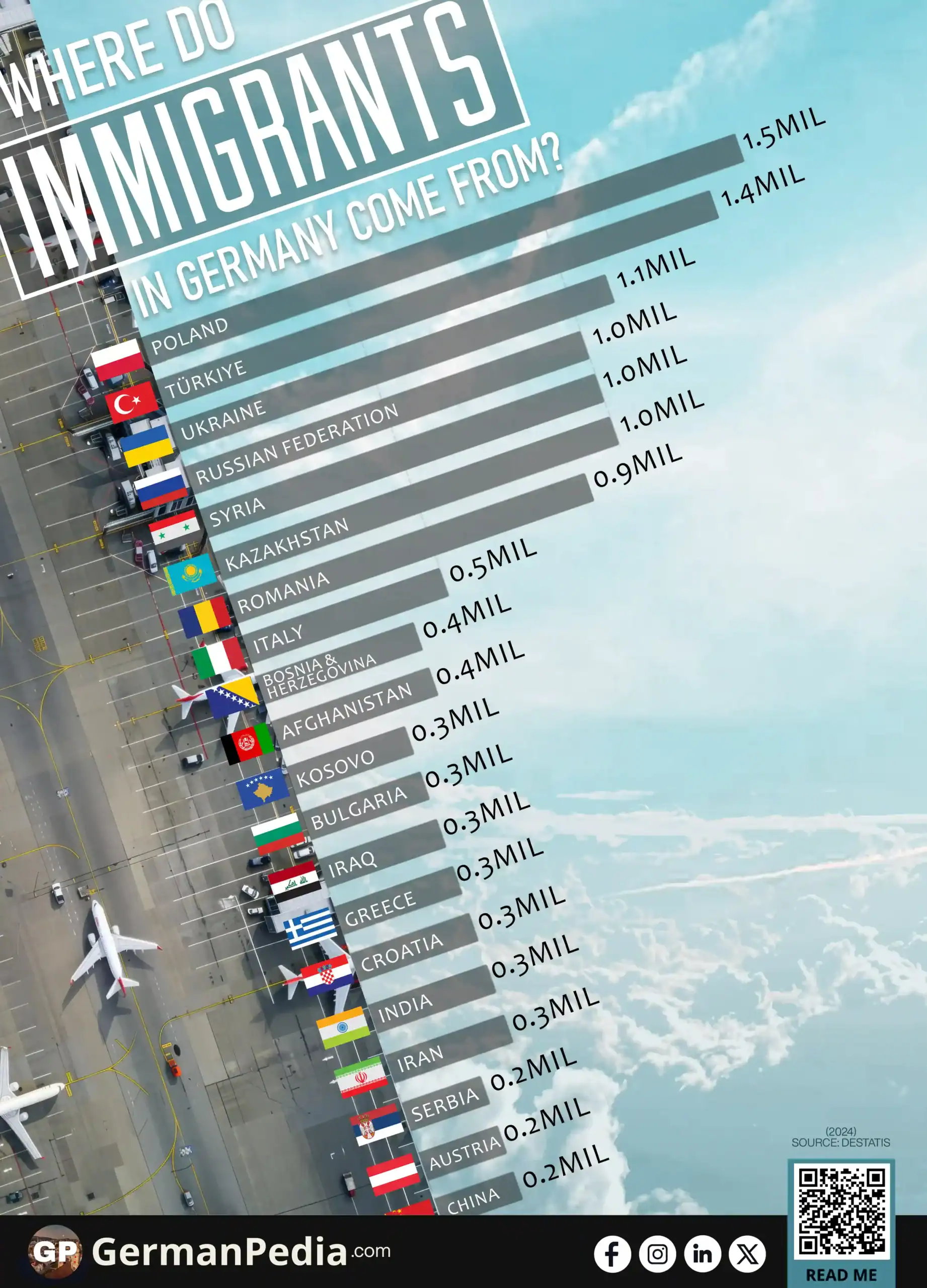
- Around 1.55 million first-generation immigrants in Germany were born in Poland. It is the largest origin group of immigrants in Germany by a clear margin.
- Refugee-origin countries are significant, but not dominant. Syria is the largest refugee-origin country. It ranks sixth overall but remains smaller than several European-origin groups.
- Long-distance migration remains limited in scale. Countries such as China and the United States are present, but have smaller populations.
Use this Visualization: You may use this image for free with proper attribution to GermanPedia (i.e., by linking back to GermanPedia).
Need help communicating complex ideas visually? We help you turn data into your most persuasive story. Contact us to learn more.
First-Generation Immigrants in Germany
| Rank | Country of birth | Population (millions) |
|---|---|---|
| 1 | Poland | 1.5 |
| 2 | Türkiye | 1.4 |
| 3 | Ukraine | 1.1 |
| 4 | Russian Federation | 1.0 |
| 5 | Syria | 1.0 |
| 6 | Kazakhstan | 1.0 |
| 7 | Romania | 0.9 |
| 8 | Italy | 0.5 |
| 9 | Bosnia and Herzegovina | 0.4 |
| 10 | Afghanistan | 0.4 |
| 11 | Kosovo | 0.3 |
| 12 | Bulgaria | 0.3 |
| 13 | Iraq | 0.3 |
| 14 | Greece | 0.3 |
| 15 | Croatia | 0.3 |
| 16 | India | 0.3 |
| 17 | Iran | 0.3 |
| 18 | Serbia | 0.2 |
| 19 | Austria | 0.2 |
| 20 | China | 0.2 |
| 21 | Hungary | 0.2 |
| 22 | Moldova | 0.2 |
| 23 | North Macedonia | 0.2 |
| 24 | Morocco | 0.2 |
| 25 | Spain | 0.2 |
| 26 | United States | 0.1 |
| 27 | Vietnam | 0.1 |
| 28 | France | 0.1 |
| 29 | Netherlands | 0.1 |
| 30 | Pakistan | 0.1 |
| 31 | United Kingdom | 0.1 |
| 32 | Czech Republic | 0.1 |
| 33 | Portugal | 0.1 |
| 34 | Brazil | 0.1 |
| 35 | Lebanon | 0.1 |
| 36 | Thailand | 0.1 |
| 37 | Egypt, Algeria, Libya, Tunisia (combined) | 0.2 |
Source: Destatis

The largest group of first-generation immigrants in Germany comes from Poland, with around 1.55 million people. This is followed by Türkiye (1.43 million) and Ukraine (1.12 million), then the Russian Federation (1.04 million) and Kazakhstan (960,000).
Four of the top five origin countries are either EU members or part of long-established European migration corridors. This firmly anchors Germany’s immigration profile in geography, labour mobility, and historical connections, rather than in exceptional or sudden inflows.
Syria ranks sixth among first-generation immigrants. Its position matters. Syria is the largest refugee-origin country in the ranking, but it does not dominate the immigrant population. The data shows a significant humanitarian inflow, but still embedded within a much larger system of European mobility.
From there, the ranking transitions into a cluster of countries shaped by earlier migration waves, particularly the 1990s displacement and EU free movement
- Italy (465,000)
- Bosnia and Herzegovina (377,000)
- Afghanistan (366,000)
- Kosovo (347,000)
- Bulgaria (302,000)
Further down the list, several countries appear with immigrant populations around or below a quarter million. This includes Iraq, Greece, Croatia, India, and Iran. At this point in the ranking, the decline in population size becomes noticeable. It highlights how quickly numbers fall once migration extends beyond Europe and its immediate neighbourhood.
Countries that are often perceived as major sources of migration (e.g., China, the United States) are present, but at clearly smaller scales. The same is true for North Macedonia, Moldova, and Hungary. They remain in the lower half of the ranking despite long-standing migration ties to Germany.
At the very bottom of the list, smaller groups underline a broader pattern. Long-distance migration to Germany exists, but remains numerically limited.
Overall, Germany’s first-generation immigrant population is shaped mainly by European labour mobility and long-standing migration links. Refugee inflows are visible and significant, but they are a relatively smaller portion of this broader European pattern.
More topics
- Top 25 Richest People in Germany (2025)
- Germany’s Smoking Rate Has Declined Over Two Decades
- Germany’s Electricity Mix: From Coal to Renewables
- Changes in Harvest of Germany’s Five Key Crops
- Top German Companies by Revenue
- Germany’s Top Car Brands by New Registrations
- Unemployment Across Germany: A Federal State Breakdown
- Where Germany’s Tourists Come From
- Germany’s Largest National Parks, Ranked by Size
- Which Federal States Drive Germany’s Economy?
- Here’s Why Divorces in Germany Are Falling
- Germans Are Marrying Later Than Ever
- How Marriage Rates Have Fallen in Germany: 1990–2023
- How Germany’s Birth Rates Dropped and Deaths Rose
- Leading Causes of Death in Germany