The Federal Cabinet adopted a labour-law bill on November 18, 2026 that would, for a limited time, let employers hire staff on fixed-term contracts without a stated reason for up to four years. The same draft would make it easier to end the jobs of high earners against a severance payment, widen Sunday and holiday work in bakeries, pastry shops and some public libraries, and tighten co-determination rules for European companies (SE), according to the Federal Ministry of Labour and Social Affairs (BMAS).
This is a cabinet draft, not a statute. Nothing in it is law yet. Today’s limits on fixed-term hiring and today’s dismissal protection still apply until parliament (Bundestag and Bundesrat) has dealt with the bill and it is promulgated.
Germany’s Labour-Law Package 2026: Key Takeaways
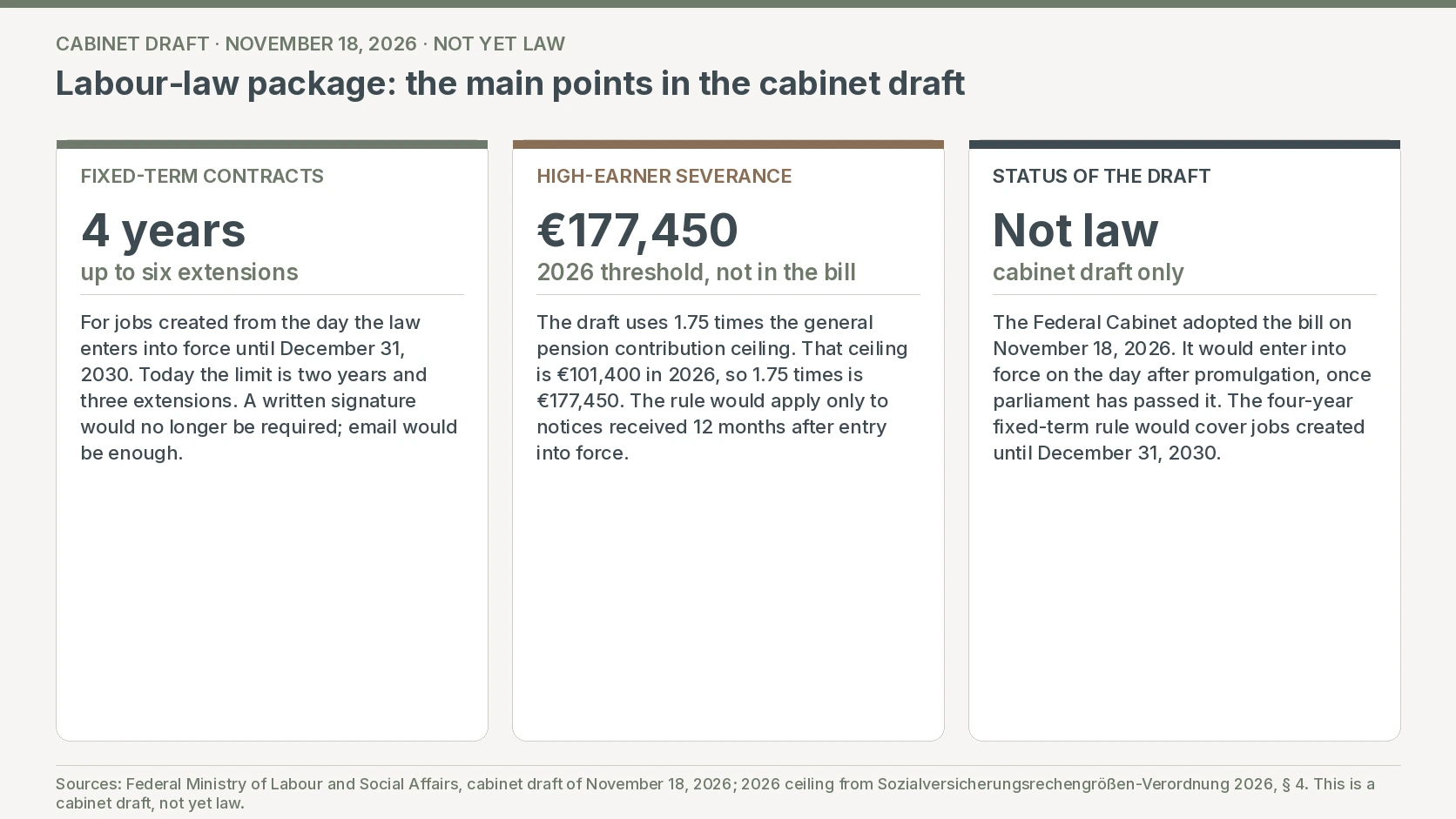
- A no-reason fixed-term contract (sachgrundlose Befristung) could last up to four years, with up to six extensions, for jobs created from the day the law enters into force until December 31, 2030. Today the limit is two years and three extensions.
- The usual ban on a new no-reason fixed-term after you have already worked for the same employer would be waived once. The fixed-term agreement could be made in text form, for example by email.
- If an employee’s fixed agreed annual pay is above 1.75 times the general pension contribution assessment ceiling (€177,450 in 2026, from the official ceiling of €101,400; the bill itself names no euro amount), and a dismissal is challenged in court and found unjustified, the labour court could, at the employer’s request and without the employer giving grounds, end the job against severance instead of reinstating the employee. This would first apply to notices received 12 months after entry into force.
- Sunday and holiday work would be expanded for bakeries and pastry shops, and for public libraries that also serve as places of encounter, culture or education.
- This is a cabinet draft. It would still have to go through the Bundestag and the Bundesrat. It is not yet law.
Fixed-Term Contracts in Germany Could Last Up to Four Years
The four-year limit and the six permitted extensions would apply only to jobs created from the day the law enters into force until December 31, 2030. The temporary rule itself would be repealed on January 1, 2031. The draft does not spell out how contracts from the window that are still running, or extended, after that date would be treated. The draft would also, once, lift the usual block on a new no-reason fixed-term if you have already worked for that employer, provided the re-hiring also takes place by December 31, 2030. For background on contracts, see our guide to hiring in Germany.
Separately, and not only for that temporary window, the fixed-term clause could be agreed in text form under Section 126b of the Civil Code. The official explanation gives email as an example. Today the clause generally needs a handwritten signature. Scientific and artistic staff under the Academic Fixed-Term Contract Act (Wissenschaftszeitvertragsgesetz, WissZeitVG) would be carved out of the four-year no-reason rule; their existing WissZeitVG framework and the ordinary two-year option would stay in place. We covered a recent change in our piece on the WissZeitVG reform.
High Earners in Germany: Easier Dismissal Against Severance
For employees whose contractually or collectively agreed annual pay, fixed in both principle and amount, is above 1.75 times the contribution assessment ceiling in the general pension insurance, the draft would treat dismissal protection more like the special rules that already apply to certain senior executives. If the employee challenges the dismissal, the employer could ask the labour court to end the job against a severance payment, and would not have to give grounds for that request. The court would set the amount under Section 10 of the Protection Against Unfair Dismissal Act. The dismissal would still have to meet that Act; if the court finds it socially unjustified, it could dissolve the contract against severance instead of keeping the employee in the job. Anyone below the threshold would keep today’s protection. For how severance usually works, see our guide to severance pay in Germany.
The official explanation is precise about what counts. Fixed monthly salary, a firmly agreed 13th or 14th monthly salary, a standing company car for private use, and occupational pensions can count. Performance bonuses, profit shares and other variable pay whose amount is not contractually fixed do not. The conditions have to be met when the notice reaches the employee. The bill does not state a euro figure. For 2026 the official ceiling is €101,400, so 1.75 times is €177,450; the ceiling changes every January 1. The new rule would apply only to notices received after 12 months have passed from the day the law enters into force.
Sunday Work in Germany: Bakeries and Public Libraries
Public libraries could employ staff on Sundays and public holidays if the library functions as a place of encounter, culture or education, and not only as a place to borrow media. The official explanation says the local operator would decide, with employee representatives, whether to use that option and how to shape it. The draft does not set a special hour cap for those library shifts.
Bakeries and pastry shops (Konditoreien) could employ staff on those days to produce and deliver goods intended for sale that same day. The official explanation says the current three-hour window for baking Sunday goods would be lifted, because larger craft bakeries have struggled to meet demand in that time. The general maximum working-time limits would still apply, and the draft does not name a new hour figure. Employees would still have to be given at least 15 Sundays off each year; the bill describes that as a clarification of the existing rule, not a new entitlement.
Stronger Co-Determination in European Companies (SE)
Federal Labour Minister Alexander Schweitzer said the package is meant to give companies more flexibility and also to improve employee rights, in particular by limiting ways to avoid co-determination in a European company (SE). The cabinet draft would rewrite the abuse ban in the SE Employee Involvement Act, with presumptions that include an SE first employing at least ten people and skipping a negotiation procedure, or relevant changes within four years of founding or of first employing ten people. If the presumption is not rebutted, negotiations would have to be held; if they fail, the statutory fallback rules would apply. Who can ask a court to review a supervisory board’s composition would also be widened, including the group works council, unions represented in the company, and 30 employees instead of today’s 100.
A narrower change would affect the Nachweisgesetz, the law on proving the main terms of a job. In industries named in Section 2a (1) of the Act to Combat Undeclared Work, the usual option of giving those terms in text form does not currently apply. The draft would let a collective agreement reopen that ordinary text-form route for employers bound by the agreement, or for employers who contractually apply the whole agreement. For what employers must tell staff today, see our guide to the information your German employer is required to give you.
Has Germany’s Labour-Law Package Been Decided?
No. The cabinet adopted the “Draft Act to Amend Certain Labour-Law Provisions and to Protect Corporate Co-Determination” on November 18, 2026, and BMAS has published that cabinet draft. It has not been passed by the Bundestag. On the ministry’s project page, a Bundesrat opinion and the Bundestag readings are still marked as not yet published. Until a statute is promulgated, current law remains in force.
If parliament passes the bill in this form, it would enter into force on the day after promulgation, except for a few provisions with their own dates. The official text does not name a calendar start date such as January 2027. The four-year fixed-term rule would then run only for jobs created up to December 31, 2030, and the high-earner severance rule would start only 12 months after entry into force. If you are negotiating a contract now, you should treat today’s rules as the ones that apply.
Sources
- Federal Ministry of Labour and Social Affairs, press release “Kabinett beschließt Arbeitsrechtspaket,” November 18, 2026: bmas.de.
- BMAS project page, “Gesetz zur Änderung bestimmter arbeitsrechtlicher Vorschriften und zum Schutz der Unternehmensmitbestimmung,” including the published cabinet draft (Regierungsentwurf) and the earlier ministry draft: bmas.de. Cabinet draft PDF: reg-arbeitsrechtspaket.pdf. All measures, time limits, the 1.75-times threshold, the 12-month transition, the Sunday-work rules and the SE provisions in this article are taken from that cabinet draft and its official explanation. The PDF header still reads “Referentenentwurf” and “Bearbeitungsstand: 17.11.2026 19:11”; BMAS publishes the same file as the cabinet decision. Status: cabinet draft, not yet law. Bundestag readings and a Bundesrat opinion are not yet published on the project page.
- Sozialversicherungsrechengrößen-Verordnung 2026, Section 4: the 2026 contribution assessment ceiling in the general pension insurance is €101,400 a year (€8,450 a month). Official overview: BMAS page on the 2026 computation ordinance. The €177,450 figure is 1.75 × €101,400; it is not a euro amount named in the cabinet bill.