The Bundesrat approved a reform of emergency care in Germany on November 20, 2026. The Bundestag had passed the law, the Gesetz zur Reform der Notfallversorgung, on October 15, 2026.
A motion to send the law to the mediation committee did not win a majority, the Bundesrat’s official session report says. The law can now be signed and published in the Federal Law Gazette (BGBl).
It had not yet been published as of November 21, 2026.
The reform is meant to connect three parts of emergency care that today often work separately:
- The statutory on-call doctor service (vertragsärztlicher Notdienst).
- Hospital emergency rooms.
- Ambulance and emergency-rescue services.
Emergency Care Reform in Germany: Key Takeaways
- The Bundesrat approved the emergency-care reform on November 20, 2026. The Bundestag had passed it on October 15, 2026.
- The law can now be signed and published. It takes effect, in general, on the day after publication, but several practical deadlines run from that date.
- The numbers do not change. Call 112 for a life-threatening emergency or a severe health problem.
- 116117 will be split into an appointment service and a 24/7 acute dispatch center (Akutleitstelle), with phone or video advice and, where needed, a home visit.
- The 116117 and 112 dispatch centers are to be linked digitally, so a call can be handed on without you having to ring the other number and repeat your details.
- Selected hospitals are to get integrated emergency centers (Integrierte Notfallzentren, or INZ), combining the emergency room, an on-call practice and a first-assessment desk. Children’s centers (KINZ) can be set up as well.
What the Emergency Care Reform in Germany Changes for 116117 and 112
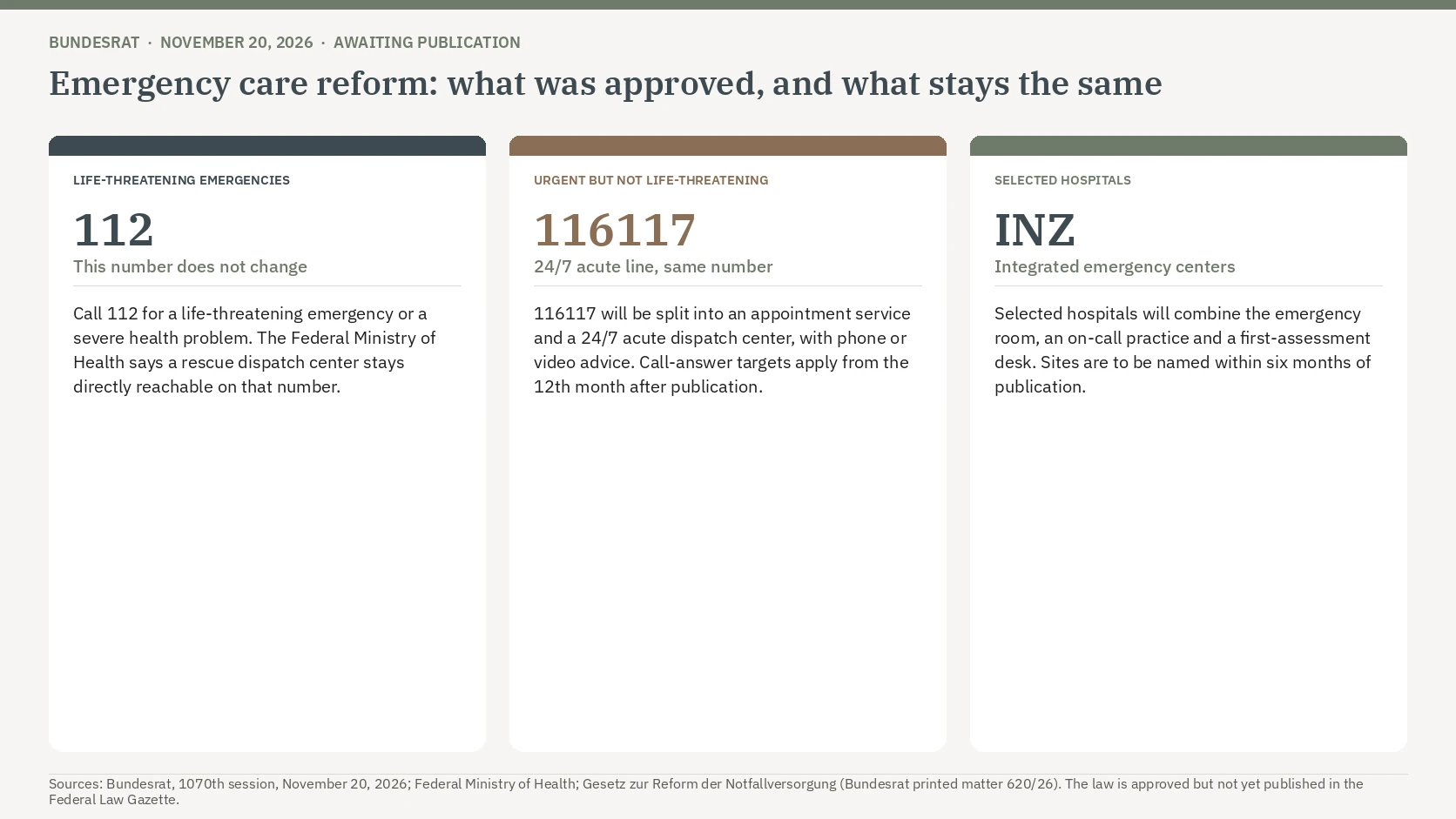
The two numbers you already use do not change. For a life-threatening emergency, or a severe health problem, you should still call 112.
The Federal Ministry of Health says a rescue dispatch center remains directly reachable on that number, and that this does not change.
For urgent cases that are not life-threatening, 116117 will be built out as an acute dispatch center. You will still use the same nationwide number.
You can already call 116117 for medical advice around the clock, as our guide to the German healthcare system explains. The reform writes a nationwide 24/7 phone and video acute service into law, and it splits appointment booking off the same number.
The appointment service only has to be reachable by phone from Monday to Saturday, instead of around the clock as today, and through digital tools at all times. The acute line is to be reachable at all times, including by digital means.
In suitable cases, phone or video advice can settle the problem so you do not have to go to an on-call practice. A home visit is still to be arranged when you cannot reasonably get to a doctor’s office or an integrated emergency center, and a remote consultation is not enough.
The 116117 acute centers and the 112 rescue dispatch centers are to be linked digitally as health guidance systems (Gesundheitsleitsysteme). If your call belongs on the other number, the staff should be able to pass you on, with the details already taken, so you do not have to call again and repeat them.
From the first day of the 12th calendar month after the law is published, the acute lines must answer 75% of calls within three minutes, and 95% within ten minutes. That target is in the adopted legal text.
If a rescue crew treats you on the spot and does not take you to a hospital, that on-scene emergency treatment is to be recognized as a statutory health-insurance benefit, not only the transport.
Integrated Emergency Centers in the Emergency Care Reform in Germany
Selected hospitals are to get integrated emergency centers. A children’s version can be set up as well.
Each center is to combine:
- The hospital emergency room.
- An on-call practice of the Association of Statutory Health Insurance Physicians (Kassenärztliche Vereinigung), next to the emergency room.
- A central first-assessment desk, which decides how urgently you need care and where in the center you should go.
You may walk into an integrated emergency center with an acute problem. The ministry says you should still try to call 116117 first, because that often saves the trip.
People who can show that 116117 sent them are, at the same level of urgency, generally to be treated before walk-in patients. The details of that proof are to be set in the national physicians’ contract (Bundesmantelvertrag).
The on-call practice in an integrated center is to be open at least at these times:
- 9 a.m. to 9 p.m. on weekends and public holidays.
- 2 p.m. to 9 p.m. on Wednesday and Friday.
- 6 p.m. to 9 p.m. on Monday, Tuesday and Thursday.
Shorter hours may be agreed if demand is low. The ministry says the center itself is open around the clock, and that the hospital emergency room covers outpatient acute care when the on-call practice and nearby partner practices are closed.
An integrated emergency center does not replace your regular doctor. Only the first care that is strictly necessary is to be given there.
The first list of hospital sites is due by the first day of the sixth calendar month after publication. The physicians’ association and the hospital then have nine months from that designation to sign a cooperation agreement for the center.
When the Emergency Care Reform in Germany Takes Effect
The law takes effect, in general, on the day after it is published in the Federal Law Gazette. That is what the amended entry-into-force article in the adopted text says.
The main rules follow that general start date:
- The split of 116117.
- The digital link with 112.
- The new emergency centers.
The site list and the call-answer targets count from the month after publication. The nine-month setup window starts when a hospital site is chosen.
Some attached financing and other social-code rules start later, in 2027 and 2028. Until the law is published, 112 and 116117 work as they do today.
What the Emergency Care Reform in Germany Means for Expats
If you have a life-threatening emergency, still call 112. Do not wait for the new centers to open.
If you are unwell but not in immediate danger, 116117 remains the number to ask where to go. The official English page for that service is at 116117.de.
The reform is designed to make that line better at giving phone or video advice, and at handing you to 112 when needed, without a second call. Do not expect an integrated emergency center at every hospital on the day the law appears in the Gazette.
Sites have to be chosen first, and each center then has a nine-month window to be organized. Until then, use emergency care as you do now.
The reform is written into Book V of the Social Code, which governs statutory health insurance. For the wider system, see our guide to the German healthcare system.
Sources
- Bundesrat, BundesratKOMPAKT, 1070th session, “Bundesrat billigt Notfallreform,” November 20, 2026: bundesrat.de. The approval, the failed mediation motion, the split of 116117, the 24/7 phone and video acute line, the health guidance systems with 112, the integrated emergency centers, the recognition of emergency rescue as a statutory health-insurance benefit, and the statement that the law can now be signed and published, taking effect in general on the day after publication, are taken from this official report.
- Bundesrat printed matter 620/26, Gesetzesbeschluss of the German Bundestag, Gesetz zur Reform der Notfallversorgung: 620/26 (PDF). This is the adopted text sent to the Bundesrat. It records that the Bundestag passed the bill on October 15, 2026, on the basis of printed matter 21/6808, with the amendments in 21/8629. The amended entry-into-force article (Article 11) is taken from this document.
- German Bundestag printed matter 21/6808, draft of a law to reform emergency care: 21/6808 (PDF). The statutory wording of the 116117 split, the 24/7 acute line, the 75% / 95% call-answer target from the first day of the 12th calendar month after publication, the composition of an integrated emergency center, the priority for patients referred by 116117, the on-call practice hours, the six-month site list and the nine-month cooperation-agreement window are taken from Article 1 of this draft, which the Bundestag adopted with the amendments in 620/26 and otherwise left unchanged.
- Federal Ministry of Health, press release, “Bundestag beschließt Notfallreform,” October 15, 2026: bundesgesundheitsministerium.de. The ministry’s law-tracker page lists the procedure dates, including the Bundesrat’s second passage on November 20, 2026: Gesetz zur Reform der Notfallversorgung.
- Federal Ministry of Health, “Fragen und Antworten zur Reform der Notfallversorgung,” as of October 15, 2026: FAQ. Used for the ministry’s public explanation that 112 does not change, that the two numbers remain, that callers can be handed on without repeating their details, that people may walk into an integrated emergency center but should preferably call 116117 first, that referred patients are generally seen sooner at the same level of urgency, that the center does not replace a regular doctor, that the center is open around the clock, and that a rescue crew may treat a person on the spot without a hospital trip. This FAQ predates the Bundesrat vote.
- The nationwide 116117 patient service, English page (HTTP 200): 116117.de.