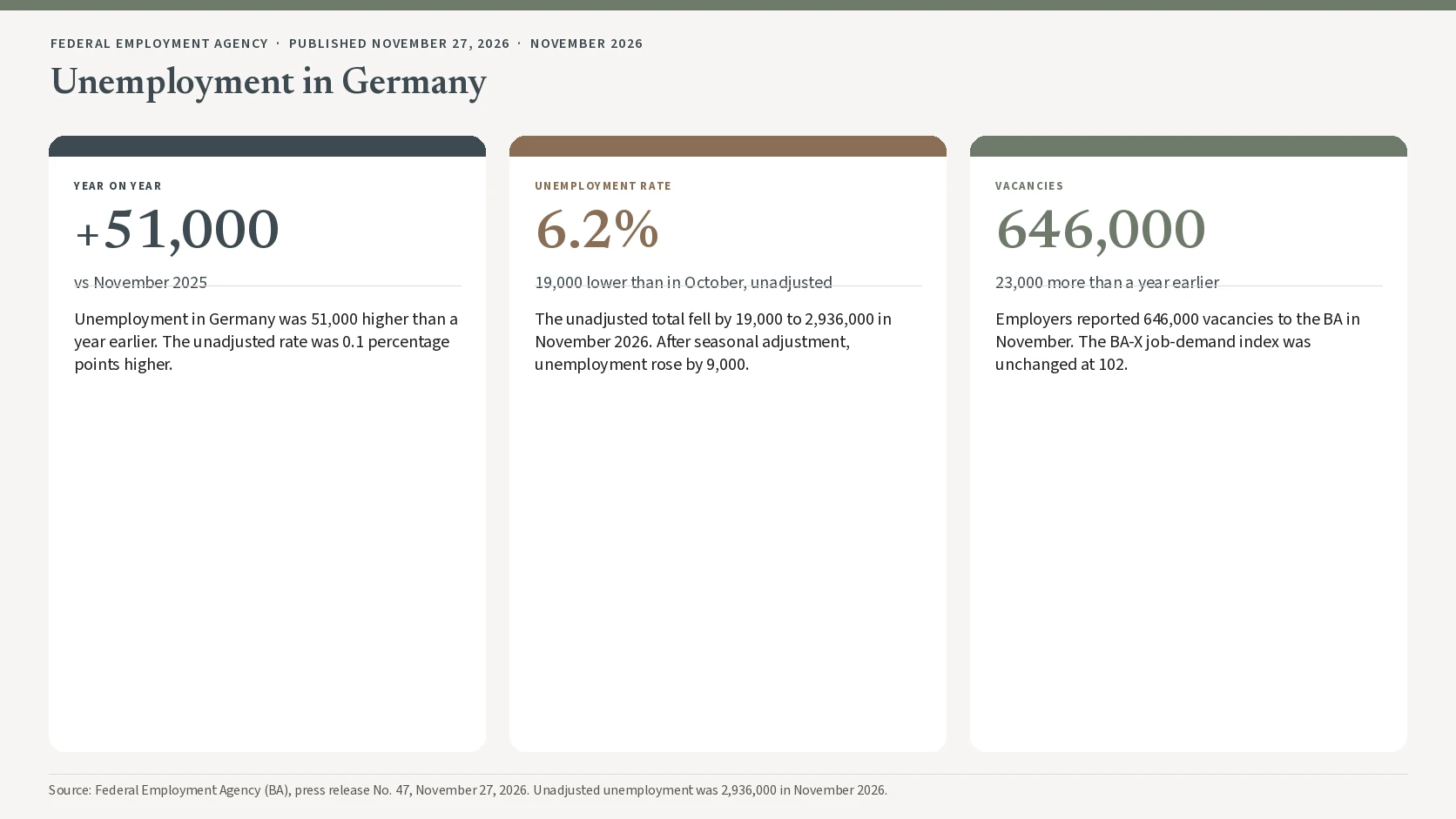
Unemployment in Germany stood at 2,936,000 in November 2026, according to official figures the Federal Employment Agency (BA) published on November 27, 2026, in its monthly labor-market report. That was 51,000 higher than in November 2025.
From October, the unadjusted total fell by 19,000, and the unemployment rate fell 0.1 percentage points to 6.2%. After seasonal adjustment, though, unemployment rose by 9,000.
Unemployment in Germany: Key Takeaways
- Unemployment in Germany stood at 2,936,000 in November 2026, the BA said on November 27, 2026. That was 19,000 lower than in October, before seasonal adjustment.
- The unadjusted unemployment rate fell 0.1 percentage points to 6.2%.
- After seasonal adjustment, unemployment rose by 9,000 from October.
- The total was 51,000 higher than in November 2025. The rate was 0.1 percentage points higher than a year earlier.
- Underemployment was 3,584,000, which was 28,000 higher than a year earlier. After seasonal adjustment, it fell by 5,000 from October.
- Employers reported 646,000 vacancies, 23,000 more than a year earlier. The BA-X job-demand index was unchanged at 102.
- An estimated 1,068,000 people received unemployment benefit (Arbeitslosengeld) in November, 84,000 more than a year earlier.
How Unemployment in Germany Moved in November
The 19,000 drop is the usual easing at the end of the autumn pickup, the BA said. The unadjusted unemployment rate also fell 0.1 percentage points, to 6.2%.
Daniel Terzenbach, the BA board member for the regions, said the slight cyclical recovery did not revive the labor market in November. The trends of recent months continued, he said.
After the usual seasonal pattern is removed, unemployment rose by 9,000 from October. That seasonally adjusted rise, and the 51,000 increase from a year earlier, are the clearer signs of the underlying trend.
Unemployment in Germany Compared With a Year Ago
The total was 51,000 higher than in November 2025. The unemployment rate was 0.1 percentage points higher than a year earlier.
Underemployment, which also counts people in labor-market programs and short-term sickness, stood at 3,584,000. That was 28,000 higher than a year earlier, though the seasonally adjusted figure fell by 5,000 from October.
The BA also cited Destatis’s ILO unemployment rate for October, which was 4.0%. That is a different measure from the BA’s registered unemployment rate, and it refers to the previous month.
Jobs, Benefits, and Unemployment in Germany
Destatis, as cited in the BA release, put employment in Germany on a domestic-concept basis at 45.84 million in October. That was 227,000 lower than a year earlier, and the seasonally adjusted figure was 22,000 lower than in September.
Employment covered by social insurance stood at 35.16 million in September, according to BA estimates. That was 61,000 lower than a year earlier, and the seasonally adjusted figure fell by 6,000 from August to September.
In September, 7.56 million people had a mini-job, 67,000 fewer than a year earlier. Of those, 3.97 million held only a mini-job, and 3.60 million held one as a side job.
Demand for workers remains weak, the BA said. Employers reported 646,000 vacancies in November, 23,000 more than a year earlier.
The BA-X job-demand index, which also tracks new vacancy reports, was unchanged at 102 in November. That was 2 points higher than a year earlier.
Between November 1 and November 23, firms filed short-time work notices covering 23,000 people. Those notices are applications, not the number already on short-time work.
The latest figures for actual short-time work (Kurzarbeitergeld) are for September and are still provisional. An estimated 113,000 employees received the benefit that month.
That was 19,000 more than in August, a rise the BA also linked to the end of the summer holidays. It was 68,000 fewer than a year earlier, though the BA said the current level is still somewhat elevated in a longer-term comparison.
An estimated 1,068,000 people received unemployment benefit (Arbeitslosengeld) in November, 84,000 more than a year earlier.
The number of working-age people entitled to basic income support (erwerbsfähige Leistungsberechtigte) was estimated at 3,646,000. That was 162,000 lower than in November 2025.
The BA said 6.7% of working-age people living in Germany were in need of this assistance.
What Unemployment in Germany Means for Workers
The labor market is still softer than a year ago. Unemployment is higher, and the BA says demand for workers remains weak, even though the number of reported vacancies was 23,000 higher than in November 2025.
The headline total is still below 3 million, as we reported when it first dropped below that mark earlier in 2026. It is, however, 51,000 higher than a year ago.
If you lose your job in Germany, statutory health insurance usually continues while you claim unemployment benefit. We explain the rules in our guide to health insurance for the unemployed.
Unemployment also differs widely by federal state. See our state-by-state breakdown of unemployment in Germany.
Sources
- Federal Employment Agency (Bundesagentur für Arbeit), press release No. 47, “Arbeitsmarkt im November 2026,” November 27, 2026: arbeitsagentur.de. The unemployment, underemployment, vacancy, BA-X, short-time work, social-insurance employment, mini-job, unemployment-benefit, and basic-income-support figures in this article are taken from that official release, as are the Destatis employment total on a domestic-concept basis and the Destatis ILO unemployment rate as cited by the BA.
- Federal Statistical Office (Destatis) published a separate October employment release the same day (N412). The article uses the Destatis figures as cited in the BA release and does not mix them with Destatis’s national-concept (resident) employment total from that release, which is a different measure: destatis.de.