The statutory fixed subsidy (Festzuschuss) for dentures, crowns and similar prosthetic treatment in Germany falls from 60% to 50% of standard care on January 1, 2027.
That cut is part of the law on stabilizing public health-insurance contribution rates, the GKV-Beitragssatzstabilisierungsgesetz. The Bundestag and the Bundesrat approved it on July 10, 2026, and it was published in the Federal Law Gazette (BGBl) on July 29, 2026, as BGBl. 2026 I No. 228.
If you keep a bonus booklet (Bonusheft) showing regular dental check-ups, the higher rates also fall. After five years they drop from 70% to 60%, and after ten years from 75% to 65%.
The Federal Ministry of Health says this returns the subsidy to the level in force before October 2020. The change amends Section 55 of Book V of the Social Code (SGB V) and takes effect on January 1, 2027.
Dental Subsidy in Germany: Key Takeaways
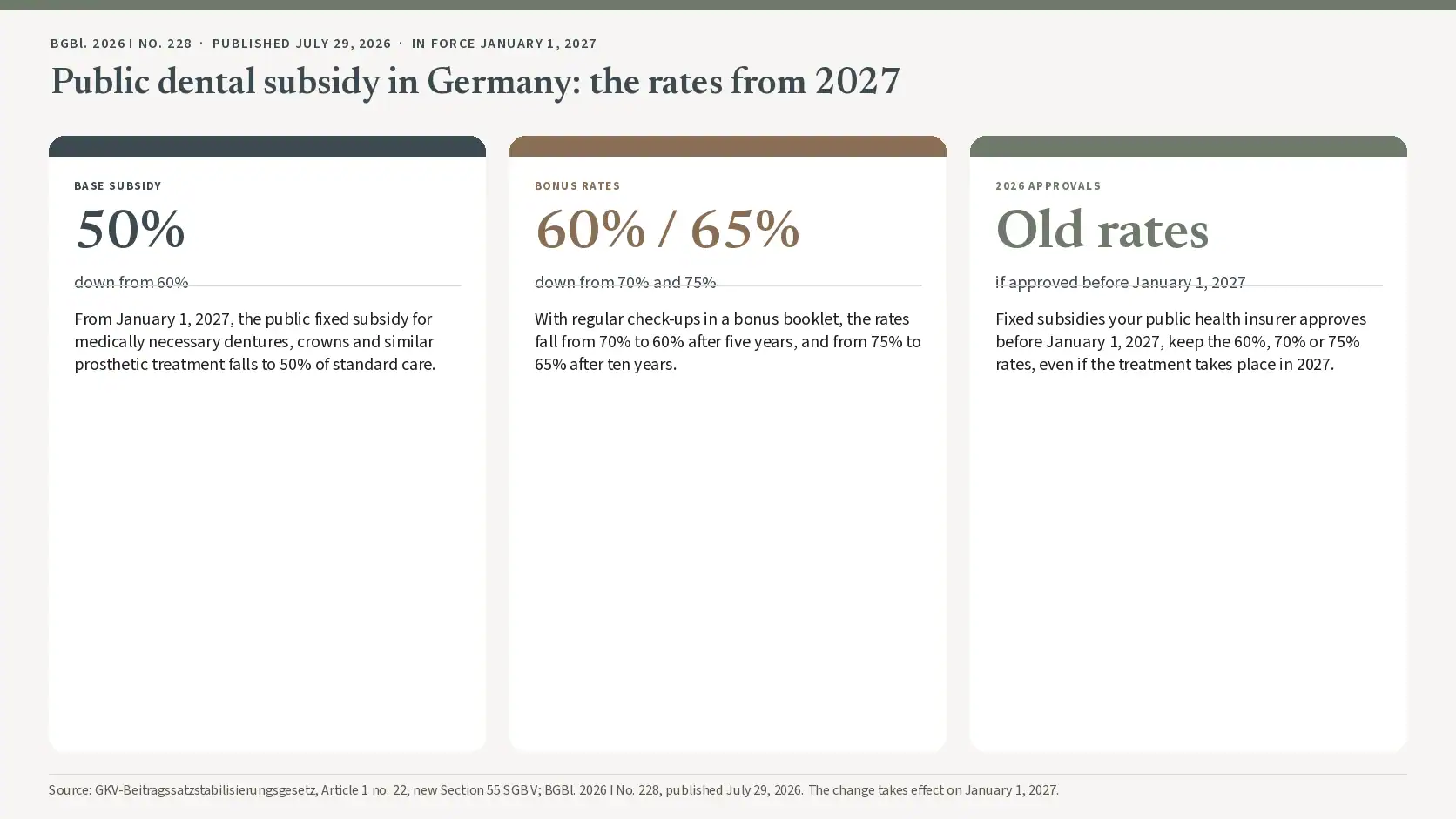
- From January 1, 2027, the public fixed subsidy for medically necessary dentures, crowns and similar prosthetic treatment falls from 60% to 50% of standard care (Regelversorgung).
- With regular check-ups recorded in a bonus booklet, the rates fall from 70% to 60% after five years, and from 75% to 65% after ten years.
- The Bundestag and the Bundesrat approved the GKV-Beitragssatzstabilisierungsgesetz on July 10, 2026. It was published in the Federal Law Gazette on July 29, 2026 (BGBl. 2026 I No. 228).
- Fixed subsidies that your public health insurer approves before January 1, 2027, keep the old rates, even if the treatment takes place in 2027.
- People with low income who qualify for the hardship rule still have the cost of standard care paid in full, the ministry says.
- This applies to people in public health insurance (gesetzliche Krankenversicherung). It does not change private dental coverage.
What Changes to the Dental Subsidy in Germany on January 1, 2027
Through December 31, 2026, public health insurance pays a fixed subsidy of 60% of the standard-care amount for medically necessary dentures, including crowns and superstructures. That is the rate in Section 55 SGB V as it now stands.
From January 1, 2027, that base rate is 50%. The new wording is in Article 1, number 22 of the published law.
The bonus rates, which rise when you attend the required check-ups, change as well:
| Rate | Through December 31, 2026 | From January 1, 2027 |
|---|---|---|
| Base subsidy | 60% | 50% |
| After 5 years of check-ups | 70% | 60% |
| After 10 years of check-ups | 75% | 65% |
Those percentages apply to the standard-care amounts set for each dental finding, not to the full bill for a more expensive treatment you choose yourself. Our guide to dental coverage in public health insurance explains how standard care and extra services are billed.
What to Do Before the Dental Subsidy in Germany Changes
The date that matters is your insurer’s approval of the fixed subsidy, not the day the dentist writes the plan, and not the day the treatment is carried out.
The new Section 55(6) SGB V says that for all fixed subsidies approved before January 1, 2027, the rules in force through December 31, 2026, continue to apply.
If you expect crowns, bridges, dentures or other prosthetic treatment soon, you can:
- Ask your dentist for a treatment and cost plan (Heil- und Kostenplan) in 2026.
- Submit it to your public health insurer in time for the fixed subsidy to be approved before January 1, 2027.
- Keep the approval, and ask your dentist and insurer if anything is still outstanding.
A plan that is only written in 2026, but approved on or after January 1, 2027, falls under the new rates.
This is general information about the law, not medical or legal advice. Your dentist and your insurer can tell you what applies in your case.
Dental Subsidy in Germany: Who Still Gets Standard Care Paid in Full
The hardship rule remains. The ministry says people with low income who would otherwise be unreasonably burdened still have the cost of standard care reimbursed in full.
The law adjusts the extra amount in those cases from 40% to 50% of standard care, so that it still adds up to 100% together with the new base subsidy. If you choose treatment that goes beyond standard care, the insurer still pays only those standard-care amounts, not the extra cost of the upgrade.
The check-up rules for the bonus, including the existing exception for missed visits in calendar year 2020, otherwise stay as they are.
Article 8(2) of the law sets January 1, 2027, as the start date for this Section 55 change. Other parts of the same law take effect on other dates and are not covered here.
Sources
- Federal Law Gazette, BGBl. 2026 I No. 228, July 29, 2026, Gesetz zur Stabilisierung der Beitragssätze in der gesetzlichen Krankenversicherung (GKV-Beitragssatzstabilisierungsgesetz), dated July 24, 2026: recht.bund.de. Article 1, number 22 amends Section 55 SGB V (new 50%, 60% and 65% rates; hardship extra amount of 50%; new subsection 6 on approvals before January 1, 2027). Article 8(2) brings number 22 into force on January 1, 2027.
- Section 55 SGB V in the version still in force through December 31, 2026 (60%, 70% and 75% rates; hardship extra amount of 40%): gesetze-im-internet.de.
- Federal Ministry of Health, law-tracker page for the GKV-Beitragssatzstabilisierungsgesetz (Bundestag second and third readings and Bundesrat second passage on July 10, 2026; publication on July 29, 2026): bundesgesundheitsministerium.de.
- Federal Ministry of Health, FAQ on the law, as of July 10, 2026, including the return of the dental subsidy to the pre-October 2020 level and the hardship rule: bundesgesundheitsministerium.de.
- Bundesrat printed matter 411/26 (decision), 1067th session, July 10, 2026: the Bundesrat decided not to call the mediation committee on the law the Bundestag had passed that day: bundesrat.de. Procedure record, including the BGBl. citation: 0411-26. Session report: BundesratKOMPAKT, 1067th session.