
Key Takeaways
- City-states such as Bremen, Berlin, and Hamburg record the highest unemployment rates, driven by service-heavy economies, smaller labor markets, and high inflows of job seekers.
- Western states like Bavaria and Baden-Württemberg consistently post the lowest unemployment rates, supported by diversified industries, strong private sectors, and high labor demand.
- Eastern federal states continue to face higher unemployment on average due to smaller labor markets, lower private-sector density, and long-term demographic change.
- Regional unemployment gaps reflect structural labor market dynamics, not differences in overall economic importance.
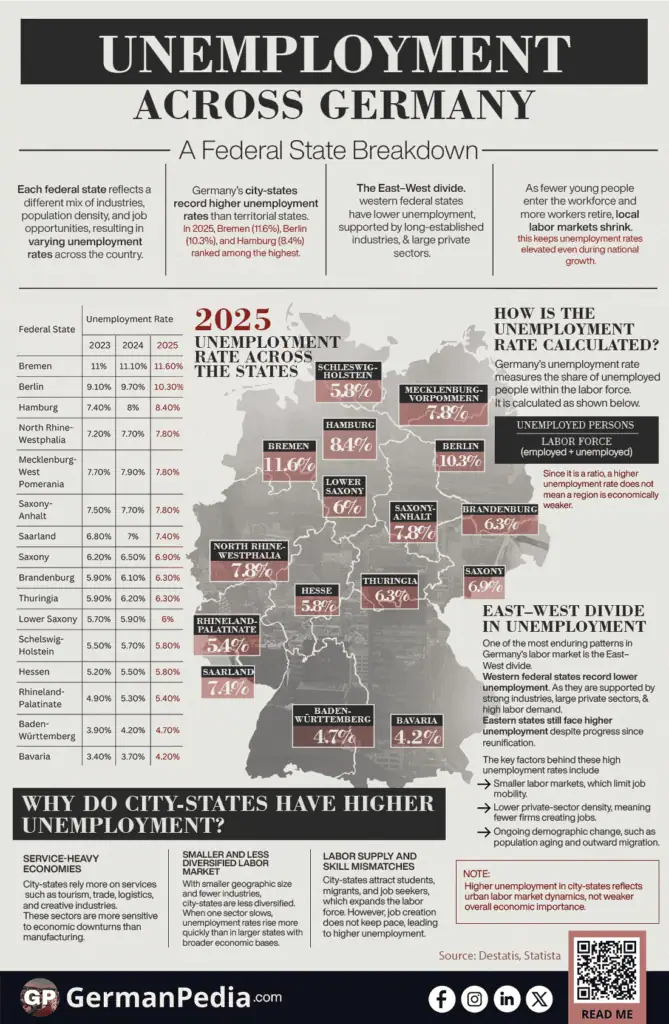
Use this Visualization: You may use this image for free with proper attribution to GermanPedia (i.e., by linking back to GermanPedia).
Germany’s Unemployment Rate By Federal State
| Federal State | Unemployment Rate (%) | ||
| 2023 | 2024 | 2025 | |
| Bremen | 10.6 | 11.1 | 11.6 |
| Berlin | 9.1 | 9.7 | 10.3 |
| Hamburg | 7.4 | 8 | 8.4 |
| North Rhine-Westphalia | 7.2 | 7.7 | 7.8 |
| Mecklenburg-West Pomerania | 7.7 | 7.9 | 7.8 |
| Saxony-Anhalt | 7.5 | 7.7 | 7.8 |
| Saarland | 6.8 | 7 | 7.4 |
| Saxony | 6.2 | 6.5 | 6.9 |
| Brandenburg | 5.9 | 6.1 | 6.3 |
| Thuringia | 5.9 | 6.2 | 6.3 |
| Lower Saxony | 5.7 | 5.9 | 6 |
| Schelswig-Holstein | 5.5 | 5.7 | 5.8 |
| Hessen | 5.2 | 5.5 | 5.8 |
| Rhineland-Palatinate | 4.9 | 5.3 | 5.4 |
| Baden-Württemberg | 3.9 | 4.2 | 4.7 |
| Bavaria | 3.4 | 3.7 | 4.2 |
Source: Destatis, Statista

Germany does not have a single, uniform labor market. Each federal state reflects a different mix of industries, population density, and job opportunities. As a result, unemployment rates vary widely across the country.
How Is the Unemployment Rate Calculated?
Germany’s unemployment rate measures the share of unemployed people within the labor force, not the total population. It is calculated as:
Unemployed persons ÷ labor force (employed + unemployed)
Since it is a ratio, a higher unemployment rate does not automatically mean a region is economically weaker. It often reflects differences in labor supply, job matching, and population mobility rather than overall economic output.
Discover differences in economic output for each federal state ->
Why Do City-States Have Higher Unemployment?
Germany’s city-states consistently record higher unemployment rates than territorial states. In 2025, Bremen (11.6%), Berlin (10.3%), and Hamburg (8.4%) ranked among the highest.
This pattern reflects structural factors rather than short-term economic weakness:
- Service-heavy economies: City-states rely more on services such as tourism, trade, logistics, and creative industries. These sectors are more sensitive to economic downturns than manufacturing, where job demand tends to be more stable.
- Smaller and less diversified labor markets: With smaller geographic size and fewer industries, city-states are less diversified. When one sector slows, unemployment rates rise more quickly than in larger states with broader economic bases.
- Labor supply and skill mismatches: City-states attract students, migrants, and job seekers, which expands the labor force. However, job creation does not always keep pace, leading to higher measured unemployment.
NOTE: Higher unemployment in city-states reflects urban labor market dynamics, not weaker overall economic importance.
Germany’s East–West Divide in Unemployment
One of the most enduring patterns in Germany’s labor market is the East–West divide.
Western federal states generally record lower unemployment. Bavaria and Baden-Württemberg rank among the lowest, with unemployment rates below 5%, supported by long-established industries, large private sectors, and strong labor demand.
In contrast, several eastern states still face higher unemployment despite significant progress since reunification. States such as Mecklenburg-Vorpommern (7.8%) and Saxony-Anhalt (7.8%) continue to record above-average rates.
The key factors behind these high unemployment rates include:
- Smaller labor markets, which limit job mobility
- Lower private-sector density, meaning fewer firms creating jobs
- Ongoing demographic change, such as population aging and outward migration
As fewer young people enter the workforce and more workers retire, local labor markets shrink. Businesses may scale back or avoid new investment, which keeps unemployment rates elevated even during periods of national growth.
More topics
- Highest Paying Jobs in Germany
- Popular Study Destinations for German Students
- Educational Attainment in European Countries
- Grocery Prices in Germany Have Increased Since 2000
- Germany’s Smoking Rate Has Declined Over Two Decades
- Germany’s Electricity Mix: From Coal to Renewables
- Changes in Harvest of Germany’s Five Key Crops
- Top German Companies by Revenue
- Germany’s Top Car Brands by New Registrations
- Unemployment Across Germany: A Federal State Breakdown
- Where Germany’s Tourists Come From
- Germany’s Largest National Parks, Ranked by Size
- Which Federal States Drive Germany’s Economy?
- How Marriage Rates Have Fallen in Germany: 1990–2023
- Leading Causes of Death in Germany
References
- https://www.statista.com/statistics/227005/unemployment-rate-in-germany/
- https://www-genesis.destatis.de/datenbank/online/statistic/13211/table/13211-0011
- https://eures.europa.eu/living-and-working/labour-market-information/labour-market-information-germany_en
- https://www.tandfonline.com/doi/full/10.1080/00343404.2025.2511713#d1e2142