Key Takeaways
- Deutsche Bank ranks only 6th among the EU’s largest banks. Germany runs the EU’s largest economy.
- BNP Paribas ranks first among the EU’s largest banks. Its total assets reach $3.28 trillion.
- Five of the EU’s ten largest banks are French: BNP Paribas, Crédit Agricole, Groupe BPCE, Société Générale, and Crédit Mutuel.
- France’s six banks in this ranking hold $12.52 trillion combined. Germany’s three hold $3.15 trillion, about a quarter as much.
- Seven of the EU’s 20 largest banks carry pro forma adjustments for mergers completed or pending in 2025 and 2026.
- EU banks operate below their optimal scale. Running separate compliance teams and money pools in each country raises costs and slows crisis response.
Use this Visualization: You may use this image for free with proper attribution to GermanPedia (i.e., by linking back to GermanPedia).
Need help communicating complex ideas visually? We help you turn data into your most persuasive story. Contact us to learn more.
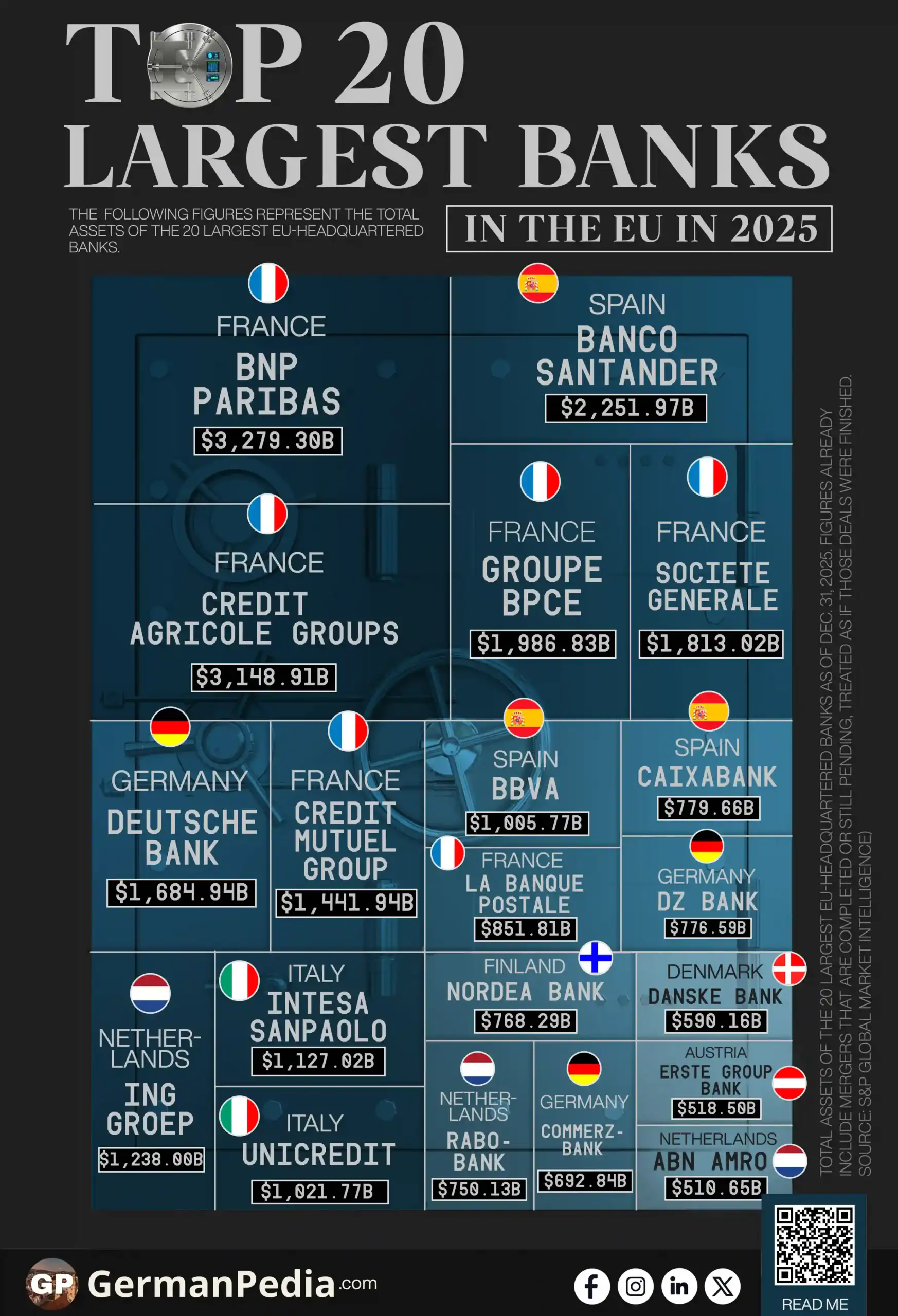
EU’S Largest Banks by Total Assets
| Rank | Bank | Headquarters | Total Assets ($B) |
|---|---|---|---|
| 1 | BNP Paribas | France | 3,279.30 |
| 2 | Crédit Agricole Group | France | 3,148.91 |
| 3 | Banco Santander | Spain | 2,251.97 |
| 4 | Groupe BPCE | France | 1,986.83 |
| 5 | Société Générale | France | 1,813.02 |
| 6 | Deutsche Bank | Germany | 1,684.94 |
| 7 | Crédit Mutuel Group | France | 1,441.94 |
| 8 | ING Groep | Netherlands | 1,238.00 |
| 9 | Intesa Sanpaolo | Italy | 1,127.02 |
| 10 | UniCredit | Italy | 1,021.77 |
| 11 | BBVA | Spain | 1,005.77 |
| 12 | La Banque Postale | France | 851.81 |
| 13 | CaixaBank | Spain | 779.66 |
| 14 | DZ Bank | Germany | 776.59 |
| 15 | Nordea Bank | Finland | 768.29 |
| 16 | Rabobank | Netherlands | 750.13 |
| 17 | Commerzbank | Germany | 692.84 |
| 18 | Danske Bank | Denmark | 590.16 |
| 19 | Erste Group Bank | Austria | 518.50 |
| 20 | ABN Amro | Netherlands | 510.65 |
Source: S&P Global Market Intelligence
Banks are ranked by total assets, with each banking group counted once.
Development banks and entities that act as central banks, banking associations, or supervisors are excluded.

Germany’s Largest Bank Ranks Only 6th in the EU
Deutsche Bank ranks 6th among the EU’s largest banks by assets. It recorded $1.68 trillion in total assets.
Germany runs the EU’s largest economy. Despite this, five banks from smaller economies rank ahead of Deutsche Bank on total assets.
- BNP Paribas: $3.28 trillion
- Crédit Agricole: $3.15 trillion
- Banco Santander: $2.25 trillion
- Groupe BPCE: $1.99 trillion
- Société Générale: $1.81 trillion
Germany’s banking assets are not missing. They are spread out. Three German banks make the EU’s top 20:
- Deutsche Bank: $1.68 trillion
- DZ Bank: $776.59 billion
- Commerzbank: $692.84 billion
Germany’s banking sector splits into three separate pillars. Private commercial banks make up one pillar. Public savings banks, known as Sparkassen, make up a second. Cooperative banks make up a third.
France, Italy, Spain, and the UK once ran similar public and cooperative banking structures. Each introduced more private ownership and reduced the state’s role starting in the 1980s. Germany’s Sparkassen and cooperative banks stayed public and mutual instead. That keeps German banking assets spread across many regional institutions rather than concentrated in a few national giants.
Five of the EU’s Ten Largest Banks Are French
Five French banks rank in the EU’s top ten:
- BNP Paribas: $3.28 trillion
- Crédit Agricole: $3.15 trillion
- Groupe BPCE: $1.99 trillion
- Société Générale: $1.81 trillion
- Crédit Mutuel: $1.44 trillion
France’s banking sector consolidated through mergers. BNP and Paribas merged in 2000 to form BNP Paribas. Nine years later, Groupe Banque Populaire merged with Groupe Caisse d’Épargne to form Groupe BPCE. Those two deals alone created two of the five French banks in the EU’s top ten.
France’s six banks in this ranking hold a combined $12.52 trillion in assets. Germany’s three banks hold $3.15 trillion combined. That is about a quarter as much, even though Germany runs the EU’s largest economy.
Spain places three banks in the top 15: Banco Santander, BBVA, and CaixaBank.
Seven of the EU’s 20 Largest Banks Already Carry New Merger Adjustments
Seven of the EU’s 20 largest banks in this ranking carry pro forma adjustments for mergers that are completed or still pending in 2025 and 2026. Pro forma means each bank’s total assets already include the deal, even before it closes.
EU banks operate below their optimal scale. Banks that work across multiple countries end up running separate compliance teams and separate pools of money in each one. That costs more and makes it harder to move money quickly when it is needed most, like during a financial crisis. Regulators want banks to merge across borders so they can combine these functions instead of duplicating them everywhere.
That shift is already underway.
- Banco Santander’s total includes its pending purchase of TSB Banking Group from Banco de Sabadell, announced in July 2025.
- Groupe BPCE’s total includes its pending acquisition of Portugal’s Novo Banco.
- Erste Group’s total includes the 49% stake it bought in Santander Bank Polska in January 2026.
These three mergers are reshaping the same landscape this article opened with. Germany’s economy leads the EU, but its banking assets stay divided among three banks and three ownership pillars. France’s six banks combine for nearly four times Germany’s total despite running a smaller economy. A country’s largest bank still reflects how its banking system is organized, not just the size of its economy.
More topics
- Germany’s Largest Banks by Assets
- Which EU Country Has the Highest Cost of Living?
- Highest-Paying Ausbildung in Germany
- EU’s Senior Population is Growing
- Which Country Owns Almost a Quarter of the EU’s Wealth?
- Which EU Country Recycles the Most?
- How much parental leave do you get in the EU?
- Which EU Countries Had the Highest Inflation Rates?
- Largest Hospitals in Germany
- Road Deaths in the EU Are Highest in Romania and Bulgaria
- EU Online Shopping Splits Sharply by Age
- EU early school leavers went down to 9.1%
- The Best EU Countries to Retire In
- Bulgaria Now Has the EU’s Highest Smoking Rate
References
- https://www.spglobal.com/market-intelligence/en/news-insights/research/2026/04/europes-50-largest-banks-by-assets-2026
- https://www.bankingsupervision.europa.eu/press/speeches/date/2026/html/ssm.sp260304~6e6c293610.en.html
- https://www.imf.org/external/pubs/nft/op/233/op233.pdf
- https://ec.europa.eu/eurostat/statistics-explained/index.php?title=National_accounts_and_GDP
- https://www.banque-france.fr/en/publications-and-statistics/publications/large-french-banking-groups-are-increasingly-concentrating-their-international-activities-euro-area