
Key Takeaways
- Ireland leads all EU countries on the Global Retirement Index 2025 with a score of 82%. It ranks 2nd globally.
- Denmark and the Netherlands both score 79%. Both countries run mandatory workplace pension systems that build savings independently of state payouts.
- Germany ranks 4th among EU countries with a score of 76%. It offers strong healthcare infrastructure, a high quality of life, and low crime rates.
- Greece and Spain are the only two EU countries to score below 55%. Both face aging populations and pension systems that were not built for current demographics.
The Global Retirement Index 2025 ranks 44 countries on retirement security.
The index does not measure pension payouts alone. It combines four sub-indices into a single score:
- Health — life expectancy, health expenditure per capita, and non-insured health expenditure
- Material Wellbeing — income equality, employment, and income per capita
- Quality of Life — happiness, environmental factors, and safety
- Finances in Retirement — interest rates, tax pressure, inflation, and government debt
A country can offer generous pensions and still score poorly. A failing healthcare system or rising public debt quietly erodes retirement security. The index captures all of it.
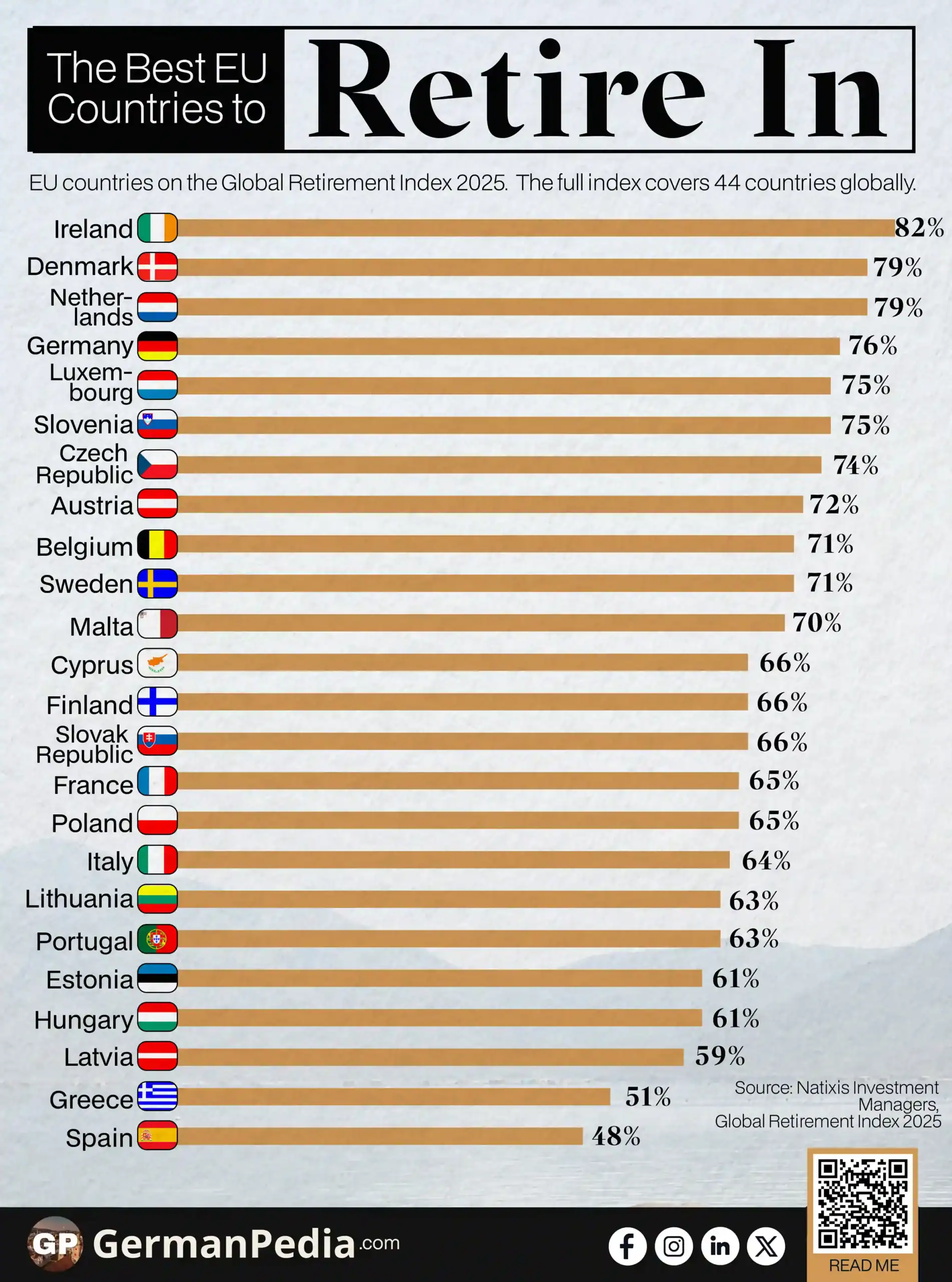
Use this Visualization: You may use this image for free with proper attribution to GermanPedia (i.e., by linking back to GermanPedia).
Need help communicating complex ideas visually? We help you turn data into your most persuasive story. Contact us to learn more.
Global Retirement Index by Country
| Country | Global Retirement Index (%) |
|---|---|
| Ireland | 82 |
| Denmark | 79 |
| Netherlands | 79 |
| Germany | 76 |
| Luxembourg | 75 |
| Slovenia | 75 |
| Czech Republic | 74 |
| Austria | 72 |
| Belgium | 71 |
| Sweden | 71 |
| Malta | 70 |
| Cyprus | 66 |
| Finland | 66 |
| Slovak Republic | 66 |
| France | 65 |
| Poland | 65 |
| Italy | 64 |
| Lithuania | 63 |
| Portugal | 63 |
| Estonia | 61 |
| Hungary | 61 |
| Latvia | 59 |
| Greece | 51 |
| Spain | 48 |
Source: Natixis Investment Managers, Global Retirement Index 2025

Ireland leads all EU countries on the Global Retirement Index 2025. It scores 82% and ranks 2nd globally.
Ireland performs well across all four sub-indices. It posts strong health outcomes, low unemployment, and high income equality. That consistency across every dimension is what separates it from the rest.
EU Wage Growth In The Last Two Decades ->
Denmark and the Netherlands both score 79%. Their strength comes from pension savings that run independently of state payouts.
Denmark runs a universal, residence‑based public pension financed by general taxation, and most Danish workers also participate in occupational pension schemes established through collective agreements.
Meanwhile, the Netherlands combines a universal state pension (AOW) with industry‑wide occupational pension funds. Most employees enroll automatically when their employer participates.
Both groups arrive at retirement with decades of contributions already working for them.
Germany scores 76%. It ranks 4th among EU countries. It scores highly on healthcare infrastructure, low crime rates, and environmental quality.
Germany’s Murder Cases Have Halved Since 2000 ->
Germany’s Electricity Mix is Shifting to Renewable Energy ->
Why Greece and Spain Rank Last in the EU
Greece and Spain are the only two EU countries to score below 55%. Greece scores 51%. Spain scores 48%.
Both countries have an aging population. In 2024, Greece and Spain both had more than one in five citizens over the age of 65. Fewer working-age people are now contributing to support a growing retiree population. With this, pension spending is rising while the contributor base is shrinking.
Country-specific decisions have deepened the problem. Greece spent years cutting pensions under post-2010 bailout conditions. Spain reversed the pension reforms that were designed to reduce its long-term pension deficit. Both countries are now carrying the cost of those decisions.
Overall, a country’s retirement security score reflects more than its pension system. It reflects decades of decisions across healthcare, labor policy, fiscal management, and demographic planning.
More topics
- Which EU Countries Have the Most Soft Power?
- EU Passports Are Among the Strongest in the World
- Which EU Countries Have the Highest Obesity Rates?
- EU House Price Index Rises Over 60% Since 2010
- EU Countries Are Only Partly Self-Sufficient in Food
- EU Wage Growth In The Last Two Decades
- Primary School Teacher Salaries in Public Institutions in the EU
- Which EU Countries Have the Highest Equity Risk Premiums?
- 49% of Young Adults Live With Their Parents in the EU
- EU Unicorn Startups: Which Countries Lead and Why
- EU Patent Applications Are Rising But Remain Concentrated
- EU Household Expenditure on Food and Non-Alcoholic Beverages
- Internet Freedom in the EU Is High but Shaped by National Rules
- Adoption of Electric and Hybrid Passenger Cars in the EU
- Net Household Saving Rates in the EU Over Time
References
- https://www.im.natixis.com/content/dam/natixis/website/insights/investor-sentiment/2025/global-retirement-index/global-retirement-index-full-report-rc154-0725.pdf
- https://www.boldin.com/retirement/where-are-the-best-places-to-be-retired/
- https://www.oecd.org/content/dam/oecd/en/publications/reports/2024/10/key-policies-to-promote-longer-working-live-country-notes_a9fc14ca/greece_03c59396/8132464b-en.pdf
- https://www.europarl.europa.eu/doceo/document/P-9-2022-003379_EN.html
- https://business.gov.nl/regulations/pension/
- https://economy-finance.ec.europa.eu/system/files/2021-05/dk_-_ar_2021_final_pension_fiche.pdf