Key Takeaways
- The UAE has the world’s fastest mobile internet at 672.68 Mbps.
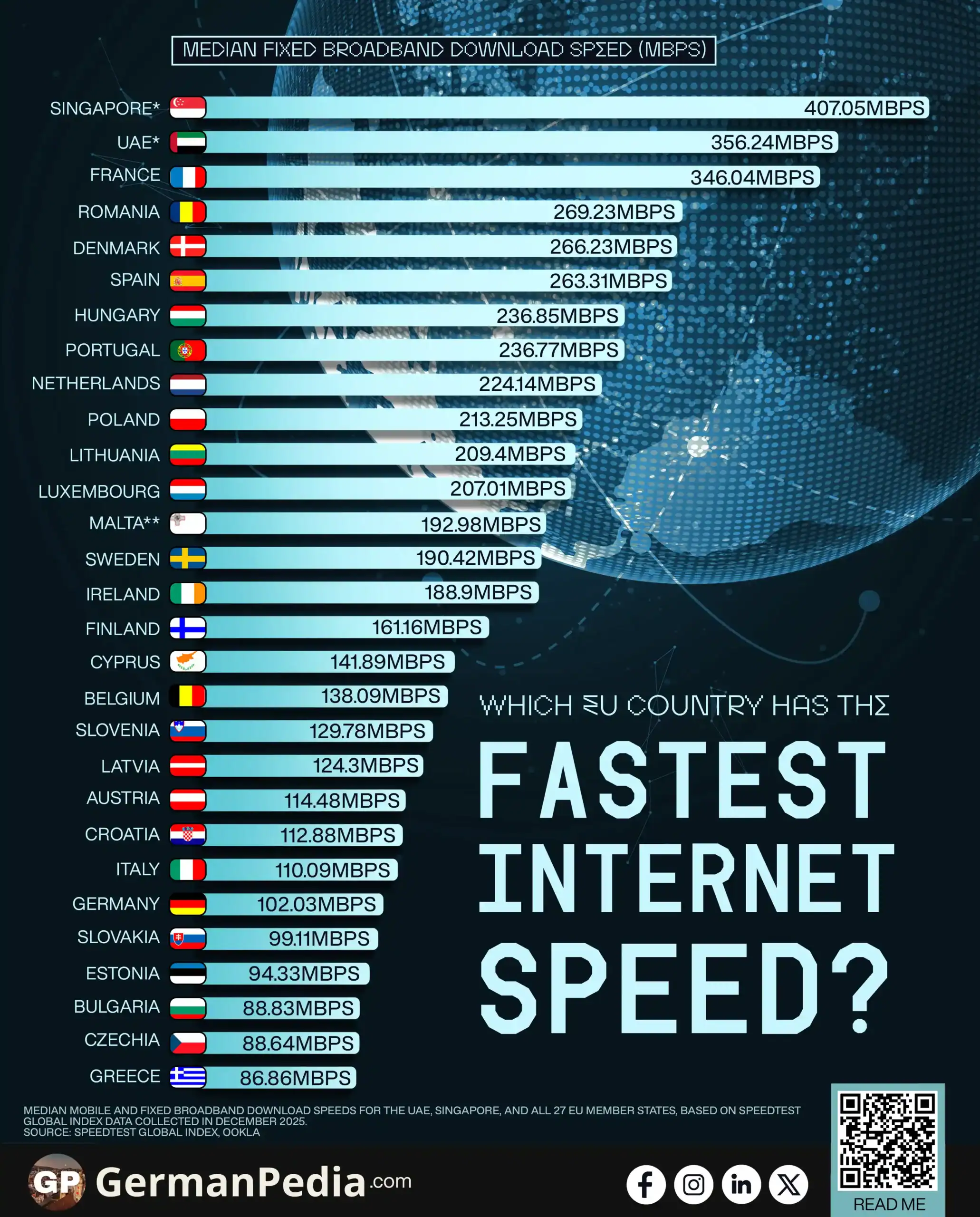
- Singapore leads the world’s fastest fixed broadband speed at 407.05 Mbps.
- Bulgaria ranks first in the EU for mobile speed at 267.37 Mbps. The EU’s Recovery and Resilience Facility put €1.6 billion into Bulgarian 5G and rural broadband networks after the pandemic.
- France has the EU’s fastest fixed broadband at 346.04 Mbps. It ranks only mid-pack on mobile speed. Fiber-optic cable now reaches about 94% of French homes and businesses.
- Germany runs the EU’s largest economy. However, its median fixed broadband speed ranks 22nd of 27 EU member states. Only 43.98% of German premises have a direct fiber connection. The EU average is 74.13%.
- Ireland records a median mobile speed of 65.94 Mbps. It is the lowest median mobile speed among EU countries.
- Across the EU, speed rankings follow network investment more than country size or wealth. Countries that rolled out fiber and 5G fastest now lead, regardless of economic size.
Use this Visualization: You may use this image for free with proper attribution to GermanPedia (i.e., by linking back to GermanPedia).
Need help communicating complex ideas visually? We help you turn data into your most persuasive story. Contact us to learn more.
Internet Speeds in the EU, the UAE, and Singapore
| Country | Median Mobile Download Speed (Mbps) | Median Fixed Broadband Download Speed (Mbps) |
|---|---|---|
| UAE* | 672.68 | 356.24 |
| Singapore* | 195.65 | 407.05 |
| Bulgaria | 267.37 | 88.83 |
| Denmark | 183.87 | 266.23 |
| Netherlands | 167.46 | 224.14 |
| Portugal | 152.22 | 236.77 |
| Luxembourg | 151.23 | 207.01 |
| Estonia | 150.05 | 94.33 |
| France | 147.49 | 346.04 |
| Slovenia | 145.55 | 129.78 |
| Finland | 142.51 | 161.16 |
| Sweden | 141.81 | 190.42 |
| Latvia | 137.34 | 124.30 |
| Greece | 135.98 | 86.86 |
| Croatia | 134.86 | 112.88 |
| Lithuania | 132.71 | 209.40 |
| Belgium | 120.28 | 138.09 |
| Austria | 115.49 | 114.48 |
| Slovakia | 111.75 | 99.11 |
| Cyprus | 110.50 | 141.89 |
| Poland | 103.08 | 213.25 |
| Czechia | 97.65 | 88.64 |
| Spain | 91.21 | 263.31 |
| Italy | 89.30 | 110.09 |
| Hungary | 86.62 | 236.85 |
| Romania | 80.10 | 269.23 |
| Germany | 76.90 | 102.03 |
| Ireland | 65.94 | 188.90 |
| Malta** | n/a | 192.98 |
Source: Speedtest Global Index, Ookla
Speeds reflect median results among users who ran tests through Ookla’s Speedtest apps and website, not a randomized, population-representative sample.
* Countries with fastest internet speeds worldwide
** = no mobile data reported by source

Internet speed is not just a matter of geography or wealth. It comes down to how much of a country’s network runs on newer technology. The UAE, the world’s fastest mobile market, shows what that investment can achieve. Some of the EU’s largest economies show what happens without it.
UAE’s Mobile Speed Is More Than 5 Times the EU Average
The UAE’s median mobile download speed reached 672.68 Mbps in December 2025. That is more than 5 times the EU27 average of 128 Mbps.
5G reaches more than 99.5% of the UAE’s populated areas. More than 23,000 network sites deliver that coverage. 5G carries far more data per second than 4G, the technology it replaces. Most EU countries have not reached that level of coverage yet.
Bulgaria Has the EU’s Fastest Mobile Internet Speed
Bulgaria records the EU’s fastest median mobile speed at 267.37 Mbps. The result traces back to Bulgaria’s Recovery and Resilience Plan. It’s an EU pandemic-recovery fund.
Bulgaria put €1.6 billion of that plan into expanding 5G and rural broadband networks. Digital investment made up 26% of Bulgaria’s entire €6.3 billion recovery plan. That share exceeds the EU’s required minimum for digital spending. A country with one of the EU’s smaller economies now outpaces Western Europe’s wealthiest states on mobile speed.
France Leads the EU on Fixed Broadband but Trails on Mobile Speed
France posts the EU’s fastest fixed broadband at 346.04 Mbps. That trails world leader Singapore’s 407.05 Mbps.
Singapore’s government began building a nationwide fiber network in 2006. Singapore also packs 5.9 million people into 730 square kilometers. That lets one fiber rollout reach nearly every address cheaply.
France’s own mobile speed of 147.49 Mbps sits closer to the EU average than the top of the ranking. The gap comes down to what the connection runs on. Fiber-optic cables carry data as pulses of light. They reach far higher speeds than copper telephone lines. Fiber now reaches about 94% of homes and businesses in France. Take-up of plans above 1 Gbps runs three times the EU average.
Germany’s Fiber Gap Holds Back Broadband Speed Despite Its Economic Size
Germany runs the EU’s largest economy. However, its median fixed broadband speed of 102.03 Mbps ranks 22nd of 27 EU member states. Its mobile speed of 76.90 Mbps ranks 25th of 27.
Germany’s limited fiber coverage explains most of the fixed broadband gap. Fiber-to-the-premises networks run fiber directly into buildings instead of stopping at a street cabinet. Only 43.98% of German premises had a direct fiber connection in 2025. The EU average was 74.13%.
Most German broadband still runs on upgraded copper lines. It’s a technology called VDSL that caps speeds well below fiber. Germany has set a target of 100% fiber coverage by 2030, matching the EU-wide goal. It currently ranks second-to-last among EU member states on fiber rollout.
The gap between the EU’s fastest and slowest connections comes down to network age. The UAE and Bulgaria built their mobile leads on aggressive 5G rollouts. France did the same with fiber. Germany, despite its economic size, has not made that switch as quickly. Closing the gap depends less on geography or population size. It depends more on how fast governments and telecom operators replace what is already in the ground.
More topics
- Broadband Prices in the EU Over Time
- Which EU Country Uses the Most Electricity?
- Which EU Country Has the Highest Cost of Living?
- Highest-Paying Ausbildung in Germany
- EU’s Senior Population is Growing
- Which Country Owns Almost a Quarter of the EU’s Wealth?
- Which EU Country Recycles the Most?
- How much parental leave do you get in the EU?
- Which EU Countries Had the Highest Inflation Rates?
- Largest Hospitals in Germany
- Road Deaths in the EU Are Highest in Romania and Bulgaria
- EU Online Shopping Splits Sharply by Age
- EU early school leavers went down to 9.1%
- Bulgaria Now Has the EU’s Highest Smoking Rate
- Germany’s Largest Banks by Assets
References
- https://www.speedtest.net/global-index#mobile
- https://tdra.gov.ae/en/media/press-release/2025/6-g
- https://reforms-investments.ec.europa.eu/recovery-and-resilience-facility-1/country-pages/bulgarias-recovery-and-resilience-plan_en
- https://en.arcep.fr/news/press-releases/view/n/fibre-deployment-in-france-281025.html
- https://digital-strategy.ec.europa.eu/en/factpages/germany-2025-digital-decade-country-report