Key Takeaways
- Malta’s tourist arrivals grew faster than any other country in this dataset between 2019 and 2025. They reached 4.02 million tourist arrivals. They increased by 46% from 2019.
- Germany and Ireland are the only two of the 26 EU countries covered where tourist arrivals remain below 2019 levels and also fell again in 2025.
- Germany’s 2025 dip partly reflects a high comparison point. Hosting the UEFA European Football Championship in 2024 drew a surge of visitors that faded the following year.
- Ireland recorded the steepest decline in the dataset. It went down by 32% since 2019. Tourist beds used to house displaced Ukrainians and asylum seekers reduced hotel capacity during the recovery years.
- Estonia’s tourist arrivals remain 16% below 2019 levels. Its direct border with Russia exposed it more to disrupted travel confidence and connectivity.
- EU tourist arrivals rose 6% overall between 2019 and 2025. Germany, Ireland, and Estonia show that recovery still depends on causes specific to each country, not just time since the pandemic.
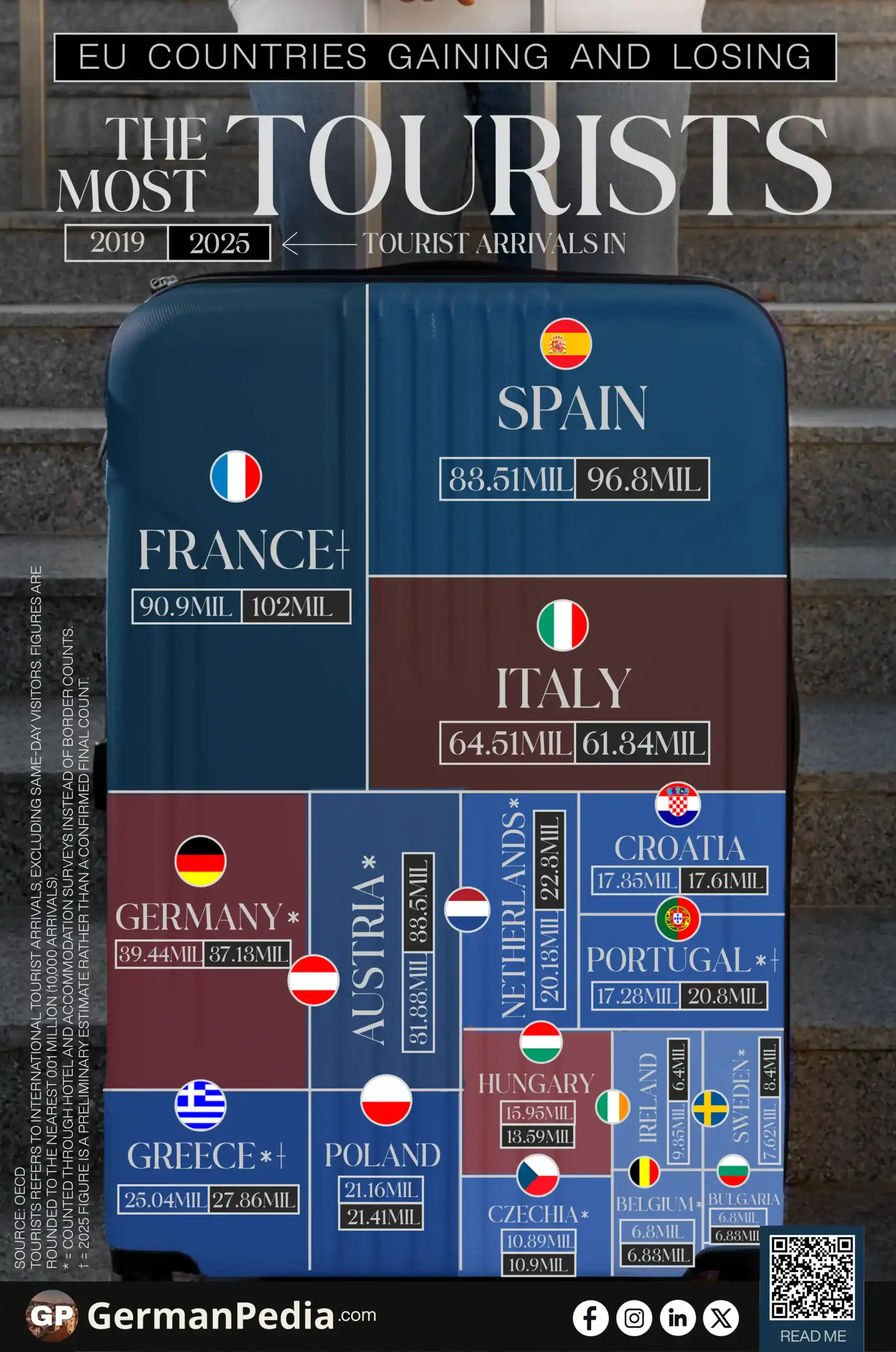
Use this Visualization: You may use this image for free with proper attribution to GermanPedia (i.e., by linking back to GermanPedia).
Need help communicating complex ideas visually? We help you turn data into your most persuasive story. Contact us to learn more.
Change in International Tourist Arrivals Across EU Countries
| Country | Tourist Arrivals | ||
|---|---|---|---|
| 2019 (In mil.) | 2025 (In mil.) | Change | |
| Malta | 2.75 | 4.02 | +46% |
| Denmark | 7.42 | 9.01 | +22% |
| Portugal*† | 17.28 | 20.78 | +20% |
| Luxembourg* | 1.19 | 1.41 | +19% |
| Spain | 83.51 | 96.80 | +16% |
| Slovenia* | 4.70 | 5.47 | +16% |
| France† | 90.90 | 102.00 | +12% |
| Netherlands* | 20.13 | 22.32 | +11% |
| Greece*† | 25.04 | 27.86 | +11% |
| Sweden* | 7.62 | 8.44 | +11% |
| Austria* | 31.88 | 33.50 | +5% |
| Finland* | 3.29 | 3.38 | +3% |
| Bulgaria | 4.07 | 4.14 | +2% |
| Croatia | 17.35 | 17.61 | +2% |
| Poland | 21.16 | 21.41 | +1% |
| Belgium* | 6.80 | 6.83 | 0% |
| Czechia* | 10.89 | 10.90 | 0% |
| Slovak Republic* | 2.48 | 2.42 | -2% |
| Romania† | 2.68 | 2.59 | -4% |
| Italy | 64.51 | 61.34 | -5% |
| Germany* | 39.44 | 37.13 | -6% |
| Latvia* | 1.95 | 1.67 | -14% |
| Hungary | 15.95 | 13.59 | -15% |
| Lithuania | 2.87 | 2.45 | -15% |
| Estonia | 3.34 | 2.80 | -16% |
| Ireland | 9.35 | 6.40 | -32% |
| EU-27 (aggregate)† | 501.24 | 529.56 | +6% |
Source: OECD
Tourists refers to international tourist arrivals, excluding same-day visitors. Figures are rounded to the nearest 0.01 million (10,000 arrivals).
* = Counted through hotel and accommodation surveys instead of border counts.
† = 2025 figure is a preliminary estimate rather than a confirmed final count.

Malta Recorded EU’s Fastest Tourist Arrival Growth
International tourism has fully rebounded across the EU on paper. International tourist arrivals across the EU’s 27 member states reached 529.6 million in 2025. That is an increase of 6% from 2019. The EU-wide average hides a split far wider than that modest gain suggests.
Malta’s tourist arrivals reached 4.02 million in 2025. They increased by 46% from 2.75 million in 2019. Among the 26 EU countries covered, it is the one where tourist arrivals grew fastest. Denmark posted the second-fastest gain among them at 22%.
Tourist spending in Malta reached €3.9 billion in 2025. That is an increase of 18.6% from the year before.
Germany and Ireland Are Still Losing Tourists
Germany and Ireland are the only two EU countries in this dataset where tourist arrivals remain below 2019 levels and kept falling in 2025. Seven other EU countries are also still below their 2019 baseline. All seven grew again in 2025.
Germany’s tourist arrivals reached 37.1 million in 2025. That is a decrease of 6% from 39.4 million in 2019. Part of that gap reflects a high comparison point. Germany hosted the UEFA European Football Championship in summer 2024. It drew a surge of foreign visitors that year. Foreign overnight stays fell 1.8% in 2025 once that boost faded.
Ireland’s tourist arrivals reached 6.40 million in 2025. That is a decrease of 32% from 9.35 million in 2019. It’s the steepest decline among the 26 countries covered. Part of that shortfall traces to reduced hotel capacity. Ireland housed Ukrainian refugees and international protection applicants in tourist accommodation during the pandemic recovery years, with roughly one in four registered tourist beds nationwide under state contract at the peak. That capacity has been returning to the market since. The shortfall from those years has not fully reversed.
Russia’s War in Ukraine Is Still Weighing on Estonia’s Tourism
Estonia’s tourist arrivals reached 2.80 million in 2025. That is a decrease of 16% from 3.34 million in 2019. This is because Russia’s invasion of Ukraine disrupted regional travel patterns.
Estonia shares a direct border with Russia. That proximity exposed it to disrupted air connectivity and dampened traveler confidence more directly than destinations farther from the conflict.
Six years past the pandemic, what separates the EU’s fastest and slowest tourism recoveries is no longer time. It’s what happened to each country in between. Malta pulled ahead for reasons the data doesn’t yet explain. Germany and Ireland fell behind for reasons that are already fading: a high comparison year and a housing shortage now easing. Estonia’s shortfall is the outlier that won’t resolve on a timeline. It ends when the war in Ukraine does.
More topics
- Most Popular EU Tourist Destinations by Overnight Stays
- Where Germany’s Tourists Come From
- Top Foreign Destinations for Germans
- Which Are the Busiest Airports in the EU?
- The Best EU Countries to Retire In
- Which EU Country Uses the Most Electricity?
- Which EU Country Has the Highest Cost of Living?
- Highest-Paying Ausbildung in Germany
- EU’s Senior Population is Growing
- Which Country Owns Almost a Quarter of the EU’s Wealth?
- Which EU Country Recycles the Most?
- How much parental leave do you get in the EU?
- Which EU Countries Had the Highest Inflation Rates?
- Largest Hospitals in Germany
- Road Deaths in the EU Are Highest in Romania and Bulgaria
References
- https://www.oecd.org/content/dam/oecd/en/publications/reports/2026/06/oecd-tourism-trends-and-policies-2026_13326fe2/3fd3cd75-en.pdf
- https://nso.gov.mt/inbound-tourism-december-2025/
- https://www.destatis.de/DE/Presse/Pressemitteilungen/2026/02/PD26_046_45412.html
- https://www.failteireland.ie/Research-Insights/Papers-Reports/June-2026-Overview-of-Temporary-Protection-(BOTP).aspx