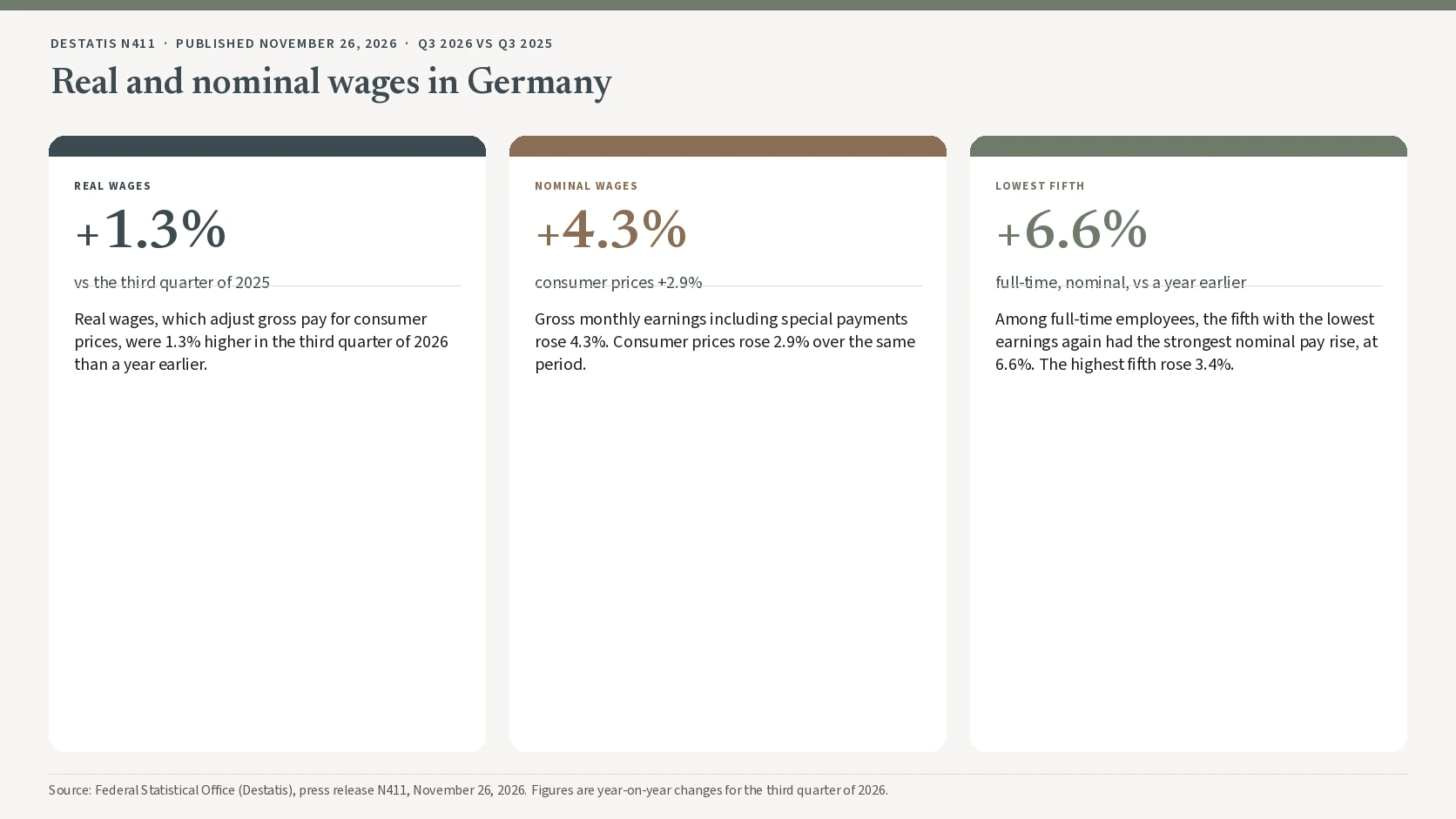
Real wages in Germany were 1.3% higher in the third quarter of 2026 than in the same quarter a year earlier, according to official figures the Federal Statistical Office (Destatis) published on November 26, 2026, in a real-wages press release. Over the same period, nominal wages rose 4.3% and consumer prices rose 2.9%.
The real-wage figure is Destatis’s measure of purchasing power. It compares the rise in gross pay with the rise in consumer prices.
Real Wages in Germany: Key Takeaways
- Real wages were 1.3% higher in the third quarter of 2026 than a year earlier, Destatis said on November 26, 2026.
- Nominal wages, meaning gross monthly earnings including special payments, rose 4.3%. Consumer prices rose 2.9%.
- Among full-time employees, the fifth with the lowest earnings again had the strongest nominal rise, at 6.6%.
- The fifth with the highest earnings saw a 3.4% nominal rise, below the economy-wide rate. Full-time employees overall rose 4.3%, the same as the economy-wide nominal figure.
- Apprentices (Auszubildende) and marginally employed people (geringfügig Beschäftigte) had a 5.6% nominal rise.
- The largest nominal increases by sector were in energy supply, at 6.7%, financial and insurance services, at 6.3%, and other business services, at 5.6%.
- Smaller nominal increases included professional, scientific and technical services, at 3.2%, other services, at 3.1%, and mining and quarrying, at 3.1%.
How Real Wages in Germany Are Measured
The nominal-wage index tracks gross monthly earnings, including special payments, for all employees. The real-wage index compares that earnings trend with consumer prices, and Destatis says it gives an indication of employees’ purchasing power in Germany.
These are average index changes, not the pay rise on one person’s salary slip. They also are not a measure of take-home pay after tax and social-security contributions.
Destatis is not currently publishing the earnings-index figures for public administration, defense and social insurance. It says methodological problems, linked to structural changes in that sector, currently limit how reliable those results are, and it points to the collectively agreed pay index (Tarifindex) as an alternative source for that sector.
Real Wages in Germany and Nominal Pay by Sector
The 1.3% real-wage rise is an economy-wide average. Destatis also reports how nominal wages changed in individual sectors compared with the third quarter of 2025:
| Sector | Nominal change vs third quarter of 2025 |
|---|---|
| Energy supply | +6.7% |
| Financial and insurance services | +6.3% |
| Other business services | +5.6% |
| Professional, scientific and technical services | +3.2% |
| Other services | +3.1% |
| Mining and quarrying | +3.1% |
These sector figures are the ones Destatis highlights in the release as above-average or comparatively small. They are nominal changes, not real-wage rates for each sector.
Who Gained Most as Real Wages in Germany Rose
Among full-time employees, Destatis groups people by earnings. The fifth with the lowest earnings (the first quintile) had an average nominal rise of 6.6% from a year earlier, again the strongest increase in that comparison.
Full-time employees overall saw a 4.3% nominal rise, the same as the economy-wide nominal-wage figure. The fifth with the highest earnings (the fifth quintile) had a 3.4% rise, below that overall rate.
Apprentices and marginally employed people also had an above-average nominal rise, at 5.6%. Marginally employed work includes minijobs, which we explain in our guide to the minijob rules in 2027.
The stronger rise at the bottom of the full-time pay scale is a change in average earnings, not a new statutory rate. The statutory minimum wage is set separately, and it is due to rise to €14.60 an hour on January 1, 2027, as we set out in Minimum Wage Rises to €14.60 and Minijob Limit to €633 in 2027.
What Real Wages in Germany Mean for Employees
If you work in Germany, this release says that, on average, gross pay including special payments rose faster than consumer prices in the third quarter of 2026. That is why Destatis reports a 1.3% rise in real wages, or purchasing power.
Your own change in pay can differ widely from that average. It depends on your sector, whether you work full time, and whether special payments were higher or lower than a year earlier.
For how typical pay differs by state, see our guide to Germany’s median wage by federal state.
Sources
- Federal Statistical Office (Destatis), press release N411, “Reallöhne im 3. Quartal 2026 um 1,3 % höher als im Vorjahresquartal,” November 26, 2026: destatis.de. All wage and price changes in this article, the sector comparisons, the full-time earnings-group figures, the figure for apprentices and marginally employed people, the explanation of the nominal-wage and real-wage indices, and the note on public administration, defense and social insurance are taken from that official release. No English version of the release was published.
- Destatis notes that further background and time series are available on its real wages and nominal wages theme page and in GENESIS-Online tables 62361. The statutory minimum-wage rate mentioned above is not from N411; it is from our earlier guide, which is based on official 2027 minimum-wage rules.