
Key takeaways
- The national median monthly wage in Germany is €4,013, with West Germany at €4,117 and East Germany at €3,539.
- Hamburg has the highest median monthly wage in Germany at €4,527. Mecklenburg-Vorpommern has the lowest at €3,294.
- Higher wages are concentrated in German states (e.g., Hamburg, Baden-Württemberg, and Hessen) with strong export industries, financial services, and corporate headquarters.
- Economic size alone does not determine pay levels. Nordrhein-Westfalen has the largest workforce, but it only slightly exceeds the national median wage.
- The East–West wage gap reflects long-term structural differences in industry concentration, capital distribution, and headquarters presence.
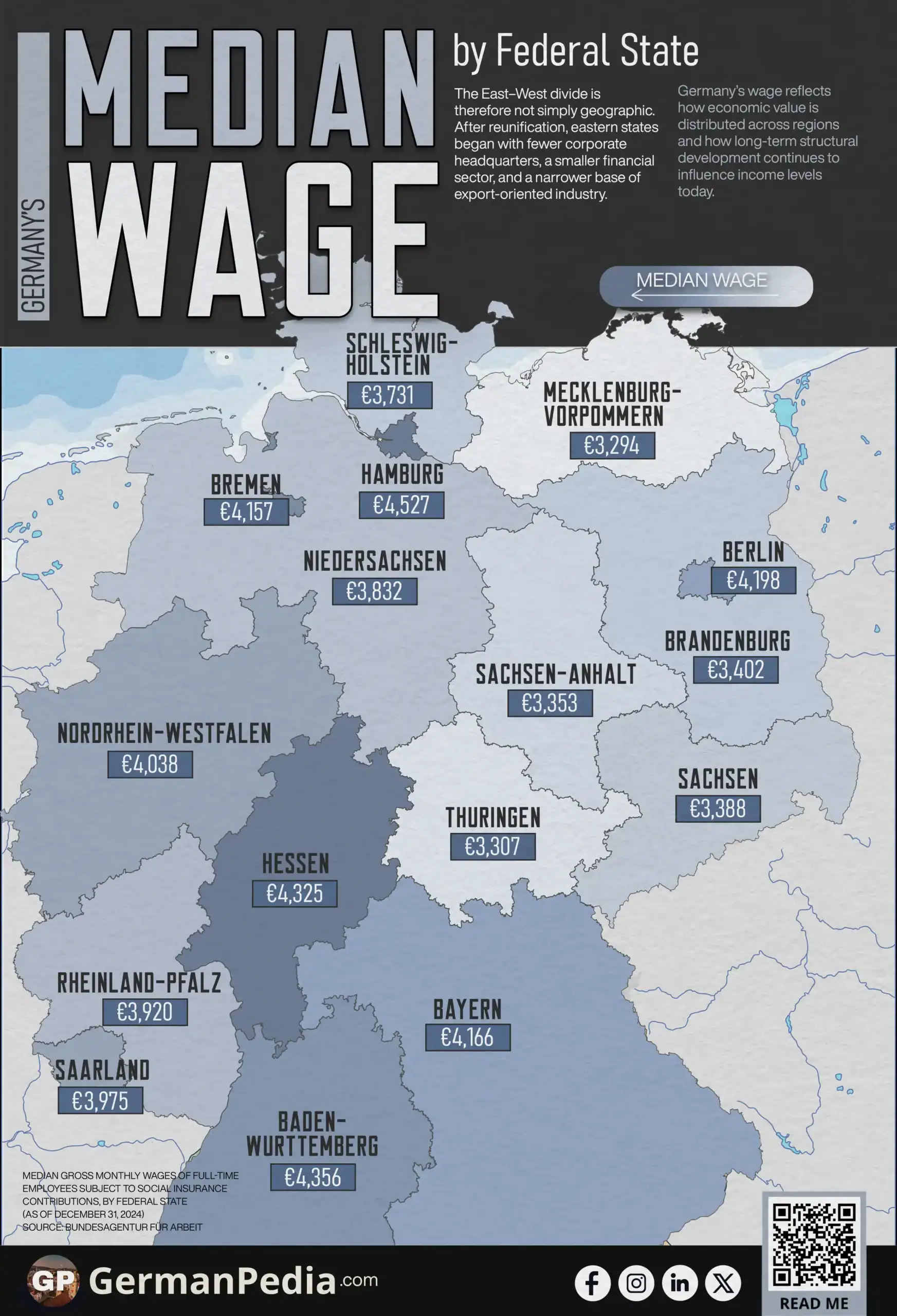
Use this Visualization: You may use this image for free with proper attribution to GermanPedia (i.e., by linking back to GermanPedia).
Need help communicating complex ideas visually? We help you turn data into your most persuasive story. Contact us to learn more.
Germany had 21.9 million full-time employees subject to social insurance contributions. In December 2024, their national median gross monthly wage was €4,013.
Across the federal states, the median wage varies.
Median Monthly Wage by Federal State
| Rank | Federal State | Total Employees (In thousands) | Median Monthly Wage (In €) |
|---|---|---|---|
| 1 | Hamburg | 702 | 4,527 |
| 2 | Baden-Württemberg | 3,192 | 4,356 |
| 3 | Hessen | 1,765 | 4,325 |
| 4 | Berlin | 1,019 | 4,198 |
| 5 | Bayern | 3,796 | 4,166 |
| 6 | Bremen | 213 | 4,157 |
| 7 | Nordrhein-Westfalen | 4,639 | 4,038 |
| 8 | Saarland | 248 | 3,975 |
| 9 | Rheinland-Pfalz | 917 | 3,920 |
| 10 | Niedersachsen | 1,915 | 3,832 |
| 11 | Schleswig-Holstein | 620 | 3,731 |
| 12 | Brandenburg | 531 | 3,402 |
| 13 | Sachsen | 972 | 3,388 |
| 14 | Sachsen-Anhalt | 486 | 3,353 |
| 15 | Thüringen | 499 | 3,307 |
| 16 | Mecklenburg-Vorpommern | 345 | 3,294 |
Source: Bundesagentur für Arbeit

Hamburg has the highest median wage among all federal states at €4,527. The city-state combines a strong logistics sector, media industries, aviation, and a high concentration of corporate headquarters. These sectors generate high economic value per worker, which supports higher wages.
Highest Paying Jobs in Germany ->
Close behind are two southern financial powerhouses. Baden-Württemberg (€4,356) owes its position to a high-value manufacturing base in automotive, engineering, and export-oriented industries. Meanwhile, Hessen (€4,325) benefits from Frankfurt’s role as Germany’s financial centre, where banking, insurance, and business services are concentrated.
These states share a common feature: high productivity and capital concentration. Wage levels rise where advanced manufacturing, finance, and headquarters functions cluster.
Beyond them, a second group clusters between €4,000 and €4,200:
- Berlin (€4,198)
- Bayern (€4,166)
- Bremen (€4,157)
- Nordrhein-Westfalen (€4,038)
Nordrhein-Westfalen is particularly notable. It has the largest workforce in Germany, yet its median wage is only slightly above the national median.
This shows that economic scale alone does not determine wages. What matters more is how much of the economy is concentrated in high-value sectors.
Unicorn Startups in Germany ->
At the lower end of the ranking are Brandenburg (€3,402), Sachsen (€3,388), Sachsen-Anhalt (€3,353), Thüringen (€3,307), and Mecklenburg-Vorpommern (€3,294). All five are eastern states.
This brings the broader picture into focus. The median wage in West Germany is €4,117. In East Germany, it is €3,539. That’s a difference of €578 per month, or around 14%.
The East–West divide is therefore not simply geographic. It reflects economic structures that developed over decades. After reunification, eastern states began with fewer corporate headquarters, a smaller financial sector, and a narrower base of export-oriented industry. These differences shaped how capital and high-paying sectors were distributed.
Although convergence has taken place over time, the concentration of high-value industries remains stronger in many Western states.
The ranking reflects this structure. Wage levels are higher where finance, advanced services, and export manufacturing are concentrated. Meanwhile, wage levels are lower in states where those sectors are less developed.
Germany’s wage map is therefore not random. It reflects how economic value is distributed across regions and how long-term structural development continues to influence income levels today.
More topics
- Top 25 Richest People in Germany (2025)
- Germany’s Smoking Rate Has Declined Over Two Decades
- Germany’s Electricity Mix: From Coal to Renewables
- Changes in Harvest of Germany’s Five Key Crops
- Top German Companies by Revenue
- Germany’s Top Car Brands by New Registrations
- Unemployment Across Germany: A Federal State Breakdown
- Where Germany’s Tourists Come From
- Germany’s Largest National Parks, Ranked by Size
- Which Federal States Drive Germany’s Economy?
- Here’s Why Divorces in Germany Are Falling
- Germans Are Marrying Later Than Ever
- How Marriage Rates Have Fallen in Germany: 1990–2023
- How Germany’s Birth Rates Dropped and Deaths Rose
- Leading Causes of Death in Germany
References
- https://statistik.arbeitsagentur.de/SiteGlobals/Forms/Suche/Einzelheftsuche_Formular.html?nn=21424&topic_f=beschaeftigung-entgelt-entgelt
- https://hamburg-business.com/en/why-hamburg/top-facts-hamburg
- https://wm.baden-wuerttemberg.de/fileadmin/redaktion/m-wm/intern/Publikationen/Wirtschaftsstandort/Wirtschaftsdaten2024_eng.pdf
- https://www.dw.com/en/german-unity-eastern-states-still-lag-economically-but-catching-up-report-says/a-58187437