
Key Takeaways
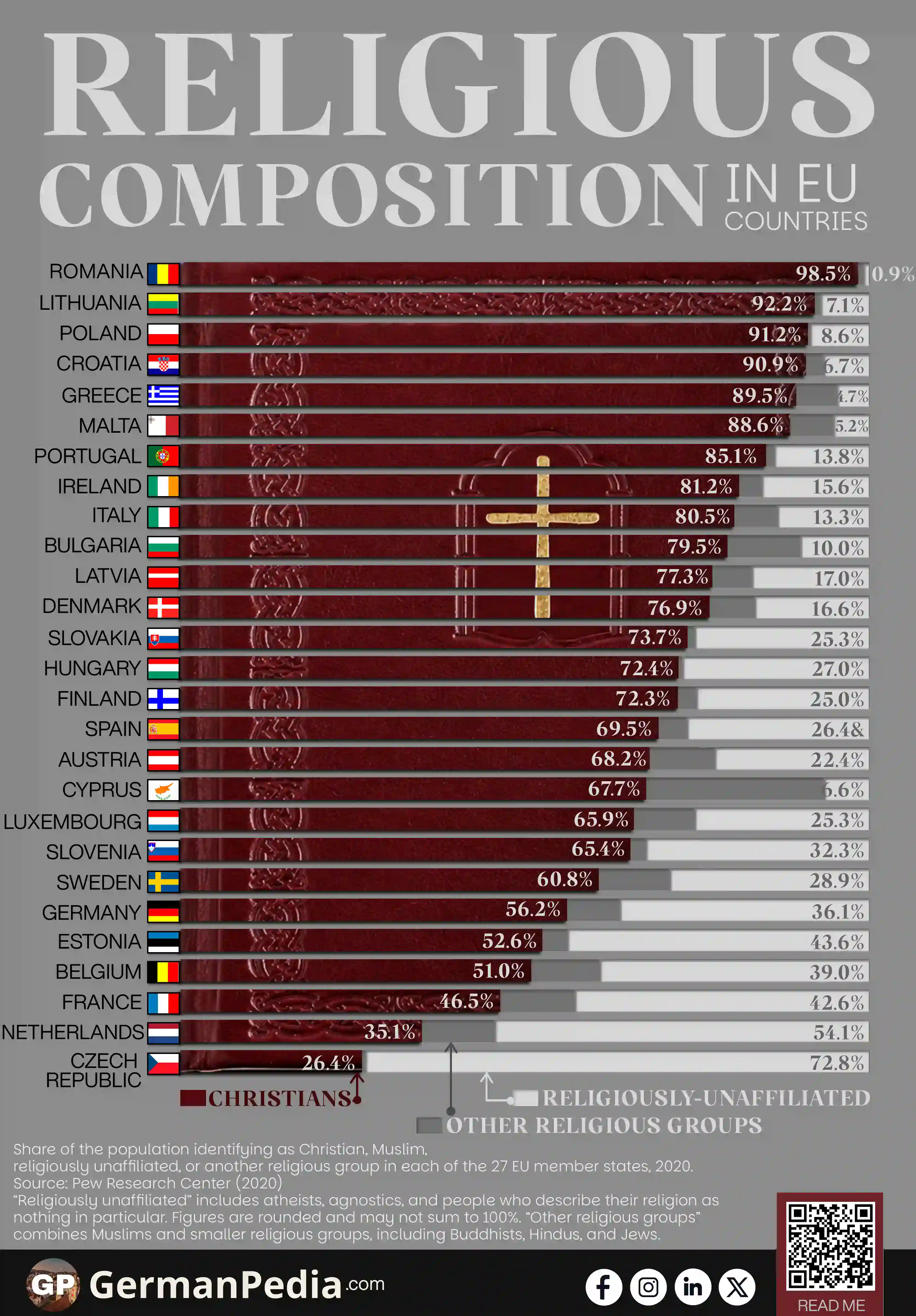
- Christianity is the largest religious group in 25 of the EU’s 27 countries in 2020.
- Czechia and the Netherlands are the EU’s only religiously unaffiliated-majority countries. The group’s share ranges from 54.1% in the Netherlands to 72.8% in Czechia.
- France has the narrowest gap between its Christian and religiously unaffiliated shares of any EU country. Christians lead the unaffiliated by just 3.8 percentage points there.
- Estonia’s religiously unaffiliated share climbed 12.1 percentage points from 2010 to 2020. No other EU country recorded a bigger increase.
- Cyprus has the EU’s highest Muslim population share, at 24.4%.
- Religious switching drives the EU’s growing unaffiliated population.
Use this Visualization: You may use this image for free with proper attribution to GermanPedia (i.e., by linking back to GermanPedia).
Need help communicating complex ideas visually? We help you turn data into your most persuasive story. Contact us to learn more.
Religious Group Composition in Each EU Country
| Country | Share out of the population (In %) | Largest group | |||
|---|---|---|---|---|---|
| Christians | Muslim | Unaffiliated | Other religions | ||
| Romania | 98.5 | 0.4 | 0.9 | 0.2 | Christian |
| Lithuania | 92.2 | <0.1 | 7.1 | 0.7 | Christian |
| Poland | 91.2 | <0.1 | 8.6 | 0.2 | Christian |
| Croatia | 90.9 | 1.4 | 6.7 | 1.0 | Christian |
| Greece | 89.5 | 5.1 | 4.7 | 0.7 | Christian |
| Malta | 88.6 | 3.6 | 5.2 | 2.6 | Christian |
| Portugal | 85.1 | 0.4 | 13.8 | 0.7 | Christian |
| Ireland | 81.2 | 1.7 | 15.6 | 1.5 | Christian |
| Italy | 80.5 | 4.4 | 13.3 | 1.8 | Christian |
| Bulgaria | 79.5 | 10.3 | 10.0 | 0.2 | Christian |
| Latvia | 77.3 | 0.7 | 17.0 | 5.0 | Christian |
| Denmark | 76.9 | 4.2 | 16.6 | 2.3 | Christian |
| Slovakia | 73.7 | <0.1 | 25.3 | 1.0 | Christian |
| Hungary | 72.4 | 0.1 | 27.0 | 0.5 | Christian |
| Finland | 72.3 | 1.6 | 25.0 | 1.1 | Christian |
| Spain | 69.5 | 3.6 | 26.4 | 0.5 | Christian |
| Austria | 68.2 | 8.3 | 22.4 | 1.1 | Christian |
| Cyprus | 67.7 | 24.4 | 6.6 | 1.3 | Christian |
| Luxembourg | 65.9 | 1.8 | 25.3 | 7.0 | Christian |
| Slovenia | 65.4 | 1.6 | 32.3 | 0.7 | Christian |
| Sweden | 60.8 | 8.1 | 28.9 | 2.2 | Christian |
| Germany | 56.2 | 6.5 | 36.1 | 1.2 | Christian |
| Estonia | 52.6 | 0.6 | 43.6 | 3.2 | Christian |
| Belgium | 51.0 | 6.8 | 39.0 | 3.2 | Christian |
| France | 46.5 | 9.1 | 42.6 | 1.8 | Christian |
| Netherlands | 35.1 | 5.5 | 54.1 | 5.3 | Unaffiliated |
| Czech Republic | 26.4 | 0.3 | 72.8 | 0.5 | Unaffiliated |
Source: Pew Research Center (2020)
“Religiously unaffiliated” includes atheists, agnostics, and people who describe their religion as nothing in particular.
*“Other religions” includes Buddhists, Hindus, Jews, and other smaller religious groups.
Figures are rounded and may not sum to 100%.

Christianity Is Still the Largest Religious Group in 25 of 27 EU Countries
Christianity remains the largest religious group in 25 of the European Union’s 27 countries in 2020.
Romania recorded the EU’s highest Christian share. It reached 98.5% of the country’s population.
Religious practice across Eastern Europe was suppressed for decades under communism. Affiliation rebounded sharply once those restrictions were lifted after 1989.
The same post-communist revival appears in Lithuania and Poland too. Both recorded Christian shares above 91% in 2020.
Romania’s dominant tradition is Orthodox Christianity. Lithuania and Poland are majority Catholic instead. Orthodox identity is especially tightly bound to national identity across Orthodox-majority countries.
However, Christianity’s lead narrows sharply toward Western Europe.
Germany’s Christian share fell to 56.2% in 2020. That was down from 62.2% in 2010.
Religious switching drives most of Germany’s decline. Alienation from the church, church tax obligations, and disagreement with its political and ethical positions are the most cited reasons. The church abuse scandal has reinforced those motivations since 2010.
Belgium shows the same decline. Its Christian share fell even further, from 61.1% to 51.0%.
Belgium’s Christian decline traces back to the collapse of its “pillarized” social structure. Pillarization split society into Catholic, socialist, and liberal blocs, each with its own institutions. That system began breaking down in the 1960s.
Belgium’s 51.0% share is the lowest Christian majority in the EU.
Czechia and the Netherlands Are the EU’s Only Religiously Unaffiliated-Majority Countries
The religiously unaffiliated outnumber Christians in Czechia and the Netherlands.
Czechia recorded a religiously unaffiliated share of 72.8% in 2020.
Christians made up just 26.4% of Czechia’s population in 2020. Its religiously unaffiliated share already stood at 68.5% in 2010.
Czechia’s secularization predates communism by centuries. It traces back to a 15th-century split from the Catholic Church.
Anticlericalism surged again after Czech independence in 1918, cutting Catholic affiliation by an estimated 1.5 million people.
Gradual drifting from religion explains why the decline continued after 2010. Among Czechs who left their childhood faith, several reasons stand out:
- 82% cite a slow fade rather than a single break
- Distrust in religious authorities follows at 49%
- Disbelief in religious teachings trails at 45%
The Netherlands’ religiously unaffiliated share stood at 45.5% in 2010, just short of a majority. A cultural shift in the 1960s drew the Netherlands away from its traditional religious communities.
The religiously unaffiliated share passed 50% by 2020. It reached 54.1%.
Catholic disaffiliation was the main driver of the Netherlands’ religiously unaffiliated increase. It fell from 27% to 19.8% of the population from 2010 to 2020. Catholic affiliation fell twice as fast as Protestant affiliation over the same span.
The Netherlands became the EU’s second religiously unaffiliated-majority country after Czechia.
France Has the EU’s Narrowest Gap Between Christians and the Religiously Unaffiliated
France’s Christian share leads its religiously unaffiliated share by just 3.8 percentage points. That is the narrowest gap between Christians and the religiously unaffiliated in any EU country.
France’s Christian share dropped from 57.1% to 46.5% between 2010 and 2020. Meanwhile, France’s religiously unaffiliated share rose from 34.5% to 42.6%.
Catholic disaffiliation drives both France’s Christian decline and its religiously unaffiliated rise. In France, 26% of all adults were raised Catholic and later left. Yet, just 2% of all adults joined Catholicism without being raised in it.
Estonia recorded the EU’s largest increase in the share of the religiously unaffiliated from 2010 to 2020. It rose 12.1 percentage points.
Christians still hold a majority in Estonia. Their share stood at 52.6% in 2020.
The religiously unaffiliated made up 43.6% of Estonia’s population in 2020. That leaves a 9.0-point gap between Estonia’s Christian and religiously unaffiliated shares. It is the second-narrowest in the EU after France.
Soviet occupation suppressed religious life in Estonia from 1940 to 1991. A brief revival followed independence. It stalled almost immediately. No Estonian church has drawn sustained public commitment since.
Islam Is the EU’s Third-Largest Religious Group in Most Countries
Islam is the third-largest religious group in most EU countries. It ranks behind Christianity and the religiously unaffiliated.
Regular migration and refugee arrivals accounted for most of Europe’s Muslim population growth between 2010 and 2016. Higher fertility rates among Muslim residents added to that growth.
Cyprus and Bulgaria are the only two EU countries with a Muslim share above 10%.
- Cyprus records the EU’s highest Muslim share, at 24.4% of the population.
- Bulgaria’s Muslim share follows at 10.3%.
France, Germany, Belgium, Austria, and Sweden all report Muslim shares above 6%. These are the highest Muslim concentrations in Western Europe.
Other religions make up a small share of the EU’s population overall. This category includes Buddhists, Hindus, Jews, and other smaller religious groups.
The EU’s religious landscape doesn’t split neatly along an East-West line. What actually separates these countries is each one’s own history with religious authority, not its location. That history decided whether the end of communism brought a revival or found a population that had already moved on.
More topics
- What Are Germany’s Top 10 Imports?
- Which EU Countries Have the Highest Theft Rates?
- EU Countries With The Cleanest Swimming Water
- Top 10 Highest Mountains in the EU
- Top Films in Germany Are Still Mostly Hollywood Hits
- Countries Driving Germany’s Quarter Trillion Export Surplus
- Which Countries Does Germany Import From Most?
- Germany’s Top 10 Exported Goods
- Germany’s Top Export Partners: Where €1.55 Trillion in Goods Go
- Which EU Countries Export the Most Food?
- EU Relies on Imports for Natural Gas
- EU Household Expenditure on Food and Non-Alcoholic Beverages
- EU Countries Are Only Partly Self-Sufficient in Food
- Leading EU Exporters and Importers of Digitally Delivered Services
- US Oil Exports to the EU Are Highly Concentrated
References
- https://www.pewresearch.org/religion/feature/religious-composition-by-country-2010-2020/
- https://www.pewresearch.org/religion/2025/06/09/religion-in-europe/
- https://ispmn.gov.ro/uploads/466.pdf
- https://www.pewresearch.org/religion/2017/05/10/religious-belief-and-national-belonging-in-central-and-eastern-europe/
- https://www.pewresearch.org/religion/2017/05/10/religious-affiliation/
- https://link.springer.com/article/10.1023/A:1006973011455
- https://www.cbs.nl/en-gb/news/2022/51/almost-6-in-10-dutch-people-do-not-have-a-religious-affiliation
- https://www.pewresearch.org/short-reads/2026/04/23/catholicism-has-lost-people-to-religious-switching-in-many-countries-while-protestantism-has-gained-in-some/
- https://www.strasbourgconsortium.org/content/blurb/files/Estonia.pdf
- https://www.bundestag.de/resource/blob/849332/1c9bf52929edaeb238b6f3b46065cdf2/WD-1-008-21-pdf-data.pdf
- https://academic.oup.com/socrel/article-abstract/51/Special_Issue/S1/1631766
- https://www.pewresearch.org/religion/2017/11/29/europes-growing-muslim-population/
- https://academic.oup.com/jcs/article-abstract/59/4/649/2669491