Key Takeaways
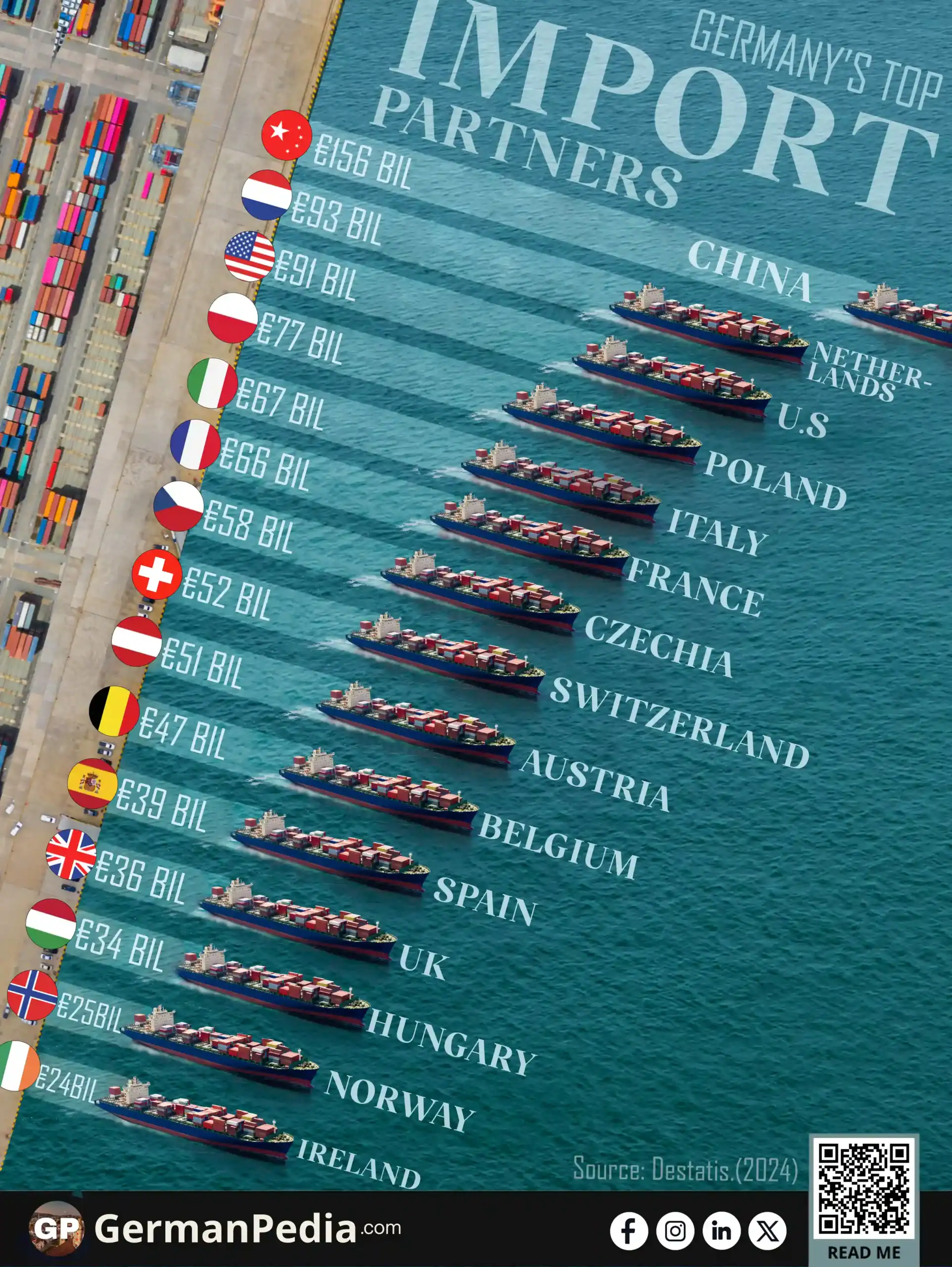
- China is Germany’s largest import partner, supplying nearly €157 billion in goods and playing a central role in industrial supply chains.
- Germany’s imports are highly concentrated within Europe, reflecting deep regional integration and cross-border production networks.
- Beyond Europe and China, Germany maintains key strategic ties, particularly with the United States and select non-EU partners, to support critical sectors such as industrial goods, pharmaceuticals, and energy.
Use this Visualization: You may use this image for free with proper attribution to GermanPedia (i.e., by linking back to GermanPedia).
Need help communicating complex ideas visually? We help you turn data into your most persuasive story. Contact us to learn more.
Germany’s Largest Import Partners
| Rank | Import Partners | Import Value (In € bn.) |
|---|---|---|
| 1 | China | 156.8 |
| 2 | Netherlands | 93.0 |
| 3 | United States | 91.8 |
| 4 | Poland | 77.3 |
| 5 | Italy | 67.2 |
| 6 | France | 66.9 |
| 7 | Czechia | 58.8 |
| 8 | Switzerland | 52.6 |
| 9 | Austria | 52.0 |
| 10 | Belgium | 47.5 |
| 11 | Spain | 39.5 |
| 12 | United Kingdom | 36.2 |
| 13 | Hungary | 34.3 |
| 14 | Norway | 25.8 |
| 15 | Ireland | 24.4 |
Source: Destatis.

China sits clearly at the top of Germany’s import list, with goods worth almost €157 billion entering the country.
This reflects China’s central role as a supplier of industrial intermediate goods, electronics, machinery, and consumer products into German and global manufacturing chains.
European neighbours and integrated supply chains
Look past China, and you’ll see Germany doing most of its business with neighbors. The Netherlands, Poland, Italy, France, and Czechia fill out the top spots. This reflects how tightly woven European supply chains have become, especially in the automotive, machinery, and chemicals sectors within the EU single market.
The Netherlands’ position is especially striking. It functions not only as an export partner but also as a logistics gateway. Many goods destined for Germany actually arrive through Dutch ports like Rotterdam before being recorded statistically as imports from the Netherlands.
Transatlantic and non‑EU import partners
The United States ranks third among Germany’s import partners, underlining the strength of transatlantic trade in high‑value sectors like machinery, vehicles, pharmaceuticals, and other technology‑related goods.
Several European countries outside the EU also play crucial roles:
- Switzerland is an important source of pharmaceuticals and chemicals
- Norway is a key supplier of natural gas and other energy products
- The UK remains a steady source of both industrial and consumer goods despite its exit from the EU
More topics
- Countries Driving Germany’s Quarter Trillion Export Surplus
- Germany’s Top Export Partners: Where €1.55 Trillion in Goods Go
- Top 25 Richest People in Germany (2025)
- Germany’s Smoking Rate Has Declined Over Two Decades
- Germany’s Electricity Mix: From Coal to Renewables
- Changes in Harvest of Germany’s Five Key Crops
- Top German Companies by Revenue
- Germany’s Top Car Brands by New Registrations
- Unemployment Across Germany: A Federal State Breakdown
- Where Germany’s Tourists Come From
- Germany’s Largest National Parks, Ranked by Size
- Which Federal States Drive Germany’s Economy?
- Divorces in Germany Are Falling
- Germans Are Marrying Later Than Ever
- How Marriage Rates Have Fallen in Germany: 1990–2023
References
- https://www.destatis.de/EN/Themes/Economy/Foreign-Trade/Tables/order-rank-germany-trading-partners.pdf?__blob=publicationFile&v=73
- https://sgc.frankfurt-school.de/wp-content/uploads/2023/09/Germany-import-dependency-from-China-September-2023.pdfhttps://santandertrade.com/en/portal/analyse-markets/germany/foreign-trade-in-figures