
Key Takeaways
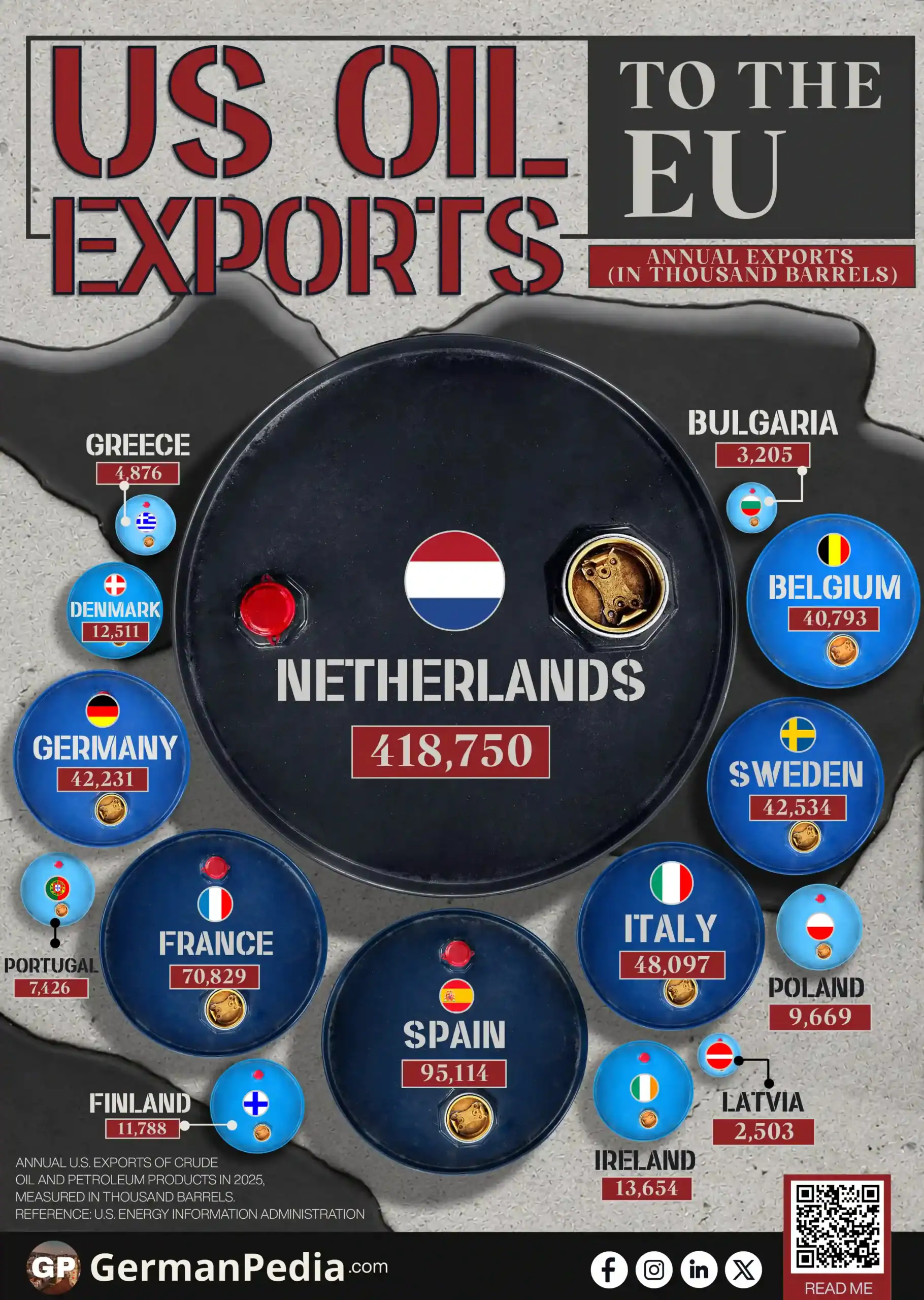
- The EU imported 845 million barrels of crude oil and petroleum products from the US in 2025, which is equal to 21.6% of its total exports.
- The Netherlands is the top buyer, importing about 419 million barrels (10.7%), reflecting its role as a hub for imports and exports rather than final consumption.
- Crude oil entering the Netherlands is often refined into petroleum products such as gasoline and diesel, then redistributed to other EU countries. The Port of Rotterdam enables this system as one of the largest oil trading and refinery centers.
- Other countries, such as Germany, Italy, and Spain, have significant refining capacity but smaller direct imports.
- The petroleum exports ranking reflects trade flows, not actual oil consumption across the EU.
Use this Visualization: You may use this image for free with proper attribution to GermanPedia (i.e., by linking back to GermanPedia).
Need help communicating complex ideas visually? We help you turn data into your most persuasive story. Contact us to learn more.
EU crude oil and petroleum products imports from the US
| Country | Annual Exports (In thousand barrels) |
|---|---|
| Netherlands | 418,750 |
| Spain | 95,114 |
| France | 70,829 |
| Italy | 48,097 |
| Sweden | 42,534 |
| Germany | 42,231 |
| Belgium | 40,793 |
| Ireland | 13,654 |
| Denmark | 12,511 |
| Finland | 11,788 |
| Poland | 9,669 |
| Portugal | 7,426 |
| Greece | 4,876 |
| Bulgaria | 3,205 |
| Latvia | 2,503 |
| Lithuania | 1,267 |
| Slovenia | 1,065 |
| Austria | 581 |
| Cyprus | 466 |
| Malta | 281 |
| Romania | 195 |
| Croatia | 169 |
| Hungary | 5 |
| Czechia | 3 |
| Estonia | 0 |
| Luxembourg | 0 |
| Slovakia | — |
Reference: U.S. Energy Information Administration

The European Union is one of the main destinations for US oil exports.
In 2025, EU countries imported over 845 million barrels of crude oil and petroleum products. This makes up 21.6% of total US exports, or roughly one in five barrels exported.
This level of oil imports reflects how Europe’s energy system adjusted after the invasion of Ukraine in 2022. As Russian supply declined, refineries across Europe needed replacement crude, and American crude oil became a key source for the EU market.
At first glance, the petroleum exports ranking across EU countries looks highly uneven. The Netherlands stands out as one of the top buyers of U.S. crude, importing over 418 million barrels in 2025. This accounts for 10.7% of total U.S. crude oil and petroleum product exports, far more than any other EU importer.
However, this does not mean the Netherlands consumes the most oil. It reflects its role as a major European oil hub within the region’s import and export system.
A large share of imported crude oil is either processed domestically or moves through the Netherlands in a processing chain.
- Crude oil is imported into the Netherlands
- It is refined into petroleum products such as gasoline and diesel
- Refined fuels are exported to other EU countries
Refining is not limited to the Netherlands. Large economies such as Germany, Italy, and Spain account for a significant share of the EU’s refining capacity.
However, the Netherlands remains the main entry and distribution point for US crude oil and petroleum products into the EU. This helps explain why its import volumes appear so high compared with other EU countries.
The key factor behind this role is the Port of Rotterdam. It is one of the largest oil trading and refinery centers in global markets, where crude is stored, refined, and redistributed across Europe through pipelines and other shipping routes.
This system explains why many countries show small shares in the oil exports data. Many countries import refined petroleum products rather than crude oil directly.
The pattern is therefore not just about consumption, but about how oil moves through the EU. Imports are concentrated at major entry hubs, while demand is spread across many countries.
More topics
- EU Relies on Imports for Natural Gas
- Petrol Prices Are Rising Across the EU
- EU Countries Are Only Partly Self-Sufficient in Food
- Public School Primary Teacher Salaries in the EU
- Internet Freedom in the EU Is High but Shaped by National Rules
- EU Wage Growth In The Last Two Decades
- Adoption of Electric and Hybrid Passenger Cars in the EU
- Net Household Saving Rates in the EU Over Time
- Countries Driving Germany’s Quarter Trillion Export Surplus
- Fuel Price Changes in Germany Amid US-Iran Tensions
- Where are Data Centers Concentrated in the EU?
- Most Surveilled Major Cities in the EU
- Germany’s Home Prices Rise 13.8% as Growth Shifts Region
- Homeownership Rate in the EU
- GDP per Capita vs Actual Consumption per Capita in the EU
References
- https://www.eia.gov/dnav/pet/pet_move_expc_a_EP00_EEX_mbbl_m.htm
- https://usafacts.org/articles/is-the-us-a-bigger-oil-importer-or-exporter/?utm_content=%5Bsection_1%5D_%5Bimage%5D&utm_source=USAFacts_Klaviyo&utm_medium=email&utm_campaign=3_2_26_Flagship_expedited%20removal%20and%20tariffs&_kx=zmQFAuAA3kuaq_c9Fve-yj4YarVK4zUfMFMpfUfBSAKxmw5S_7nkpi5b5VWrUFaG.SH8aQb
- https://www.eia.gov/todayinenergy/detail.php?id=64964
- https://www.cbs.nl/en-gb/news/2025/20/imports-from-us-are-mainly-oil-gas-and-services
- https://www.hydrocarbonengineering.com/refining/30082018/germany-italy-spain-contribute-more-than-35-percent-european-refining-capacity/
- https://www.portofrotterdam.com/en/logistics/cargo/liquid-bulk/crude-oil
- https://ec.europa.eu/eurostat/web/products-eurostat-news/w/ddn-20251219-2