Key Takeaways
- Germany recorded an overall foreign trade surplus of approximately €243 billion in 2024.
- Germany’s largest trade surpluses are concentrated among advanced economies that serve as key export markets. The list is led by the United States.
- European countries dominate the surplus side. It reflects geographic proximity, shared EU rules, and integrated supply chains.
- Germany’s largest trade deficits are concentrated among countries that act as supplier economies rather than primary export destinations.
- China accounts for Germany’s largest bilateral trade deficit. It is a reflection of its role as a major source of manufactured goods and intermediate inputs.
- Surplus and deficit patterns highlight how Germany balances export-driven growth with reliance on key international suppliers.
Use this Visualization: You may use this image for free with proper attribution to GermanPedia (i.e., by linking back to GermanPedia).
Need help communicating complex ideas visually? We help you turn data into your most persuasive story. Contact us to learn more.
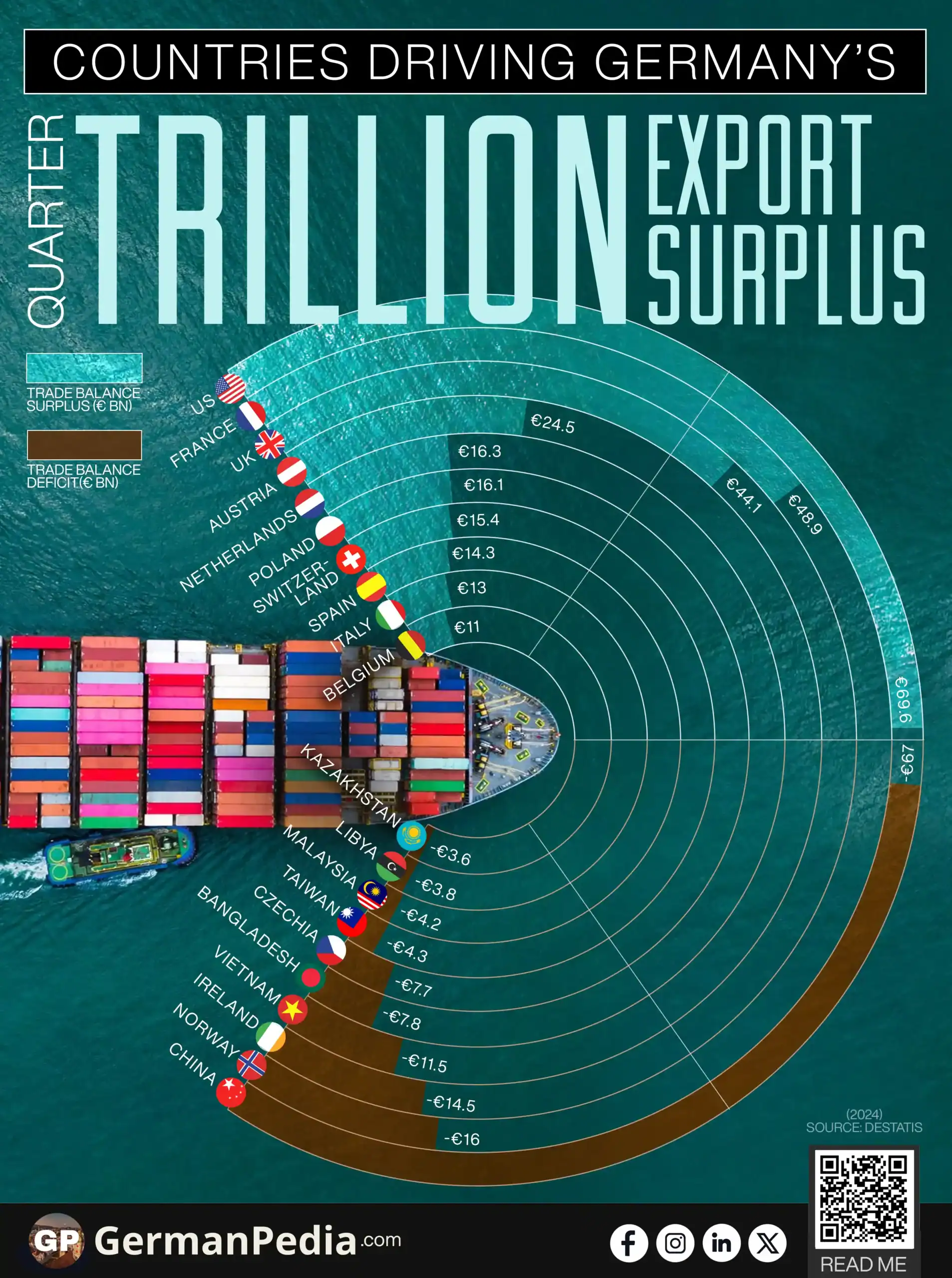
Germany recorded a positive overall foreign trade balance of approximately €243 billion in 2024. While Germany exports and imports goods worldwide, its bilateral trade balances vary widely by partner country. This reflects the different roles they play in the economy.
Countries Where Germany’s Trade Surplus Is Highest
| Rank | Partner Country | Trade Balance (€ bn) |
|---|---|---|
| 1 | United States | +69.6 |
| 2 | France | +48.9 |
| 3 | United Kingdom | +44.1 |
| 4 | Austria | +24.5 |
| 5 | Netherlands | +16.3 |
| 6 | Poland | +16.1 |
| 7 | Switzerland | +15.4 |
| 8 | Spain | +14.3 |
| 9 | Italy | +13.0 |
| 10 | Belgium | +10.9 |
Source: Destatis

Germany’s strongest positive trade balances are concentrated among countries that also rank as top export destinations. These partners primarily function as end markets for German goods. They absorb more exports than they supply in imports.
Which Countries are Germany’s Top Import Partners ->
The United States leads by a wide margin. It is Germany’s largest surplus partner. This reflects strong demand for German vehicles, machinery, and industrial equipment, which are product categories that consistently dominate Germany’s export statistics.
What are the top car brands in Germany? ->
What are Germany’s biggest companies? ->
Several European countries also appear at the top of the surplus ranking. This includes France, Austria, and the Netherlands. Germany also has export-heavy relationships with these countries, mainly because of their geographic proximity and shared EU regulations.
Overall, the surplus side of Germany’s trade balance is dominated by advanced economies with strong consumption demand. This is where German manufacturing competitiveness translates into net export gains.
Countries Where Germany’s Trade Deficit Is Largest
| Rank | Partner Country | Trade Balance (€ bn) |
|---|---|---|
| 1 | China | −66.9 |
| 2 | Norway | −16.0 |
| 3 | Ireland | −14.5 |
| 4 | Vietnam | −11.5 |
| 5 | Bangladesh | −7.8 |
| 6 | Czechia | −7.7 |
| 7 | Taiwan | −4.3 |
| 8 | Malaysia | −4.2 |
| 9 | Libya | −3.8 |
| 10 | Kazakhstan | −3.6 |
Source: Destatis
Meanwhile, countries where Germany consistently imports more than it exports are on the opposite side of the list. These partners tend to function as supplier economies. They provide inputs that support German production rather than serving as major sales markets.
Which Countries are Germany’s Top Export Partners ->
China stands out clearly, accounting for Germany’s largest negative bilateral trade balance by a wide margin. This reflects China’s role as a major source of manufactured goods and intermediate inputs. At the same time, China ranks among Germany’s leading import partners. This reinforces its position as a key supplier within global value chains.
Other deficit partners include Norway, Ireland, Vietnam, and Bangladesh. While each relationship differs in structure, they share a common feature. Germany relies on these countries for energy, intermediate goods, or manufactured inputs that are essential to domestic industry and export production.
These bilateral trade deficits are a normal part of how Germany’s trade system operates. Overall, Germany continues to record a large trade surplus, which is proof that it is not economically weak.
How did Germany’s GDP grow over the years? ->
Trade Surpluses and Deficits Reflect Roles in Germany’s Economy
Germany’s largest trade surpluses and deficits point to a clear pattern. Countries with strong positive balances tend to be final markets for German industrial output. Meanwhile, countries with large negative balances tend to be key suppliers within Germany’s production network.
Proximity supports this pattern in Europe, where short distances and shared rules make cross-border trade easier. However, trade deficits with more distant countries mainly reflect their role as suppliers in global supply chains, rather than geography alone.
In this sense, Germany’s foreign trade balance is less about individual wins or losses. Rather, it is more about how different partners play different roles in an interconnected global economy.
More topics
- Top 25 Richest People in Germany (2025)
- Germany’s Smoking Rate Has Declined Over Two Decades
- Germany’s Electricity Mix: From Coal to Renewables
- Changes in Harvest of Germany’s Five Key Crops
- Top German Companies by Revenue
- Germany’s Top Car Brands by New Registrations
- Unemployment Across Germany: A Federal State Breakdown
- Where Germany’s Tourists Come From
- Germany’s Largest National Parks, Ranked by Size
- Which Federal States Drive Germany’s Economy?
- Here’s Why Divorces in Germany Are Falling
- Germans Are Marrying Later Than Ever
- How Marriage Rates Have Fallen in Germany: 1990–2023
- How Germany’s Birth Rates Dropped and Deaths Rose
- Leading Causes of Death in Germany