
Key Takeaways
- Frankfurt am Main ranks first among major German cities for crime rate. It recorded 15,026 offences per 100,000 residents in 2025.
- Munich is Germany’s third-largest city. It recorded 6,061 offences per 100,000 residents. This puts it near the bottom for crime rate among all 80 cities tracked.
- Bremen, Düsseldorf, and Hannover round out the top five German cities with highest crime rates. Each recorded more than 12,800 offences per 100,000 residents.
- Cities with heavy commuter and transit traffic show inflated crime rates. Their case counts include offences by people who do not live there.
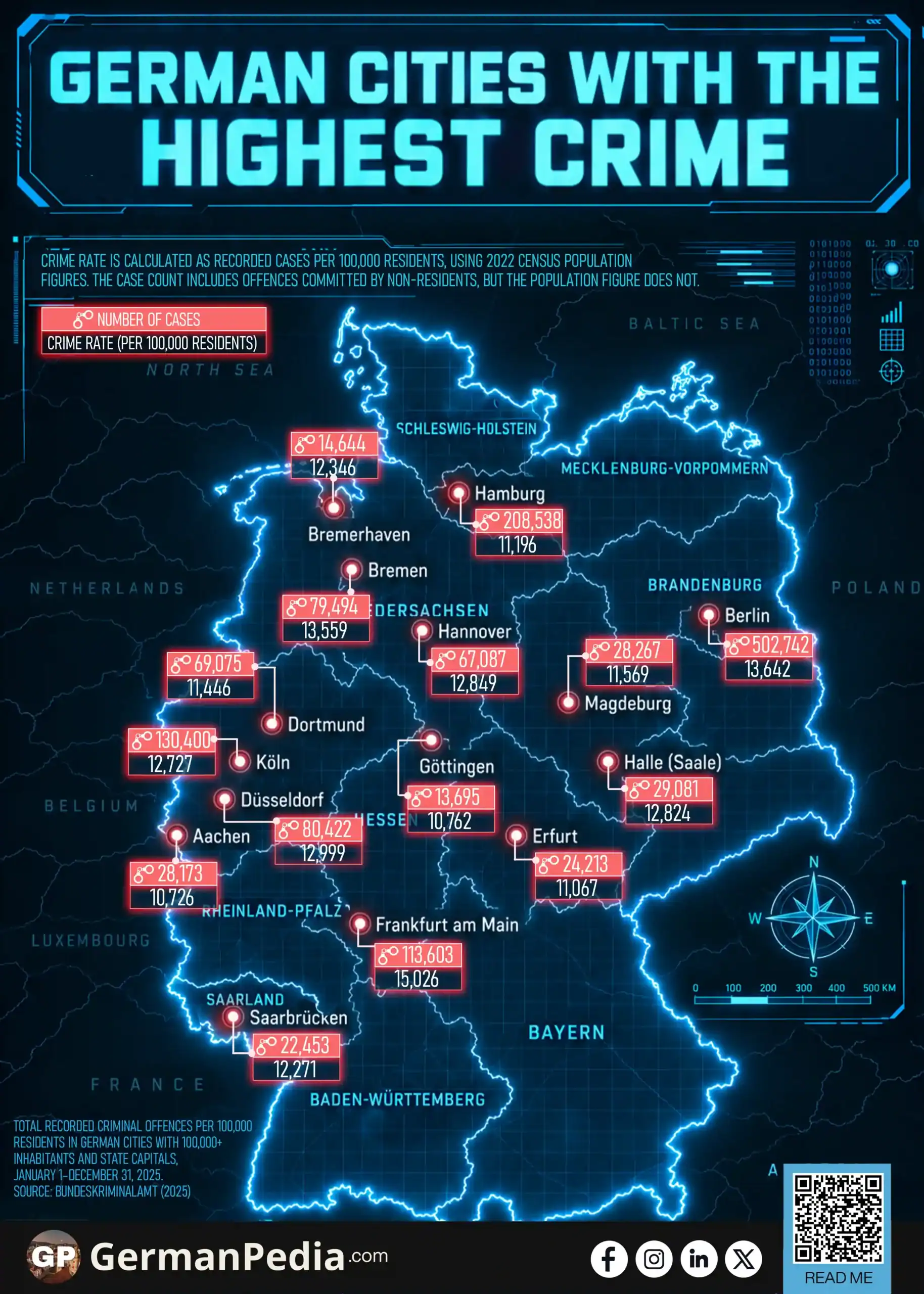
Use this Visualization: You may use this image for free with proper attribution to GermanPedia (i.e., by linking back to GermanPedia).
Need help communicating complex ideas visually? We help you turn data into your most persuasive story. Contact us to learn more.
German Cities With the Highest Crime Rates
| Rank | City | Cases | Crime Rate (per 100,000 residents) |
|---|---|---|---|
| 1 | Frankfurt am Main | 113,603 | 15,026 |
| 2 | Berlin | 502,742 | 13,642 |
| 3 | Bremen | 79,494 | 13,559 |
| 4 | Düsseldorf | 80,422 | 12,999 |
| 5 | Hannover | 67,087 | 12,849 |
| 6 | Halle (Saale) | 29,081 | 12,824 |
| 7 | Köln | 130,400 | 12,727 |
| 8 | Bremerhaven | 14,644 | 12,346 |
| 9 | Saarbrücken | 22,453 | 12,271 |
| 10 | Magdeburg | 28,267 | 11,569 |
| 11 | Dortmund | 69,075 | 11,446 |
| 12 | Hamburg | 208,538 | 11,196 |
| 13 | Erfurt | 24,213 | 11,067 |
| 14 | Göttingen | 13,695 | 10,762 |
| 15 | Aachen | 28,173 | 10,726 |
Source: Bundeskriminalamt (2025)
Crime rate is calculated as recorded cases per 100,000 residents, using 2022 census population figures. The case count includes offences committed by non-residents, but the population figure does not.

Frankfurt Records Germany’s Highest Crime Rate Among Major Cities
Berlin recorded more than 500,000 criminal offences in 2025. It has the highest raw number of any German city.
However, raw counts mostly track population size. Adjusted for population, Frankfurt am Main ranks first for crime rate out of all cities in Germany.
Frankfurt am Main recorded 113,603 criminal offences in 2025. That equals 15,026 offences per 100,000 residents.
That is the highest rate among the 80 cities tracked in Germany’s city-level crime statistics.
Berlin’s crime rate lands lower than Frankfurt’s. It stands at 13,642 offences per 100,000 residents.
That is because Berlin also holds roughly five times Frankfurt’s population. At the same time, Frankfurt’s case count includes offences committed by non-residents:
- Airport passengers
- Train commuters
- Visitors passing through the city
None of them count toward Frankfurt’s population. That mismatch pushes Frankfurt’s rate above cities with similar case totals but fewer daily non-residents.
Why Crime Rates Run Higher in Commuter and Transit Hub Cities
Frankfurt (15,026), Düsseldorf (12,999), Hannover (12,849), and Cologne (12,727) are four of the 15 German cities with the highest crime rates.
Each of these cities hosts a major airport, train hub, or trade fair ground that draws large non-resident crowds daily.
A high crime rate does not mean these cities are the most dangerous to live in. Non-residents show up in their case counts but not in their population totals.
That is why cities with heavy transit traffic rank near the top of the list.
Munich Records Low Crime Rates Despite Being Germany’s Third-Largest City
Munich is Germany’s third-largest city. It recorded only 6,061 offences per 100,000 residents.
That puts it near the bottom of the list for crime rate.
That result breaks from Germany’s other large cities.
- Berlin ranks second nationally for crime rate.
- Cologne is the fourth-largest city. It ranks seventh.
- Hamburg ranks twelfth. It is the second-largest.
Munich is the only one of Germany’s four largest cities to miss the top 15. City size alone does not predict crime rate.
Crime rate is a more meaningful number than raw case totals for comparing German cities. But it has its own limits.
Rate can run high in cities with heavy non-resident traffic. It does not rise or fall simply with a city’s size.
More topics
- Germany’s Murder Cases Have Halved Since 2000
- Which are the toughest prisons in the EU?
- Sexual Violence and Rape Increased in the EU
- The Best EU Countries to Retire In
- Top 13 Most Valuable Brands in the EU
- Where are Billionaires Concentrated in the EU?
- Bulgaria Now Has the EU’s Highest Smoking Rate
- Road Deaths in the EU Are Highest in Romania and Bulgaria
- Which Federal States Drive Germany’s Economy?
- Which EU Country Has the Highest Labour Cost?
- Top 20 Largest Banks in the EU
- Which EU Country Has the Fastest Internet Speed?
- Best EU Countries for Women
- Which EU country has the highest divorce rate?
- Largest Foreign Nationalities in Berlin