Key Takeaways
- Billionaires are concentrated in Europe’s largest economies since they can generate more opportunities for wealth creation.
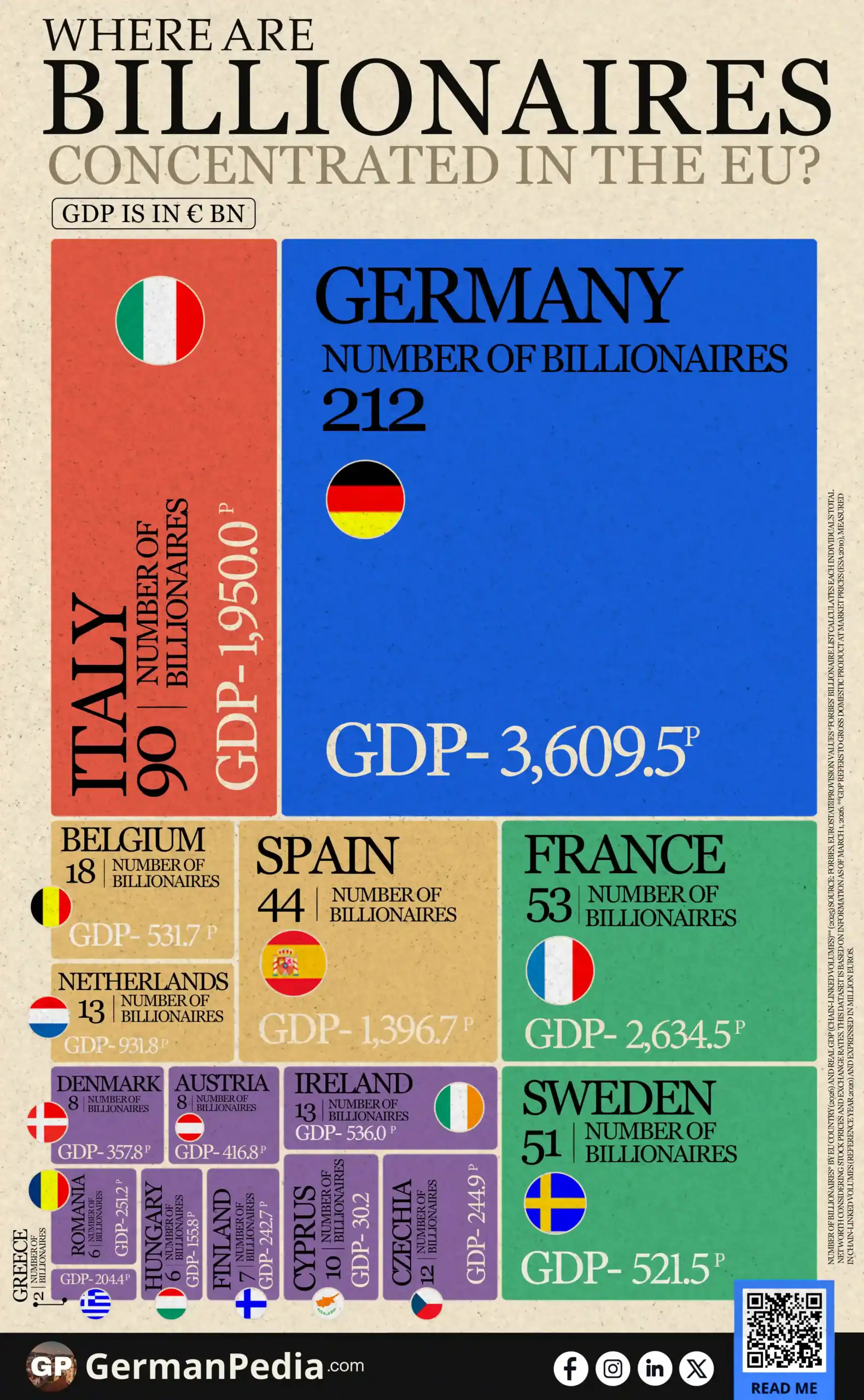
- Germany leads with 212 billionaires, with a GDP of €3.6 trillion. This is more than double Italy’s 90 billionaires.
- In countries such as Cyprus, a small economic base can amplify ratios, making billionaire concentration appear exceptionally high.
- Some countries generate fewer billionaires than expected. In Portugal, wealth is more often held in housing and deposits rather than large equity-based fortunes.
- Economic structure shapes extreme wealth. GDP sets the scale, but factors like capital markets, large firms, and equity ownership also determine how many billionaires emerge.
Use this Visualization: You may use this image for free with proper attribution to GermanPedia (i.e., by linking back to GermanPedia).
Need help communicating complex ideas visually? We help you turn data into your most persuasive story. Contact us to learn more.
Billionaires in Europe by Country and GDP
| Country | Number of Billionaires (2026) | GDP (€ bn, 2025) | Billionaires per €100B |
|---|---|---|---|
| Germany | 212 | 3,609.5ᵖ | 5.87 |
| Italy | 90 | 1,950.0 | 4.62 |
| France | 53 | 2,634.5ᵖ | 2.01 |
| Sweden | 51 | 521.5 | 9.78 |
| Spain | 44 | 1,396.7ᵖ | 3.15 |
| Belgium | 18 | 531.7ᵖ | 3.39 |
| Netherlands | 13 | 931.8 | 1.40 |
| Ireland | 13 | 536.0 | 2.43 |
| Poland | 12 | 642.0 | 1.87 |
| Czechia | 12 | 244.9 | 4.90 |
| Cyprus | 10 | 30.2ᵖ | 33.15 |
| Austria | 8 | 416.8 | 1.92 |
| Denmark | 8 | 357.8 | 2.24 |
| Finland | 7 | 242.7 | 2.88 |
| Hungary | 6 | 155.8ᵖ | 3.85 |
| Romania | 6 | 251.2ᵖ | 2.39 |
| Greece | 2 | 204.4ᵖ | 0.98 |
| Estonia | 2 | 29.1 | 6.87 |
| Bulgaria | 2 | 75.2ᵖ | 2.66 |
| Luxembourg | 1 | 69.0ᵖ | 1.45 |
| Croatia | 1 | 68.1ᵖ | 1.47 |
| Portugal | 1 | 243.7ᵖ | 0.41 |
Source: Forbes, Eurostat
*Forbes’ billionaire list calculates each individual’s total net worth considering stock prices and exchange rates. This dataset is based on information as of March 1, 2026.
**GDP here means gross domestic product at market prices, under the EU’s standard accounting rules (ESA 2010). It’s measured in chain-linked volumes, a method that adjusts for inflation using 2020 as the reference year, and expressed in millions of euros.
ᵖ provisional values

The EU countries with the most billionaires are also the largest economies:
- Germany → 212 billionaires (€3.6 trillion in real GDP)
- Italy → 90 (€2.0 trillion)
- France → 53 (€2.6 trillion)
- Spain → 44 (€1.4 trillion)
These countries account for the majority of billionaires in the EU.
This reflects economic scale. Larger economies create more business activity, larger firms, and more opportunities for capital accumulation. These increase the chances of producing billionaires.
While this pattern holds across most countries, differences emerge when adjusting for economic size. Some economies produce more billionaires relative to their output, while others produce fewer.
Several countries stand out, including:
- Sweden → nearly 10 billionaires per €100 billion
- Germany → around 6 per €100 billion
- Czechia → close to 5 per €100 billion
These figures suggest that certain economies are more conducive to generating extreme wealth, often reflecting:
- strong export sectors
- concentration of large firms
- access to capital and ownership structures
By contrast, others generate fewer billionaires relative to their size:
- France → around 2 per €100 billion
- Netherlands → around 1.4
- Portugal → less than 0.5
This shows that similar economic output does not translate equally into extreme wealth.
In smaller economies, a few billionaires can have a big impact on the ratio. Cyprus shows this clearly. It has 33 billionaires per €100 billion of GDP, despite having one of the smallest economies in the EU (€30 billion).
At the lower end, some countries remain consistently below the EU range. Most Portuguese household wealth, for example, sits in housing and bank deposits, not in stocks or business ownership. Housing and savings tend to grow in value slowly. Billionaire fortunes are usually built from large ownership stakes in companies. Those stakes can multiply in value much faster.
Overall, billionaires in Europe are concentrated in the largest economies, but economic size alone does not determine how many emerge. The structure of the economy also matters, including the presence of large firms and financial hubs, as well as how wealth is concentrated and accumulated.
More topics
- GDP of European Countries
- Employment by Federal State in Germany
- Germany’s Median Wage by Federal State
- Germany’s Top 8 Most Valuable Brands
- Which Federal States Drive Germany’s Economy?
- EU Unicorn Startups: Which Countries Lead and Why
- Where People Move Within Germany by Federal State
- Top 10 Largest Employers in Germany
- Women Are Increasing in Managerial Roles Across the EU
- Apartment Rents in Germany Rise by 24% in Five Years
- Germany’s Home Prices Rise 13.8% as Growth Shifts Regions
- Where Do People Arriving from Abroad Settle in Germany?
- Environmental Impact of AI Websites in Germany
- Income Millionaires In Germany by State
- Happiness vs Income in the EU
References
- https://www.forbes.com/billionaires/
- https://www.euronews.com/business/2025/10/08/which-european-countries-have-the-most-billionaires-and-how-many-are-in-each
- https://ec.europa.eu/eurostat/databrowser/view/nama_10_gdp__custom_20890841/default/table
- https://www.caixabankresearch.com/en/economics-markets/activity-growth/how-portugals-household-wealth-distributed