
Key Takeaways
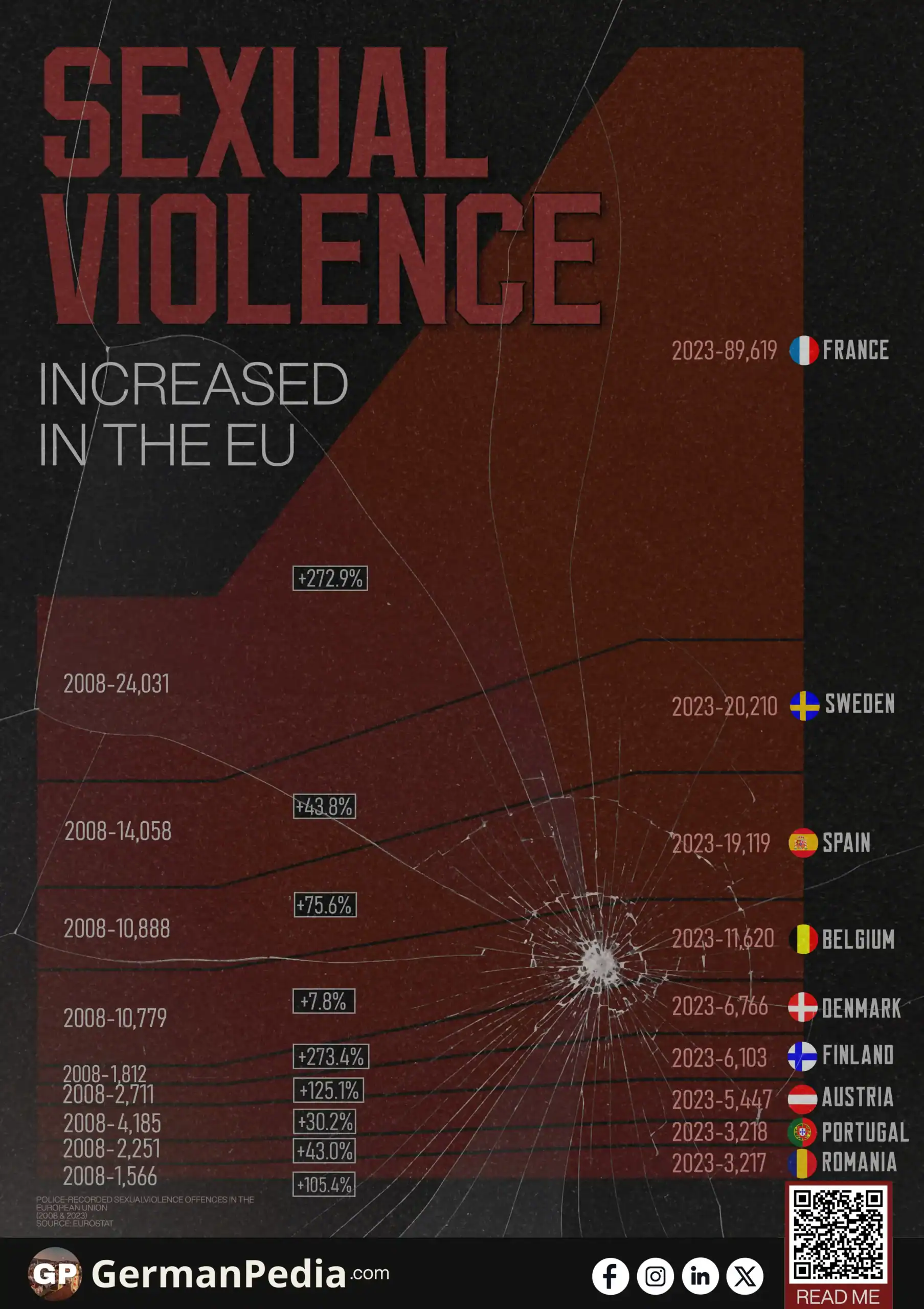
- Police-recorded sexual violence cases in the EU increased by 63.6% between 2008 and 2023.
- Police-recorded rape cases rose more sharply than sexual violence. It increased by 155.1% across the EU during the same period.
- Legal reforms, broader definitions of rape, and improved reporting influence the drastic increase in numbers.
Use this Visualization: You may use this image for free with proper attribution to GermanPedia (i.e., by linking back to GermanPedia).
Need help communicating complex ideas visually? We help you turn data into your most persuasive story. Contact us to learn more.
Cases of Sexual Violence in the EU
| Country | Number of Sexual Violence Offences | ||
| 2008 | 2023 | % Change | |
| France | 24,031 | 89,619 | +272.9% |
| Germany | 56,784 | 52,656 | –7.3% |
| Sweden | 14,058 | 20,210 | +43.8% |
| Spain | 10,888 | 19,119 | +75.6% |
| Belgium | 10,779 | 11,620 | +7.8% |
| Denmark | 1,812 | 6,766 | +273.4% |
| Italy | − | 6,742 | − |
| Finland | 2,711 | 6,103 | +125.1% |
| Austria | 4,185 | 5,447 | +30.2% |
| Netherlands | 10,495 | 4,970 | –52.6% |
| Poland | : | 3,515 | − |
| Portugal | 2,251 | 3,218 | +43.0% |
| Romania | 1,566 | 3,217 | +105.4% |
| Ireland | 1,200 | 2,942 | +145.2% |
| Czechia | 1,680 | 1,864 | +11.0% |
| Greece | 682 | 1,047 | +53.5% |
| Croatia | 765 | 836 | +9.3% |
| Bulgaria | 749 | 624 | –16.7% |
| Slovakia | − | 588 | − |
| Latvia | − | 551 | − |
| Hungary | 464 | 537 | +15.7% |
| Estonia | 268 | 426 | +59.0% |
| Slovenia | 312 | 344 | +10.3% |
| Luxembourg | − | 305 | − |
| Lithuania | 368 | 181 | –50.8% |
| Malta | 80 | 157 | +96.3% |
| Cyprus | 97 | 111 | +14.4% |
Source: Eurostat

Police-recorded sexual offences increased significantly across the European Union between 2008 and 2023.
On average, the total recorded cases of sexual violence in the EU rose from 153,637 in 2008 to 251,332 in 2023. That shows an increase of 63.6 %.
France (+272.9%) and Denmark (+273.4%) recorded some of the largest percentage increases. At the same time, a few countries saw declines, including:
- Germany (–7.3%)
- Bulgaria (–16.7%)
- Netherlands (–52.6%)
- Lithuania (–50.8%)
Sexual violence is a broad legal category. It may include sexual assault, abuse, and other non-rape offences, and definitions differ across national criminal codes. Changes over time reflect:
- Expanded legal definitions
- Inclusion of additional offence types
- Improved police recording systems
- Increased reporting by victims
Since the category is wide, it is particularly sensitive to legislative and recording changes.
Cases of Rape in the EU
| Country | Number of Rape Offences | ||
| 2008 | 2023 | % Change | |
| France | 10,277 | 41,652 | +305.3% |
| Germany | 7,292 | 13,108 | +79.8% |
| Sweden | 4,901 | 8,908 | +81.8% |
| Spain | 2,437 | 4,890 | +100.7% |
| Belgium | 3,231 | 4,409 | +36.5% |
| Denmark | 975 | 2,375 | +143.6% |
| Italy | − | − | − |
| Finland | 915 | 2,379 | +160.0% |
| Austria | 693 | 2,328 | +235.8% |
| Netherlands | 1,945 | 2,415 | +24.2% |
| Poland | 1,611 | 499 | –69.0% |
| Portugal | 314 | 494 | +57.3% |
| Romania | 1,016 | 2,660 | +161.8% |
| Ireland | 331 | 1,004 | +203.3% |
| Czechia | 529 | 1,748 | +230.4% |
| Greece | 232 | 293 | +26.3% |
| Croatia | 188 | 422 | +124.5% |
| Bulgaria | 262 | 75 | –71.4% |
| Slovakia | 152 | 100 | –34.2% |
| Latvia | 100 | 283 | +183.0% |
| Hungary | 214 | 537 | +150.9% |
| Estonia | 160 | 191 | +19.4% |
| Slovenia | 230 | 258 | +12.2% |
| Luxembourg | 57 | 146 | +156.1% |
| Lithuania | 164 | 92 | –43.9% |
| Malta | 19 | 63 | +231.6% |
| Cyprus | 34 | 41 | +20.6% |
Source: Eurostat
EU-wide police-recorded rape cases rose from 38,024 in 2008 to 96,983 in 2023. It reflected a rise of 155.1 % across the EU.
Several countries recorded two- or three-fold increases in rape cases:
- France (+305.3%)
- Austria (+235.8%)
- Czechia (+230.4%)
- Ireland (+203.3%)
In contrast, Poland (–69.0%), Bulgaria (–71.4%), and Lithuania (–43.9%) recorded declines.
The sharper rise in rape cases compared to overall sexual violence is partly linked to legal reforms across the EU during the 2010s.
Several Member States changed how rape is defined in criminal law. Instead of requiring proof of force or resistance, new laws focus on the lack of consent. Examples include:
- Germany’s 2016 reform (“No means no”)
- Sweden’s 2018 reform
- Denmark’s 2021 consent law
- Spain’s 2022 reform (“Only yes means yes”)
More cases can qualify as rape under the law when legal definitions broaden. This can lead to higher recorded case numbers, especially where reforms coincide with sharp increases.
However, legal reform does not fully explain the trend.
Recorded cases are also influenced by:
- Greater public awareness
- Increased reporting by victims
- Improved police recording standards
- Stronger victim support systems
Over the past fifteen years, many EU countries have strengthened their legal and institutional responses to sexual offences. Rising recorded cases reflect changes in laws, reporting behaviour, and classification, alongside possible shifts in underlying incidents.
Police-recorded statistics are shaped by how offences are defined and documented, not only by crime levels themselves. The European Union’s rising figures, therefore, indicate greater recorded visibility while also reflecting institutional and legal change over time.
More topics
- Germany’s Murder Cases Have Halved Since 2000
- Top Relocation Destinations for Germans
- Germany is Losing €100 Billion Every Year
- Germans Earn More Than Foreign Workers Across Germany
- Top German Companies by Revenue
- Apartment Rents in Germany Rise by 24% in Five Years
- Unemployment Across Germany: A Federal State Breakdown
- Germany’s Fastest-Growing Jobs by LinkedIn
- EU Unicorn Startups: Which Countries Lead and Why
- Italy is the Old Man of Europe
- Highest Paying Jobs in Germany
- How Marriage Rates Have Fallen in Germany: 1990–2023
- Countries Driving Germany’s Quarter Trillion Export Surplus
- GDP of European Countries