Key Takeaways
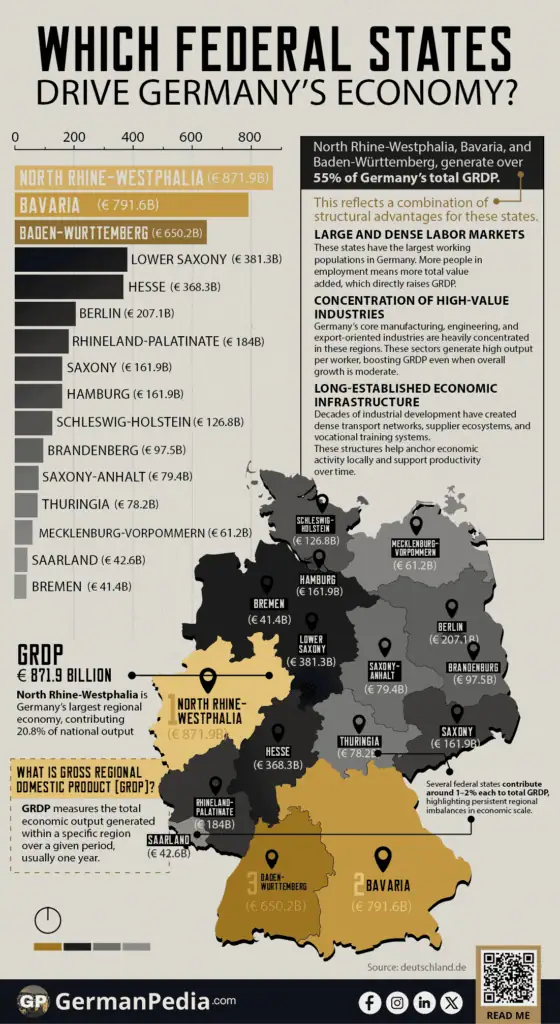
- Germany’s economic output is highly concentrated. The top three federal states, North Rhine-Westphalia, Bavaria, and Baden-Württemberg, generate over 55% of Germany’s total gross regional domestic product (GRDP).
- North Rhine-Westphalia is Germany’s largest regional economy. It contributed 20.8% of national output (871.9 € billion) in 2024.
- Several federal states contribute around 1–2% each to the total GRDP. It highlights persistent regional imbalances in economic scale.
- The dominance of the top states reflects large labor markets, high-value industries, and long-established economic infrastructure.
Use this Visualization: You may use this image for free with proper attribution to GermanPedia (i.e., by linking back to GermanPedia).
Gross Regional Domestic Product by German Federal State
| Federal State | GRDP (billion €) | Share of National Total (%) |
|---|---|---|
| North Rhine-Westphalia | 871.9 | 20.8 |
| Bavaria | 791.6 | 18.9 |
| Baden-Württemberg | 650.2 | 15.5 |
| Lower Saxony | 381.3 | 9.1 |
| Hesse | 368.3 | 8.8 |
| Berlin | 207.1 | 4.9 |
| Rhineland-Palatinate | 184.0 | 4.4 |
| Saxony | 161.9 | 3.9 |
| Hamburg | 161.9 | 3.9 |
| Schleswig-Holstein | 126.8 | 3 |
| Brandenburg | 97.5 | 2.3 |
| Saxony-Anhalt | 79.4 | 1.9 |
| Thuringia | 78.2 | 1.9 |
| Mecklenburg-Vorpommern | 61.2 | 1.5 |
| Saarland | 42.6 | 1 |
| Bremen | 41.4 | 1 |
Source: deutschland.de

What Is Gross Regional Domestic Product (GRDP)?
Gross Regional Domestic Product (GRDP) measures the total economic output generated within a specific region over a given period, usually one year. It is the regional equivalent of Gross Domestic Product (GDP) at the national level.
When the GRDP of all 16 federal states is added together, it equals Germany’s national GDP.
GRDP helps answer questions, such as:
- Which federal states drive Germany’s economy?
- How is economic activity distributed across regions?
- Why do some states contribute disproportionately to national output?
Germany Has a Highly Concentrated Economic Landscape
Germany’s economic output is heavily concentrated in a small number of federal states. North Rhine-Westphalia (871.9 € billion), Bavaria (791.6 € billion), and Baden-Württemberg (650.2 € billion) together generate more than half of Germany’s total GRDP, underscoring their central role in the national economy.
At the lower end of the ranking, several federal states contribute around 1–2% each to national output. These include Saxony-Anhalt, Thuringia, Mecklenburg-Vorpommern, Saarland, and Bremen.
While their absolute GRDP levels are much lower, these states still play important regional roles and are often more sensitive to structural economic changes.
Overall, Germany’s GRDP distribution highlights a clear regional imbalance, with economic activity concentrated in a handful of populous and industrialized states, while others contribute smaller but relatively stable shares.
Why Do the Top Three Federal States Dominate Germany’s GRDP?
The dominance of North Rhine-Westphalia, Bavaria, and Baden-Württemberg reflects a combination of structural advantages. These include:
- Large and dense labor markets. These states have the largest working populations in Germany. More people in employment means more total value added, which directly raises GRDP.
- Concentration of high-value industries: Germany’s core manufacturing, engineering, and export-oriented industries are heavily concentrated in these regions. These sectors generate high output per worker, boosting GRDP even when overall growth is moderate.
- Long-established economic infrastructure: Decades of industrial development have created dense transport networks, supplier ecosystems, and vocational training systems. These structures help anchor economic activity locally and support productivity over time.
In contrast, smaller or more rural states tend to rely on narrower economic bases. While they play important regional roles, lower population density and a different sector mix limit their share of national output.
More topics
- Germany’s GDP Growth: Three Decades of Economic Evolution
- Germany’s GDP per Capita Has Nearly Tripled Since 1991
- Which EU Country Has the Highest Trade-to-GDP Ratio?
- GDP of European Countries
- How Germany’s Debt-to-GDP Ratio Has Changed Since 2000s
- GDP per Capita vs Actual Consumption per Capita in the EU
- Highest Paying Jobs in Germany
- Popular Study Destinations for German Students
- Educational Attainment in European Countries
- Grocery Prices in Germany Have Increased Since 2000
- Germany’s Smoking Rate Has Declined Over Two Decades
- Germany’s Electricity Mix: From Coal to Renewables
- Changes in Harvest of Germany’s Five Key Crops
- Top German Companies by Revenue
- Germany’s Top Car Brands by New Registrations