Key Takeaways
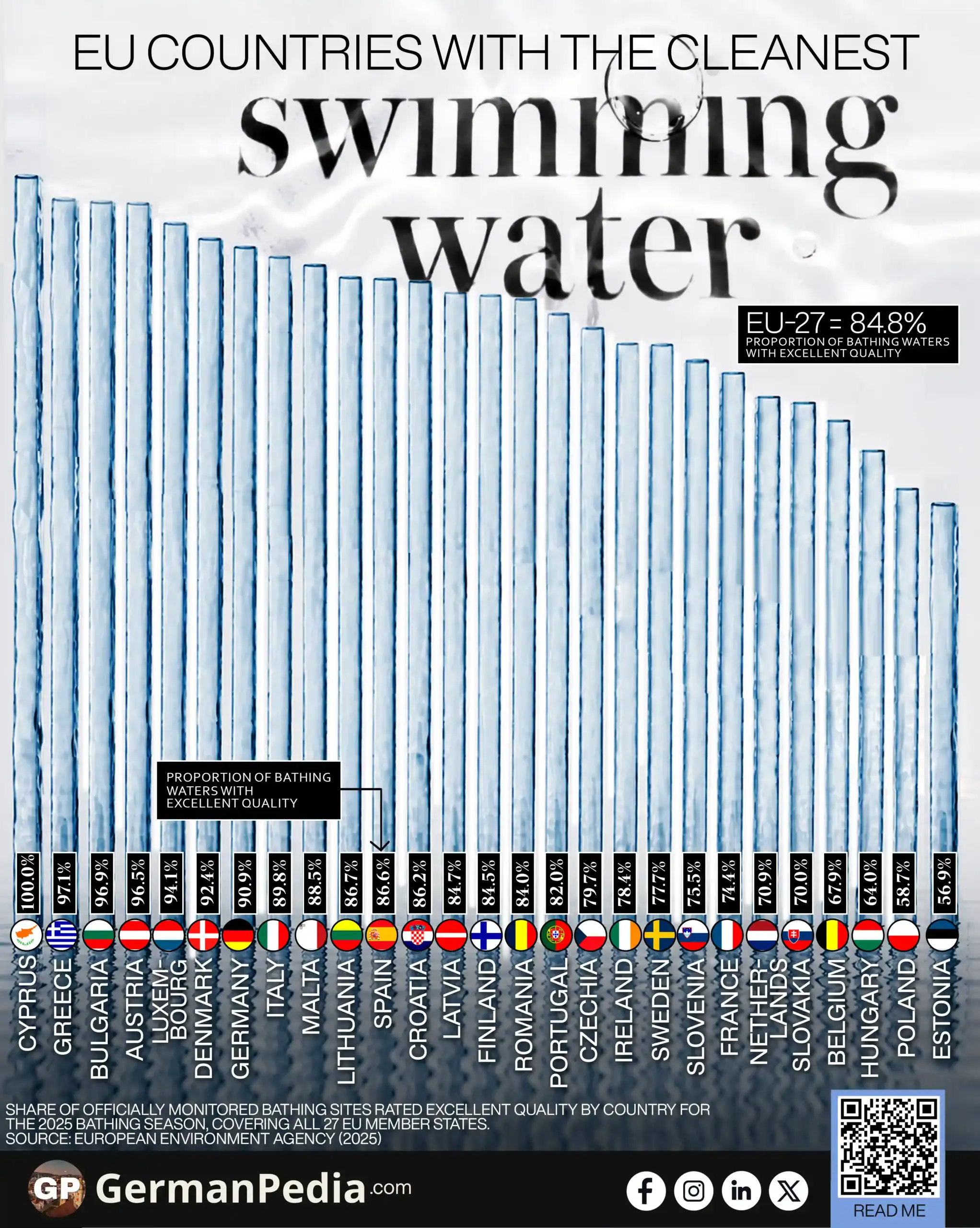
- Cyprus, Greece, Bulgaria, and Austria all cleared 95% excellent bathing water quality in 2025.
- Estonia ranks lowest of all 27 EU countries. Just 56.9% of its bathing waters are rated excellent quality.
- Coastal bathing sites across Europe reached 87.4% excellent quality in 2025. Inland lakes and rivers reached only 78.3%.
- Rivers are the riskiest place to swim in Europe. Only 47% of designated river bathing sites reached excellent quality in 2025.
- Investment in wastewater treatment and collection is the main driver behind the difference between Europe’s best and worst bathing water.
Use this Visualization: You may use this image for free with proper attribution to GermanPedia (i.e., by linking back to GermanPedia).
Need help communicating complex ideas visually? We help you turn data into your most persuasive story. Contact us to learn more.
Share of Bathing Waters Rated Excellent Quality Across EU Countries
| Country | Proportion of bathing waters with excellent quality (In %) |
|---|---|
| Cyprus | 100.0 |
| Greece | 97.1 |
| Bulgaria | 96.9 |
| Austria | 96.5 |
| Luxembourg | 94.1 |
| Denmark | 92.4 |
| Germany | 90.9 |
| Italy | 89.8 |
| Malta | 88.5 |
| Lithuania | 86.7 |
| Spain | 86.6 |
| Croatia | 86.2 |
| EU-27 | 84.8 |
| Latvia | 84.7 |
| Finland | 84.5 |
| Romania | 84.0 |
| Portugal | 82.0 |
| Czechia | 79.7 |
| Ireland | 78.4 |
| Sweden | 77.7 |
| Slovenia | 75.5 |
| France | 74.4 |
| Netherlands | 70.9 |
| Slovakia | 70.0 |
| Belgium | 67.9 |
| Hungary | 64.0 |
| Poland | 58.7 |
| Estonia | 56.9 |
Source: European Environment Agency (2025)
“Excellent” is the highest of four EU bathing water quality classifications (excellent, good, sufficient, poor), based on levels of E. coli and intestinal enterococci bacteria found in each sample.
Each country’s percentage is its own share of excellent-rated sites out of all its own monitored sites. It is not a share of the EU-wide total.
The EU-27 monitored 22,010 officially designated bathing water sites in total for the 2025 season.

85% of the EU’s bathing sites were rated excellent in 2025. That average hides how differently individual countries perform.
A site can be rated excellent, good, sufficient, or poor. Only the poor tier fails to meet the legal safety standard.
Four countries cleared 95% excellent water quality:
- Cyprus: 100.0%
- Greece: 97.1%
- Bulgaria: 96.9%
- Austria: 96.5%
Investment in wastewater treatment plants and sewage collection networks drove most of the EU’s improvement in bathing water quality over the past few decades.
Cyprus and Bulgaria also had zero sites rated poor quality in 2025.
Every one of their monitored sites reached at least “sufficient” quality. That is the minimum standard set by EU law.
Luxembourg, Malta, and Romania share that same distinction.
Four EU countries had less than 70% of their bathing sites rated excellent in 2025:
- Belgium: 67.9%
- Hungary: 64.0%
- Poland: 58.7%
- Estonia: 56.9%
4.6% of Estonia’s bathing waters were rated poor in 2025. That is the highest poor-site share of any EU country.
Only two other EU countries crossed the 3% mark:
- Netherlands: 4.1%
- France: 3.3%
Heavy rainfall can overwhelm wastewater treatment systems beyond their capacity. When that happens, untreated sewage reaches the water before treatment plants can process it.
Coastal Bathing Water Often Has Better Quality Than Inland Water
Where you swim matters as much as which country you visit.
87.4% of coastal bathing sites across Europe were rated excellent in 2025. Only 78.3% of inland lakes and rivers reached that same standard.
Rivers struggled the most of any water type.
Europe monitored around 1,200 river bathing sites in 2025. Only 47% reached excellent quality.
A handful of major cities have made their rivers swimmable anyway. Berlin, Paris, and Budapest are among the capitals that have launched organised river swimming spots in recent years.
Many inland sites in central Europe are small lakes, ponds, or slow-moving rivers. Those smaller water bodies are more exposed to short-term pollution after heavy rain or drought.
Germany joins Austria, Finland, Denmark, and Luxembourg as the only countries where at least 90% of inland sites are rated excellent.
Investment in wastewater treatment and collection likely explains much of the gap between the EU’s best and worst performers.
More topics
- How Much Water Do EU Households Use?
- Water Stress Is Declining in Most EU Countries
- EU Countries With the Most Greenhouse Gas Emissions
- Forest Area in the EU Varies Widely by Country
- Which EU Country Uses the Most Electricity?
- Best EU Countries for Women
- EU Defense Spending by Country
- Which EU Country Has the Highest iPhone Price?
- Which EU Country Uses the Most Electricity?
- EU Countries Gaining and Losing the Most Tourists
- Which EU Country Has the Fastest Internet Speed?
- Top 20 Largest Banks in the EU
- Which EU Country Has the Highest Labour Cost?
- Which EU country has the highest divorce rate?
- Largest Foreign Nationalities in Berlin