Key Takeaways
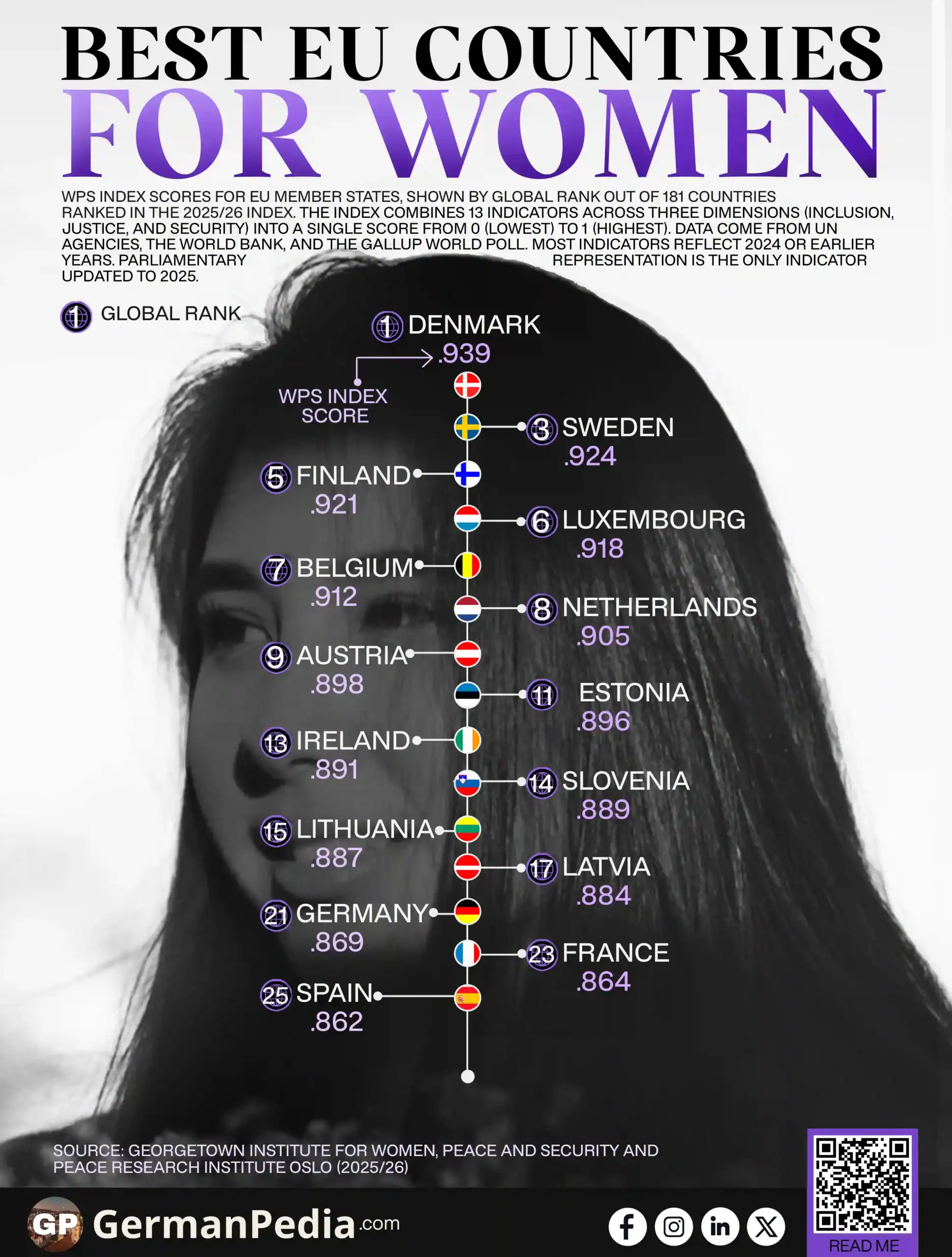
- Denmark ranks 1st among 181 countries on the 2025/26 Women, Peace and Security Index. It holds the highest score of any EU member at .939.
- Greece ranks lowest among EU countries on the index. It holds 60th place globally with a score of .752. Its gender employment gap of 18.8 percentage points is the EU’s second-widest.
- Seven of the EU’s nine highest-ranked countries for women are in Northern or Western Europe. They are Denmark, Sweden, Finland, Luxembourg, Belgium, the Netherlands, and Austria.
- Poland, Hungary, Romania, and Slovakia all border Ukraine. Each still scores zero on the index’s measures of armed conflict exposure and political violence against women.
- Differences among EU countries on the index come from family and labor policy, not from safety or conflict exposure. Countries with dual-earner, dual-carer family policies rank highest among EU members.
Use this Visualization: You may use this image for free with proper attribution to GermanPedia (i.e., by linking back to GermanPedia).
Need help communicating complex ideas visually? We help you turn data into your most persuasive story. Contact us to learn more.
EU Countries by Women, Peace and Security Index Score
| Global Rank | Country | WPS Index Score |
|---|---|---|
| 1 | Denmark | .939 |
| 3 | Sweden | .924 |
| 5 | Finland | .921 |
| 6 | Luxembourg | .918 |
| 7 | Belgium | .912 |
| 8 | Netherlands | .905 |
| 9 | Austria | .898 |
| 11 | Estonia | .896 |
| 13 | Ireland | .891 |
| 14 | Slovenia | .889 |
| 15 | Lithuania | .887 |
| 17 | Latvia | .884 |
| 21 | Germany | .869 |
| 23 | France | .864 |
| 25 | Spain | .862 |
| 26 | Portugal | .861 |
| 27 | Poland | .854 |
| 30 | Malta | .841 |
| 32 | Czechia | .832 |
| 32 | Hungary | .832 |
| 38 | Bulgaria | .814 |
| 39 | Italy | .811 |
| 43 | Romania | .801 |
| 46 | Slovakia | .797 |
| 48 | Croatia | .788 |
| 52 | Cyprus | .770 |
| 60 | Greece | .752 |
Source: Georgetown Institute for Women, Peace and Security and Peace Research Institute Oslo (2025/26)
The index combines 13 indicators across three dimensions (inclusion, justice, and security) into a single score from 0 (lowest) to 1 (highest). Data come from UN agencies, the World Bank, and the Gallup World Poll. Most indicators reflect 2024 or earlier years. Parliamentary representation is the only indicator updated to 2025.

Denmark ranks 1st out of 181 countries on the 2025/26 Women, Peace and Security Index. It scored a WPS Index Score of 0.939.
The index scores each country on 13 measures of economic inclusion, legal protection, and physical security. Each measure is scored on its own scale. All 13 are then combined into one number between 0 and 1. The full range runs from Denmark’s .939 down to Afghanistan’s .279. That is a span of .66 points across all 181 ranked countries.
Greece ranks 60th globally on the same index. It trails Denmark by .187 points. That gap may look small on a 0-to-1 scale, but it reflects a real difference in how women live. EU membership does not guarantee equal outcomes for women. National policy differences separate the bloc’s highest and lowest performers for women.
Nordic Countries Rank Highest for Women in the EU
Denmark, Sweden, and Finland hold three of the EU’s top five positions for women on the index. Luxembourg, Belgium, the Netherlands, and Austria fill four more of the top nine.
The Nordic lead traces to a specific policy shift. Sweden replaced maternity leave with parental leave in 1974. The new system was open to both parents instead of mothers alone. This became known as the dual-earner, dual-carer model. It means both parents share paid work and caregiving, not just one. Sweden later reserved specific leave months for fathers only, starting in 1995. That policy is credited with a sharp rise in how much leave fathers actually take.
Denmark and Finland built comparable systems. They paired parental leave with state-funded childcare that lets both parents remain in paid work after a child is born.
Greece Ranks Lowest for Women in the EU Because of Its Labor Market, Not Insecurity
Greece holds the EU’s lowest position for women on the index. It ranks 60th globally. Its low score comes almost entirely from the inclusion dimension, not from justice or security.
The index’s security dimension measures armed conflict exposure and political violence against women. Poland, Hungary, Romania, and Slovakia all border Ukraine. Each still scores zero on both measures. Greece’s political violence figure is 0.1 events per 100,000 women. That is close to zero on a scale where the worst-scoring country worldwide reaches above 3.
Greece’s weak point is employment. The gender employment gap measures how many more men than women, aged 20 to 64, are working. Greece has the EU’s second-widest gender employment gap. It measured 18.8 percentage points in 2024. Only Italy’s gap was wider, at 19.4 percentage points.
This gender employment gap has also not moved, even a decade later. Most other EU countries narrowed their gaps over the same period.
Gender Pay Gap Across EU Countries ->
The two ends of the EU list point to different lessons. Nordic countries built specific family policies that let both parents work, and both parents care for children. Greece’s low rank shows what happens without that. Its labor market gap has not moved in a decade. EU membership sets shared legal rights for women. It does not set shared outcomes. Those still depend on what each government chooses to build.
More topics
- Gender Pay Gap Across EU Countries
- Sexual Violence and Rape are Rising in the EU
- Gender Employment Patterns Across Germany’s Labour Market
- Which EU Country Uses the Most Electricity?
- Which EU Country Has the Highest Cost of Living?
- Highest-Paying Ausbildung in Germany
- EU’s Senior Population is Growing
- Which Country Owns Almost a Quarter of the EU’s Wealth?
- Which EU Country Recycles the Most?
- How much parental leave do you get in the EU?
- Which EU Countries Had the Highest Inflation Rates?
- Largest Hospitals in Germany
- Road Deaths in the EU Are Highest in Romania and Bulgaria
- EU Online Shopping Splits Sharply by Age
- EU early school leavers went down to 9.1%