Key Takeaways
- Four EU countries, Germany, Italy, France, and Poland, account for 57% of the EU’s total greenhouse gas emissions.
- Germany ranks first in the EU with 672 million tonnes in 2024. That is 21.6% of the EU’s entire output.
- Poland ranks fourth despite having a smaller economy than Spain. Coal accounts for 54% of Poland’s electricity mix and 44.9% of its total greenhouse gas emissions.
- Poland has no national climate law. A social contract with the mining industry sets the last coal mine closure at 2049.
- The 10 smallest EU emitters combined produced 172.9 million tonnes. Germany alone emitted 672 million tonnes.
The EU has 27 member states. Four of them produce more than half of their greenhouse gas emissions.
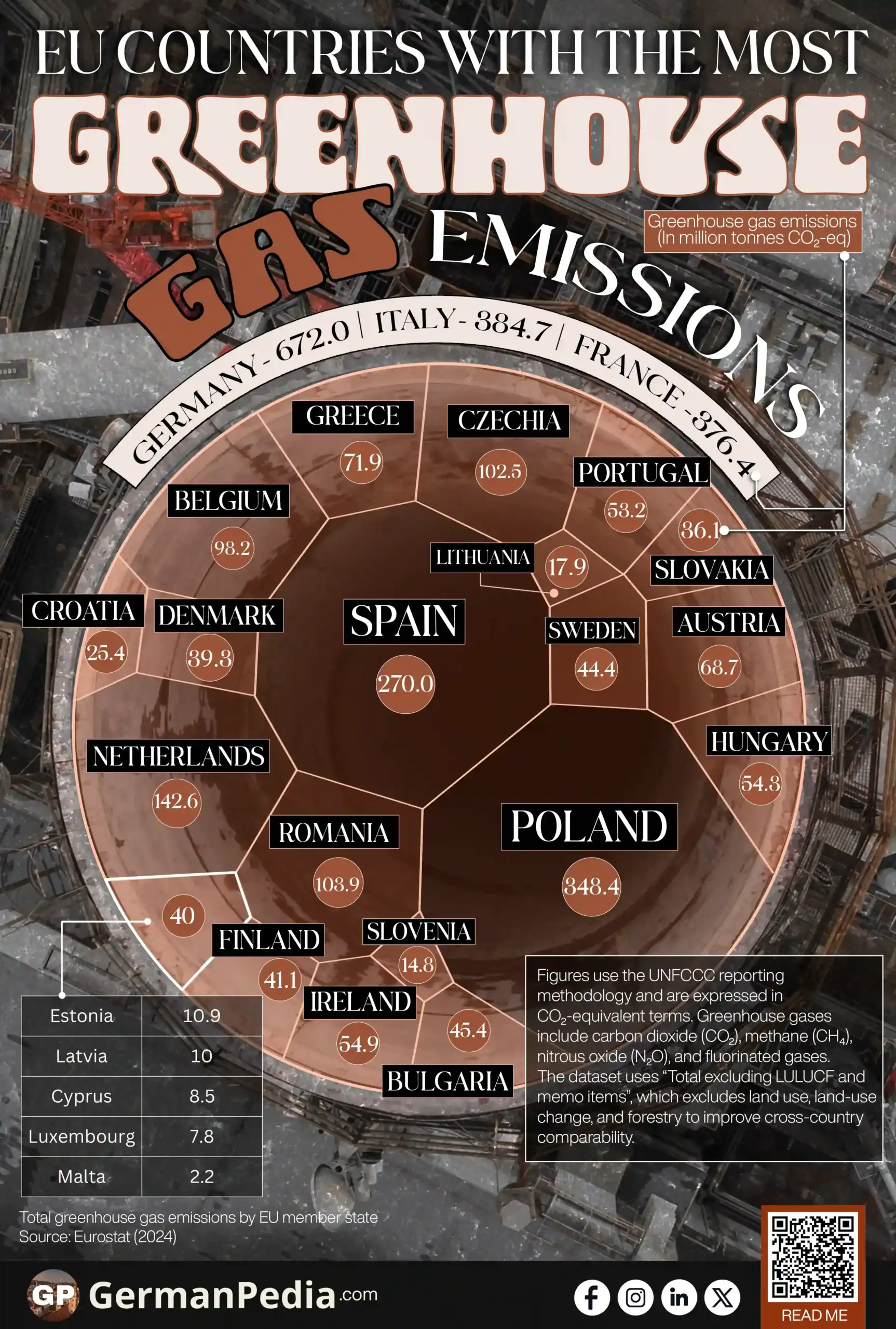
Germany, Italy, France, and Poland together emitted 1,782 million tonnes of CO₂-equivalent in 2024. That is 57% of the EU’s total output.
Greenhouse gas emissions, including carbon dioxide, methane, nitrous oxide, and fluorinated gases, are converted into CO₂-equivalent terms. This allows gases with different warming impacts to be compared as a single figure.
Use this Visualization: You may use this image for free with proper attribution to GermanPedia (i.e., by linking back to GermanPedia).
Need help communicating complex ideas visually? We help you turn data into your most persuasive story. Contact us to learn more.
Greenhouse Gas Emissions in the EU
| Country | Greenhouse Gas Emissions (In million tonnes CO₂-eq) |
|---|---|
| Germany | 672.0 |
| Italy | 384.7 |
| France | 376.4 |
| Poland | 348.4 |
| Spain | 270.0 |
| Netherlands | 142.6 |
| Romania | 103.9 |
| Czechia | 102.5 |
| Belgium | 98.2 |
| Greece | 71.9 |
| Austria | 68.7 |
| Ireland | 54.9 |
| Hungary | 54.3 |
| Portugal | 53.2 |
| Bulgaria | 45.4 |
| Sweden | 44.4 |
| Finland | 41.1 |
| Denmark | 39.3 |
| Slovakia | 36.1 |
| Croatia | 25.4 |
| Lithuania | 17.9 |
| Slovenia | 14.8 |
| Estonia | 10.9 |
| Latvia | 10.0 |
| Cyprus | 8.5 |
| Luxembourg | 7.8 |
| Malta | 2.2 |
Source: Eurostat (2024)
Figures use the UNFCCC reporting methodology and are expressed in CO₂-equivalent terms. Greenhouse gases include carbon dioxide (CO₂), methane (CH₄), nitrous oxide (N₂O), and fluorinated gases. The dataset uses “Total excluding LULUCF and memo items”, which excludes land use, land-use change, and forestry to improve cross-country comparability.

Germany Accounts for More Than a Fifth of EU Emissions
Germany ranks first among all EU member states for greenhouse gas emissions. It emitted 672 million tonnes in 2024.
That figure represents 21.6% of the EU’s total output. It is also 75% higher than Italy’s, the second-ranked country.
Germany’s position at the top is driven by its energy sector. The country has historically relied on coal for power generation. Coal is the most carbon-intensive fossil fuel in use. Germany has committed to phasing out coal-fired power generation by 2030. Its emissions have declined in recent years. In absolute terms, Germany still emits more than the combined total of the 18 lowest-emitting EU member states.
Poland Ranks Above Spain Despite a Smaller Economy
Poland ranks fourth with 348.4 million tonnes. Spain ranks fifth with 270.0 million tonnes.
Spain’s economy is larger. Poland emits more. Coal explains the difference.
Poland is the EU country that relies on coal for power generation the most. Coal accounts for 54% of its electricity mix. It is also responsible for 44.9% of Poland’s total greenhouse gas emissions. This pushes Poland’s emissions significantly above where its economic size alone would place it.
Poland has not adopted a national climate law or a long-term carbon neutrality target. A social contract signed with the mining industry in 2021 sets the scheduled closure of the last Polish coal mine at 2049. That gives Poland’s coal sector nearly three more decades of operation.
What Does the Distribution of Greenhouse Gas Emissions Across the EU Mean?
The EU’s 2030 climate target is a 55% reduction in net greenhouse gas emissions compared to 1990 levels. Progress toward that target will be shaped largely by four countries.
Germany, Italy, France, and Poland together represent 57% of EU output. Decisions on coal phaseout, energy transition, and industrial decarbonisation in these four countries will determine how much the EU as a whole moves toward its 2030 goal.
Poland’s position is the most uncertain of the four. It is a top-four emitter. It has no national climate law. Its coal sector has a contractual mandate to operate until 2049.
More topics
- Germany’s Electricity Mix: From Coal to Renewables
- Adoption of Electric and Hybrid Passenger Cars in the EU
- Environmental Impact of AI Websites in Germany
- EU Relies on Imports for Natural Gas
- Which EU Countries Have the Most Soft Power?
- Countries Driving Germany’s Quarter Trillion Export Surplus
- Germany’s Top Export Partners: Where €1.55 Trillion in Goods Go
- Germany’s Top Import Partners
- EU Relies on Imports for Natural Gas
- US Oil Exports to the EU Are Highly Concentrated
- Government Spending on Education in EU Countries
- The Best EU Countries to Retire In
- EU Passports Are Among the Strongest in the World
- Internet Use for Mental Health Information Across the EU
- EU Alternatives to Common US Platforms
References
- https://ec.europa.eu/eurostat/databrowser/view/env_air_gge/default/table?lang=en
- https://www.cleanenergywire.org/factsheets/germanys-greenhouse-gas-emissions-and-climate-targets
- https://www.eea.europa.eu/en/europe-environment-2025/countries/poland
- https://www.cleanenergywire.org/factsheets/clew-guide-upcoming-election-will-shape-direction-and-pace-polands-energy-transition
- https://climate.ec.europa.eu/eu-action/european-climate-law_en