Key Takeaways
- Italy ranks first in the EU for UNESCO World Heritage Sites. It holds 62 of the EU’s 444 total UNESCO World Heritage Sites.
- Italy’s high count of UNESCO World Heritage Sites traces back to centuries as separate city-states rather than one nation. Each one now counts as its own UNESCO site.
- Four EU countries hold 223 of the EU’s 444 UNESCO World Heritage Sites: Italy, France, Germany, and Spain. That nearly matches the 221 World Heritage Sites held by the other 23 EU countries combined.
- Ratification date alone does not explain why Italy, France, Germany, and Spain lead the EU in UNESCO World Heritage Sites. Technical capacity to prepare nominations made the real difference.
- Germany’s most recent UNESCO World Heritage Sites addition came in July 2025. Neuschwanstein and three other King Ludwig II castles joined the list that year.
- UNESCO limits most countries to one new nomination a year. That cap is why Italy, France, Germany, and Spain built a lead that won’t close anytime soon.
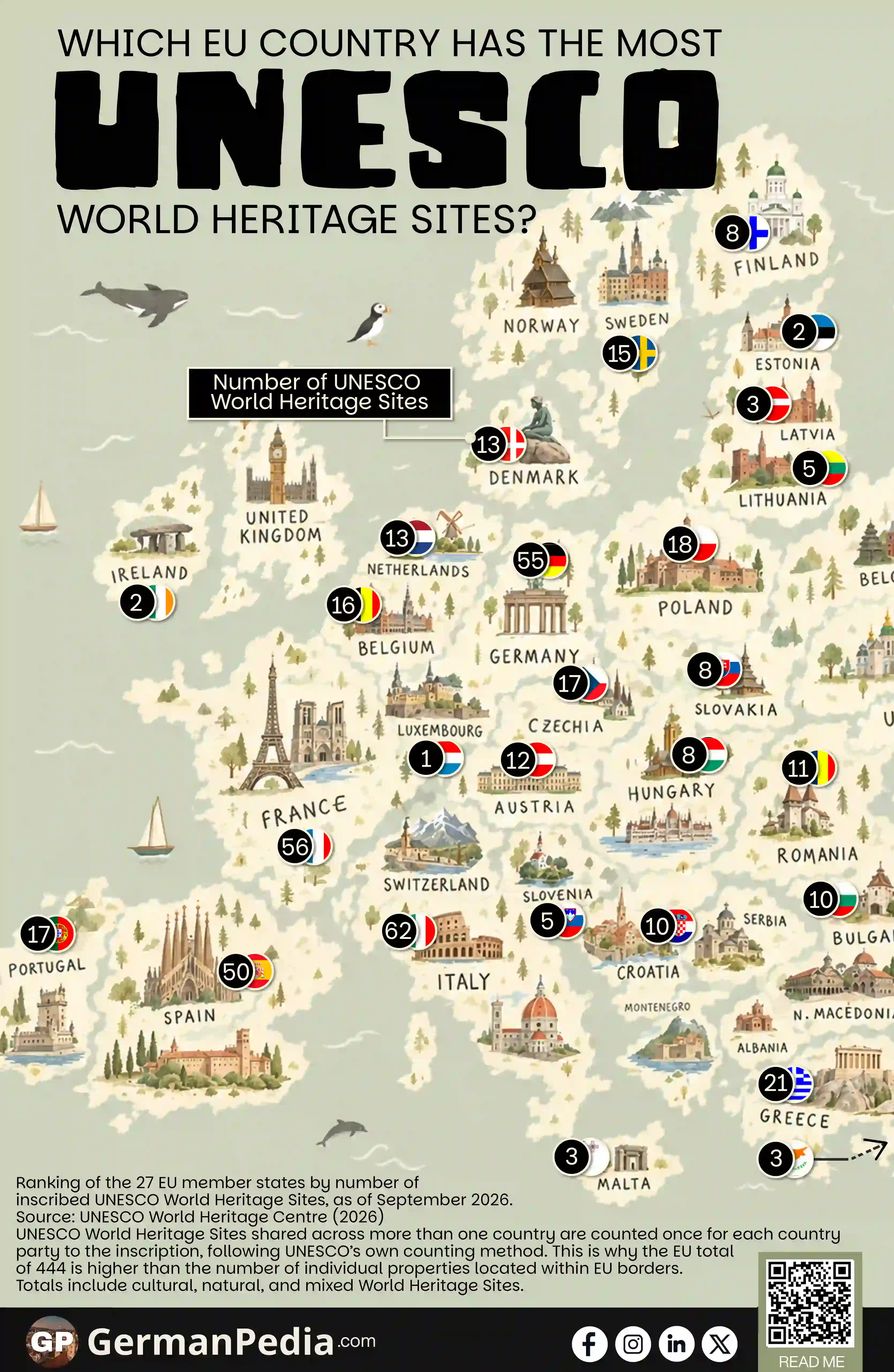
Use this Visualization: You may use this image for free with proper attribution to GermanPedia (i.e., by linking back to GermanPedia).
Need help communicating complex ideas visually? We help you turn data into your most persuasive story. Contact us to learn more.
EU Countries Ranked by UNESCO World Heritage Sites
| Rank | EU Country | UNESCO World Heritage Sites |
|---|---|---|
| 1 | Italy | 62 |
| 2 | France | 56 |
| 3 | Germany | 55 |
| 4 | Spain | 50 |
| 5 | Greece | 21 |
| 6 | Poland | 18 |
| 7 | Czechia | 17 |
| 8 | Portugal | 17 |
| 9 | Belgium | 16 |
| 10 | Sweden | 15 |
| 11 | Denmark | 13 |
| 12 | Netherlands | 13 |
| 13 | Austria | 12 |
| 14 | Romania | 11 |
| 15 | Bulgaria | 10 |
| 16 | Croatia | 10 |
| 17 | Finland | 8 |
| 18 | Hungary | 8 |
| 19 | Slovakia | 8 |
| 20 | Lithuania | 5 |
| 21 | Slovenia | 5 |
| 22 | Cyprus | 3 |
| 23 | Latvia | 3 |
| 24 | Malta | 3 |
| 25 | Estonia | 2 |
| 26 | Ireland | 2 |
| 27 | Luxembourg | 1 |
Source: UNESCO World Heritage Centre (2026)
UNESCO World Heritage Sites shared across more than one country are counted once for each country party to the inscription, following UNESCO’s own counting method. This is why the EU total of 444 is higher than the number of individual properties located within EU borders.
Totals include cultural, natural, and mixed World Heritage Sites.

Italy Ranks First in the EU for UNESCO World Heritage Sites
Italy holds 62 UNESCO World Heritage Sites. it holds the most among all EU countries.
Italy also ranks first worldwide for the largest number of UNESCO World Heritage Sites. China ranks second, with a total of 61.
Italy spent centuries as a patchwork of independent city-states rather than one nation with a single capital. Each city-state built its own historic core instead of sharing one national capital’s landmarks.
Building a separate historic core in each city-state is why Italy’s UNESCO list skews so heavily cultural. Of Italy’s 62 World Heritage Sites, 56 are cultural landmarks such as historic centers and archaeological areas.
UNESCO’s cultural sites are places built by people, like cities, churches, or monuments. Natural sites are naturally occurring places valued for their biodiversity or geology.
The other 6 Italian sites are natural. Italy is a small, densely settled country.
Centuries of building left little room for large-scale wilderness to survive.
Vast countries like Canada and China have far more untouched land. Natural sites make up a much bigger share of their UNESCO totals.
Four Countries Hold Just Over Half of the UNESCO World Heritage Sites in the EU
Italy is not alone at the top of the EU’s UNESCO World Heritage Sites ranking.
France, Germany, and Spain each hold at least 50 UNESCO World Heritage Sites:
- France: 56
- Germany: 55
- Spain: 50
Together, the top four EU countries hold 223 UNESCO World Heritage Sites.
The other 23 EU countries hold 221 UNESCO World Heritage Sites combined. That near-tie comes down to headcount, not catching up.
Each of the 23 other EU countries averages fewer than 10 UNESCO World Heritage Sites.
Italy, France, Germany, and Spain all ratified the World Heritage Convention early, between 1975 and 1982. Ratifying means officially joining the treaty and agreeing to follow its rules.
A country cannot nominate any site until it ratifies the Convention. Early ratification gave all four decades of extra time to build their lists.
Ratification date alone does not explain the gap. Poland ratified the Convention in 1976, the same year as Germany, yet holds only 18 sites today.
Technical capacity made the difference in the EU’s top four, not simply time in the Convention. Technical capacity means having the staff and expertise to prepare a nomination application.
Technical capacity means having the staff and expertise to prepare a nomination application that meets UNESCO’s own approval standards.
Italy built a standing UNESCO office inside its Ministry of Culture to do exactly this work. Decades of that steady staffing turned Italy’s early ratification into an actual lead.
Germany’s UNESCO World Heritage Sites List Keeps Adding New Sites
Germany ranks third in the EU for UNESCO World Heritage Sites. It holds 55 sites. Of those, 52 are cultural, and 3 are natural.
Germany’s UNESCO World Heritage Sites list leans cultural for the same reason Italy’s does. It spent centuries as a patchwork of independent kingdoms, duchies, and free cities rather than one nation.
A duchy was a territory ruled by a duke instead of a king. A free city governed itself instead of answering to a king.
Germany’s most recent addition to UNESCO World Heritage Sites came in July 2025. The World Heritage Committee added four Bavarian castles built by King Ludwig II:
- Neuschwanstein
- Linderhof
- Schachen
- Herrenchiemsee
The four Bavarian castles share a single style: King Ludwig II’s 19th-century vision of medieval and baroque romance.
UNESCO lists the four Bavarian castles as one property made up of four separate locations. That single listing is why Germany’s 2025 addition only used one of its yearly nomination slots.
The same one-nomination-per-year cap on UNESCO World Heritage nominations applies to every country, not just Germany.
History set today’s UNESCO World Heritage Sites ranking. The same rules that took Italy and Germany decades to build their leads will take just as long for anyone chasing them.
More topics
- EU Countries With the Most Serial Killers
- Organ Donation Rates Across the EU
- Top 30 Greenest Cities in the EU
- Most Valuable Football Clubs in the EU
- Top Car-Producing Countries in the EU
- Top EU Countries by First-Instance Asylum Approvals
- Which Countries Does Germany Import From Most?
- Germany’s Top 10 Exported Goods
- Germany’s Top Export Partners: Where €1.55 Trillion in Goods Go
- Top Films in Germany Are Still Mostly Hollywood Hits
- Top 10 Highest Mountains in the EU
- EU Countries Are Only Partly Self-Sufficient in Food
- Leading EU Exporters and Importers of Digitally Delivered Services
- US Oil Exports to the EU Are Highly Concentrated
- Largest Religion in EU Countries
References
- https://whc.unesco.org/en/list/
- https://whc.unesco.org/en/nominations/
- https://whc.unesco.org/en/statesparties/
- https://whc.unesco.org/en/globalstrategy/
- https://unesco.cultura.gov.it/en/nomination/
- https://unesco.diplo.de/unesco-en/inscription-of-the-castles-of-king-ludwig-ii-of-bavaria-to-the-list-of-unesco-world-heritage-sites-2727496