
Key Takeaways
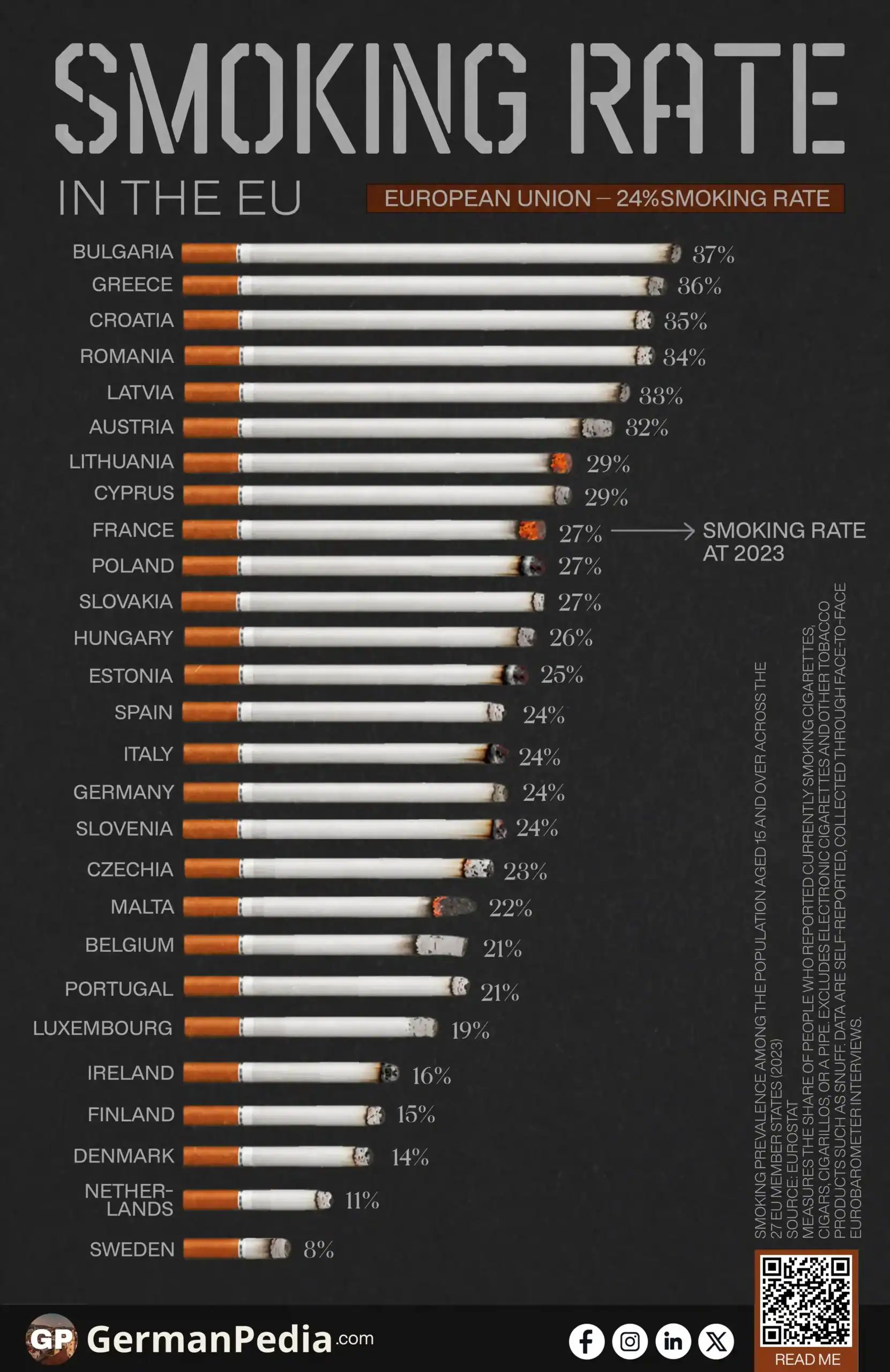
- Bulgaria recorded a 37% smoking rate in 2023. It was the highest rate in the EU.
- Greece led in 2006 with a 42% smoking rate. However, it fell to 36% by 2023.
- The EU27 average fell from an estimated 31% in 2006 to 24% in 2023. That is a drop of 7 percentage points across 27 countries.
- Denmark and the Netherlands recorded the steepest declines in the EU. Both fell 18 percentage points between 2006 and 2023.
- Six countries had higher smoking rates in 2023 than in 2006. That includes Bulgaria, Croatia, Romania, Austria, Slovakia, and Slovenia.
- Sweden has the lowest smoking rate in the EU at 8%. This dataset excludes snus. It is a smokeless tobacco product used daily by 22% of Swedish men in 2024.
- Bulgaria’s cheap cigarette prices and low quit attempt rates help explain why its smoking rate stayed flat while the EU average fell sharply.
Use this Visualization: You may use this image for free with proper attribution to GermanPedia (i.e., by linking back to GermanPedia).
Need help communicating complex ideas visually? We help you turn data into your most persuasive story. Contact us to learn more.
Change in Smoking Rates Across EU Countries
| Country | Smoking Rate | ||
|---|---|---|---|
| 2006 | 2023 | Change (in pp) | |
| European Union | 31%* | 24% | -7 |
| Denmark | 32% | 14% | -18 |
| Netherlands | 29% | 11% | -18 |
| Ireland | 29% | 16% | -13 |
| Finland | 26% | 15% | -11 |
| Sweden | 18% | 8% | -10 |
| Hungary | 36% | 26% | -10 |
| Spain | 34% | 24% | -10 |
| Poland | 35% | 27% | -8 |
| Estonia | 33% | 25% | -8 |
| Italy | 31% | 24% | -7 |
| Luxembourg | 26% | 19% | -7 |
| Germany | 30% | 24% | -6 |
| Greece | 42% | 36% | -6 |
| Czechia | 29% | 23% | -6 |
| France | 33% | 27% | -6 |
| Belgium | 26% | 21% | -5 |
| Lithuania | 34% | 29% | -5 |
| Latvia | 36% | 33% | -3 |
| Malta | 25% | 22% | -3 |
| Portugal | 24% | 21% | -3 |
| Cyprus | 31% | 29% | -2 |
| Bulgaria | 36% | 37% | +1 |
| Austria | 31% | 32% | +1 |
| Slovenia | 23% | 24% | +1 |
| Croatia | 33% | 35% | +2 |
| Slovakia | 25% | 27% | +2 |
| Romania | 31% | 34% | +3 |
Source: Eurostat
Measures the share of people who reported currently smoking cigarettes, cigars, cigarillos, or a pipe. Excludes electronic cigarettes and other tobacco products such as snuff. Data are self-reported, collected through face-to-face Eurobarometer interviews.
* = estimated value

In 2006, Greece had the highest smoking rate in the EU. It showed that 42% of its population aged 15 and over smoked. By 2023, Greece had cut that rate to 36%. Bulgaria did not cut nearly as much. Its rate rose slightly, from 36% to 37%, over the same 17 years. That is enough for Bulgaria to overtake Greece as the EU’s highest-smoking country.
The wider EU pattern runs the opposite way. The EU27 average fell from an estimated 31% in 2006 to 24% in 2023. The EU’s Tobacco Products Directive became applicable across all member states in 2016. It made large combined health warnings mandatory on cigarette packs. It also banned cigarettes with characterising flavours.
Bulgaria Overtakes Greece as the EU’s Highest-Smoking Country
Bulgaria’s smoking rate has barely moved in 17 years. Cigarette prices help explain why. In 2016, a pack of cigarettes in Bulgaria cost €2.42. It is the cheapest in the EU. The EU average that year was €4.41.
Quitting is rare, too. A 2017 Eurobarometer survey found that 78% of Bulgarian smokers had never tried to quit. In the UK, only 29% of smokers said the same.
Greece still ranks second-highest in the EU at 36%. Its drop from 42% was real. It just was not steep enough to keep pace as other countries cut faster.
Sweden Has the EU’s Lowest Smoking Rate, But This Count Excludes Snus
Sweden’s smoking rate fell from 18% in 2006 to 8% in 2023. That is the lowest rate in the EU. Denmark and the Netherlands also posted steep declines. Both fell 18 percentage points. Those are the largest drops of any EU country.
Sweden’s cigarette count leaves out snus. This dataset covers cigarettes, cigars, cigarillos, and pipe tobacco. It does not cover snus, a smokeless oral tobacco product. In 2024, 22% of Swedish men and 10% of Swedish women reported using snus daily. Sweden’s low cigarette-smoking rate does not mean Swedes have stopped using tobacco. Many have shifted to a product that this survey does not measure.
The pattern across the EU is not just a decline. It is an uneven decline. Bulgaria’s flat rate shows what happens when cheap cigarettes and low quit rates work against a bloc-wide trend. Its overtaking of Greece is not a sign that Bulgaria has gotten worse. It is a sign that everyone else got better faster.
More topics
- Largest Hospitals in Germany
- Which EU Country Has the Most Healthy Life Years?
- Hospital Capacity Across Germany: A State-by-State Comparison
- Internet Use for Mental Health Information Across the EU
- Most Prosperous EU Countries by Prosperity Index
- Leading Causes of Death in Germany
- Causes of Death in Germany By Gender
- How Germany’s Birth Rates Dropped and Deaths Rose
- Germany’s Healthcare Expenditure Vs. Aging Population
- Which EU Country Uses the Most Electricity?
- Which EU Countries Had the Highest Inflation Rates?
- EU Self-Supplied Water Use by Economic Sector
- Which EU Countries Have the Highest Unemployment?
- Average Working Hours in EU Countries
- How Much Water Do EU Households Use?
References
- https://ec.europa.eu/eurostat/databrowser/view/sdg_03_30__custom_22135016/default/table
- https://extranet.who.int/fctcapps/fctcapps/fctc/kh/tobacco-taxation/news/blogpost-eastern-europe-smokers-paradise
- https://health.ec.europa.eu/tobacco/product-regulation_en
- https://www.folkhalsomyndigheten.se/the-public-health-agency-of-sweden/living-conditions-and-lifestyle/andtg/tobacco/use-of-tobacco-and-nicotine-products/