Key Takeaways
- Paris ranks as the largest city among the EU countries with 2022 population data. Its greater-city population of 10.35 million exceeds Madrid’s and Barcelona’s combined.
- Germany, Italy, and Spain each place three or more cities among the EU’s 20 largest cities by population.
- Germany leads with four of the EU’s largest cities by population: Berlin, Hamburg, Munich, and Cologne.
- Only 6.5% of Germans lived in Berlin in January 2023. Germany’s population spreads across many mid-sized cities instead of concentrating in one dominant capital.
- City-size patterns across the EU trace back to how power was historically shared within each country. France kept power in one capital, while Germany spread power across many regions instead.
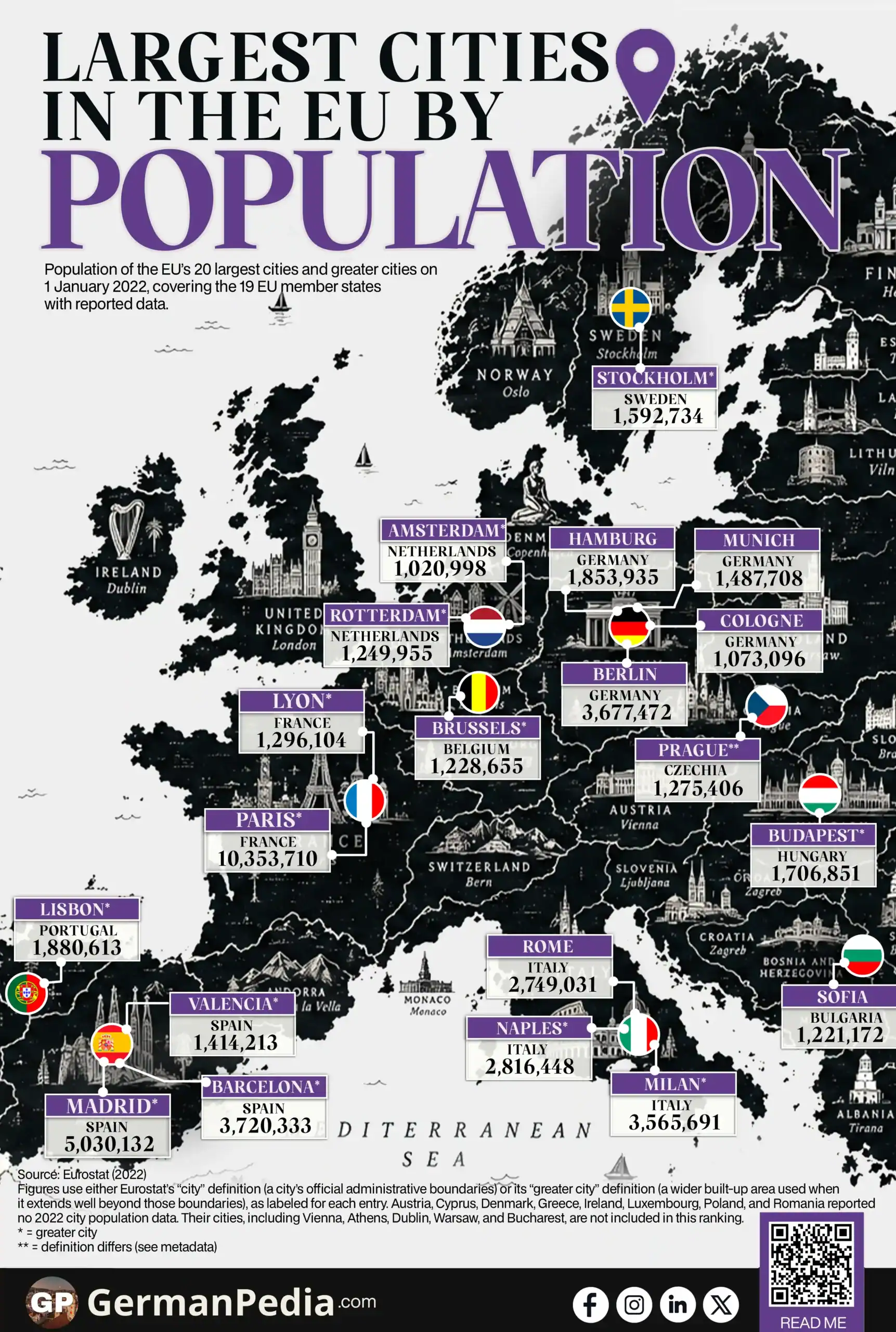
Use this Visualization: You may use this image for free with proper attribution to GermanPedia (i.e., by linking back to GermanPedia).
Need help communicating complex ideas visually? We help you turn data into your most persuasive story. Contact us to learn more.
EU Cities With the Largest Populations
| Rank | City | Country | Population |
|---|---|---|---|
| 1 | Paris* | France | 10,353,710 |
| 2 | Madrid* | Spain | 5,030,132 |
| 3 | Barcelona* | Spain | 3,720,333 |
| 4 | Berlin | Germany | 3,677,472 |
| 5 | Milan* | Italy | 3,565,691 |
| 6 | Naples* | Italy | 2,816,448 |
| 7 | Rome | Italy | 2,749,031 |
| 8 | Lisbon* | Portugal | 1,880,613 |
| 9 | Hamburg | Germany | 1,853,935 |
| 10 | Budapest* | Hungary | 1,706,851 |
| 11 | Stockholm* | Sweden | 1,592,734 |
| 12 | Munich | Germany | 1,487,708 |
| 13 | Valencia* | Spain | 1,414,213 |
| 14 | Lyon * | France | 1,296,104 |
| 15 | Prague** | Czechia | 1,275,406 |
| 16 | Rotterdam* | Netherlands | 1,249,955 |
| 17 | Brussels* | Belgium | 1,228,655 |
| 18 | Sofia | Bulgaria | 1,221,172 |
| 19 | Cologne | Germany | 1,073,096 |
| 20 | Amsterdam* | Netherlands | 1,020,998 |
Source: Eurostat (2022)
Figures use either Eurostat’s “city” definition (a city’s official administrative boundaries) or its “greater city” definition (a wider built-up area used when it extends well beyond those boundaries), as labeled for each entry.
Austria, Cyprus, Denmark, Greece, Ireland, Luxembourg, Poland, and Romania reported no 2022 city population data. Their cities, including Vienna, Athens, Dublin, Warsaw, and Bucharest, are not included in this ranking.
* = greater city
** = definition differs (see metadata)

Paris’s Population Gap Traces to France’s Centralized Political History
Paris ranks first among the largest EU cities by population. Its greater-city population reached 10.35 million in January 2022.
Paris’ total population is larger than the combined populations of Madrid (5.03 million) and Barcelona (3.72 million).
Paris’s greater-city population is 2.8 times larger than Berlin’s. Berlin ranks fourth among the EU’s largest cities by population.
Paris’s dominance reflects a monocentric pattern. It is where political and economic power concentrates in one capital rather than spreading across several cities.
Metropolitan regions show the same monocentric pattern.
Metropolitan-region population counts people across a wider area. It is shaped by commuting patterns rather than city or greater-city boundaries.
In January 2023, Paris’s metropolitan region held 3.9 times as many people as Marseille’s. Marseille is France’s second-largest metropolitan region.
Hungary and Austria follow the same monocentric model. Each country’s capital-region population dwarfed its second-largest metropolitan region:
- Budapest: 2.9 mil. people, about 4.8 times Miskolc’s 0.62 million
- Vienna: 3.0 mil. people, about 3.6 times Linz’s 0.82 million
Germany Places The Most Cities in the EU’s 20 Largest Cities by Population
Germany places four cities among the EU’s 20 largest population:
- Berlin: 3.68 million
- Hamburg: 1.85 million
- Munich: 1.49 million
- Cologne: 1.07 million
Berlin is Germany’s largest city. However, it ranks only fourth among the EU’s 20 largest cities by population.
Germany’s population spreads across many mid-sized cities instead of concentrating in one capital. Only 6.5% of Germans lived in Berlin in January 2023.
Berlin’s 6.5% share is far smaller than the capital-region shares in France, Hungary, or Austria.
Germany, Italy, and Poland are the EU’s only large countries where less than one-tenth of the national population lives in the capital region.
Most and Least Populated Countries in Europe ->
Italy also places multiple cities among the EU’s 20 largest cities by population.
- Milan: 3.57 million
- Naples: 2.82 million
- Rome: 2.75 million
Spain also places three cities among the EU’s 20 largest cities by population: Madrid, Barcelona, and Valencia. Together, these three cities hold about 2.1 million more people than Germany’s four cities combined.
Centuries of political history shape where a country’s population concentrates. It is not just where its city borders happen to sit.
Monocentric countries like France, Hungary, and Austria built their political and economic life around one dominant capital.
In contrast to monocentric countries, countries like Germany are federally structured and historically fragmented. Their population is spread across many regional centers instead. Italy follows Germany’s pattern too.
Germany and Italy’s shared polycentric pattern explains why both place several cities in this ranking rather than one dominant one.
More topics
- Indian Population in Berlin, Ranked by District
- EU’s Senior Population is Growing
- Foreign-Born Population in the EU Is Rising
- Population of Cities in Germany [German Population Statistics]
- Which EU country has the highest alcohol consumption?
- Best EU Countries for Women
- Which Countries Does Germany Import From Most?
- Germany’s Top 10 Exported Goods
- Germany’s Top Export Partners: Where €1.55 Trillion in Goods Go
- Which EU Countries Export the Most Food?
- EU Relies on Imports for Natural Gas
- EU Household Expenditure on Food and Non-Alcoholic Beverages
- EU Countries Are Only Partly Self-Sufficient in Food
- Leading EU Exporters and Importers of Digitally Delivered Services
- US Oil Exports to the EU Are Highly Concentrated
- Italy Uses the Most Cooling Energy in the EU