
Takeaways
- Bavaria has the largest number of hospitals across Germany. It recorded 352 hospitals in 2023.
- North Rhine-Westphalia recorded the highest number of cases per hospital. In 2023, it climbed to 12,768 cases each.
- More hospitals do not automatically mean higher capacity per hospital.
- Urbanised German states tend to concentrate care in fewer, high-volume hospitals.
- Larger and more rural states spread patient loads across more facilities, resulting in lower average case volumes per hospital.
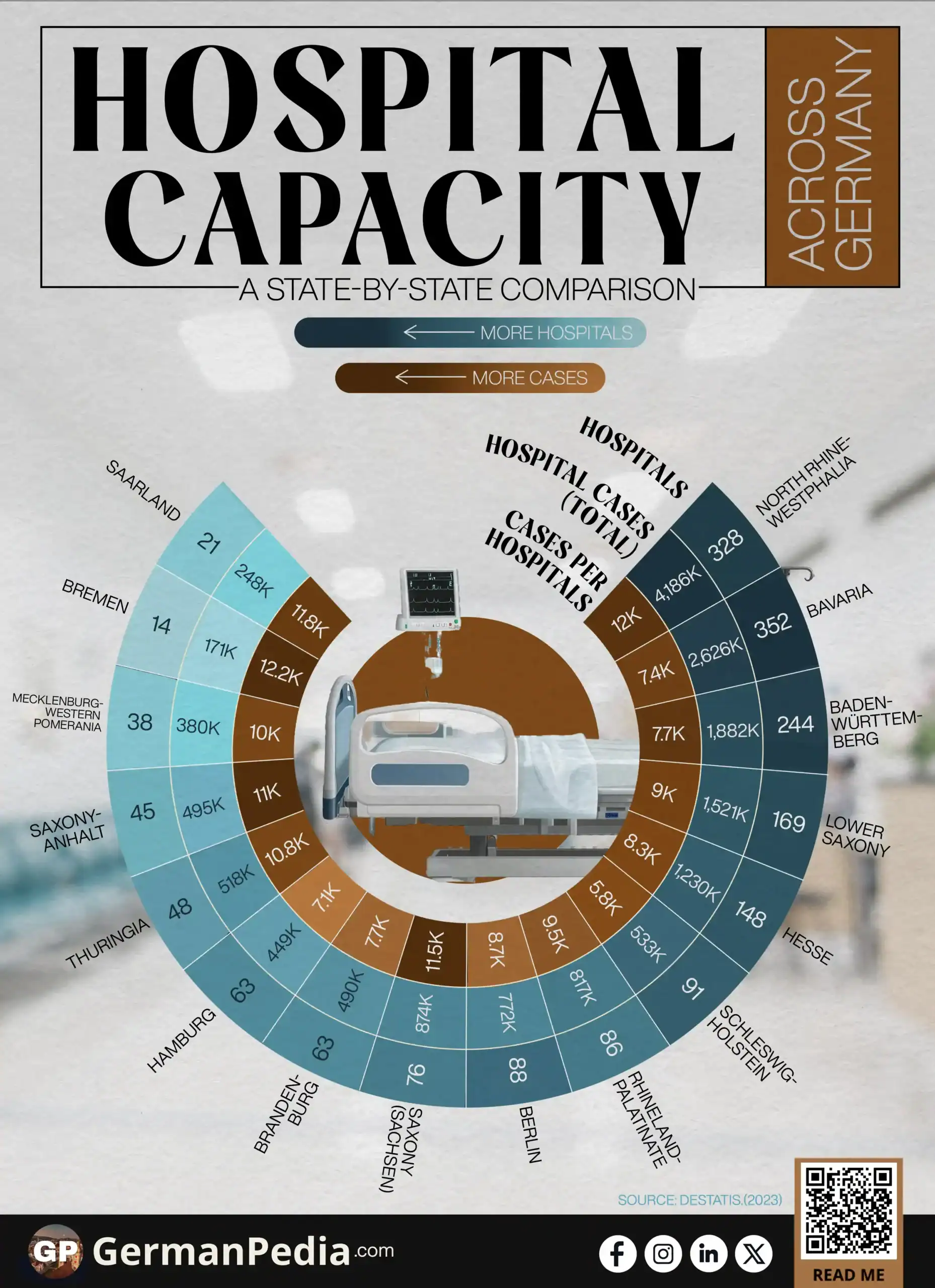
Use this Visualization: You may use this image for free with proper attribution to GermanPedia (i.e., by linking back to GermanPedia).
Need help communicating complex ideas visually? We help you turn data into your most persuasive story. Contact us to learn more.
Why Cases per Hospital Matter
Looking at hospital counts alone can be misleading.
A state may operate many hospitals, yet each facility may treat relatively few cases. Another state may run fewer hospitals that handle much higher patient volumes.
By comparing cases per hospital, we can better see how hospital capacity is distributed across facilities within each state.
Hospital Cases per Hospital in Germany
| State (Bundesland) | Hospitals | Hospital Cases (total) | Cases per Hospital |
|---|---|---|---|
| North Rhine-Westphalia | 328 | 4,186,321 | 12,768 |
| Bavaria | 352 | 2,626,492 | 7,462 |
| Baden-Württemberg | 244 | 1,882,791 | 7,713 |
| Lower Saxony | 169 | 1,521,596 | 9,003 |
| Hesse | 148 | 1,230,372 | 8,315 |
| Schleswig-Holstein | 91 | 533,955 | 5,868 |
| Rhineland-Palatinate | 86 | 817,637 | 9,510 |
| Berlin | 88 | 772,778 | 8,781 |
| Saxony (Sachsen) | 76 | 874,990 | 11,513 |
| Brandenburg | 63 | 490,979 | 7,789 |
| Hamburg | 63 | 449,461 | 7,133 |
| Thuringia | 48 | 518,837 | 10,809 |
| Saxony-Anhalt | 45 | 495,154 | 11,003 |
| Mecklenburg-Western Pomerania | 38 | 380,823 | 10,022 |
| Bremen | 14 | 171,082 | 12,206 |
| Saarland | 21 | 248,867 | 11,851 |
Source: Destatis

The Bavaria–NRW Contrast in Hospital Capacity
Bavaria operates 24 more hospitals than NRW, yet NRW treats around 1.6 million more hospital cases each year.
When broken down per facility, the difference becomes clear:
- NRW: 12,768 cases per hospital
- Bavaria: 7,462 cases per hospital
That represents a 71% higher average patient volume per hospital in NRW.
This gap does not imply better or worse care. It reflects different structural realities.
Bavaria’s large geographic area and many rural regions require a denser hospital network to maintain access. By contrast, NRW’s high population density allows demand to be concentrated in fewer, larger hospitals serving major urban areas.
Small German States, High Hospital Workloads
Smaller states reinforce the same pattern.
Bremen operates just 14 hospitals, yet each hospital handles an average of 12,206 cases per year. This closely matches NRW’s intensity. Saarland shows a similar profile, with 11,851 cases per hospital across 21 facilities.
By contrast, Brandenburg’s 63 hospitals average around 7,800 cases per facility. Its workload is comparable to Bavaria’s despite Brandenburg’s much smaller population.
Population of Cities in Germany ->
A Clear Structural Divide
Taken together, the figures point to a consistent divide in how hospital capacity is organised across Germany.
To make this pattern clearer, states can be grouped by average cases per hospital:
States with high cases per hospital (10,000+):
- North Rhine-Westphalia
- Bremen
- Saarland
- Saxony
- Saxony-Anhalt
- Thuringia
- Mecklenburg–Western Pomerania
States with lower cases per hospital (around 7,000–8,000):
- Bavaria
- Baden-Württemberg
- Brandenburg
- Hamburg
- Lower Saxony
- Hesse
- Rhineland-Palatinate
- Schleswig-Holstein
- Berlin
City-states and highly urbanised regions are more likely to fall into the high-volume group, while larger and more rural states tend to appear in the lower-volume group.
Berlin sits between these two models, reflecting its role as both a dense city and a regional healthcare hub.
What This Means for Patients
In more urbanised states such as North Rhine-Westphalia or Bremen, care is typically concentrated in fewer, higher-volume hospitals. These facilities often treat many patients each year and may offer a broader range of specialised services.
In larger, more rural states such as Bavaria or Baden-Württemberg, smaller hospitals are spread out to ensure geographic access, resulting in lower average patient volumes per facility.
Neither approach is better than the other. Patients in urban states benefit from centralized expertise but may face longer travel for non-local care. Those in rural states gain better geographic access yet encounter fewer high-volume centers, potentially limiting specialized options.
It is also important to note that cases per hospital is not the sole measure of quality or medical capacity, though it provides valuable insight into how care is organized. Quality depends on many additional factors, including staffing levels, equipment, case complexity, and clinical outcomes.
The data show that German states organise hospital care differently based on geography, population density, and settlement patterns. However, they have one similar goal: to ensure reliable access to hospital care.
More topics
- Highest Paying Jobs in Germany
- Popular Study Destinations for German Students
- Educational Attainment in European Countries
- Grocery Prices in Germany Have Increased Since 2000
- Germany’s Smoking Rate Has Declined Over Two Decades
- Germany’s Electricity Mix: From Coal to Renewables
- Changes in Harvest of Germany’s Five Key Crops
- Top German Companies by Revenue
- Germany’s Top Car Brands by New Registrations
- Unemployment Across Germany: A Federal State Breakdown
- Where Germany’s Tourists Come From
- Germany’s Largest National Parks, Ranked by Size
- Which Federal States Drive Germany’s Economy?
- How Marriage Rates Have Fallen in Germany: 1990–2023
- Leading Causes of Death in Germany