Key Takeaways
- Germany produced 44% of all the lignite mined in the EU in 2022.
- Germany consumed 109.2 million tonnes of coal in 2025. It ranks first in the EU, driven mainly by brown coal (also called lignite).
- Poland burns more hard coal than any other EU country. Coal also heats more Polish homes directly than in any other EU country.
- Poland and Czechia are the only EU countries that still mine hard coal domestically. EU state aid rules pushed most other member states out of hard coal mining after 2010.
- Brown coal barely crosses EU borders. It stays almost entirely in the country where it is mined.
- Coal consumption in the EU now tracks domestic mining more than energy demand. Countries with coal or lignite deposits still burn the most. Countries without domestic reserves have largely moved away from the fuel.
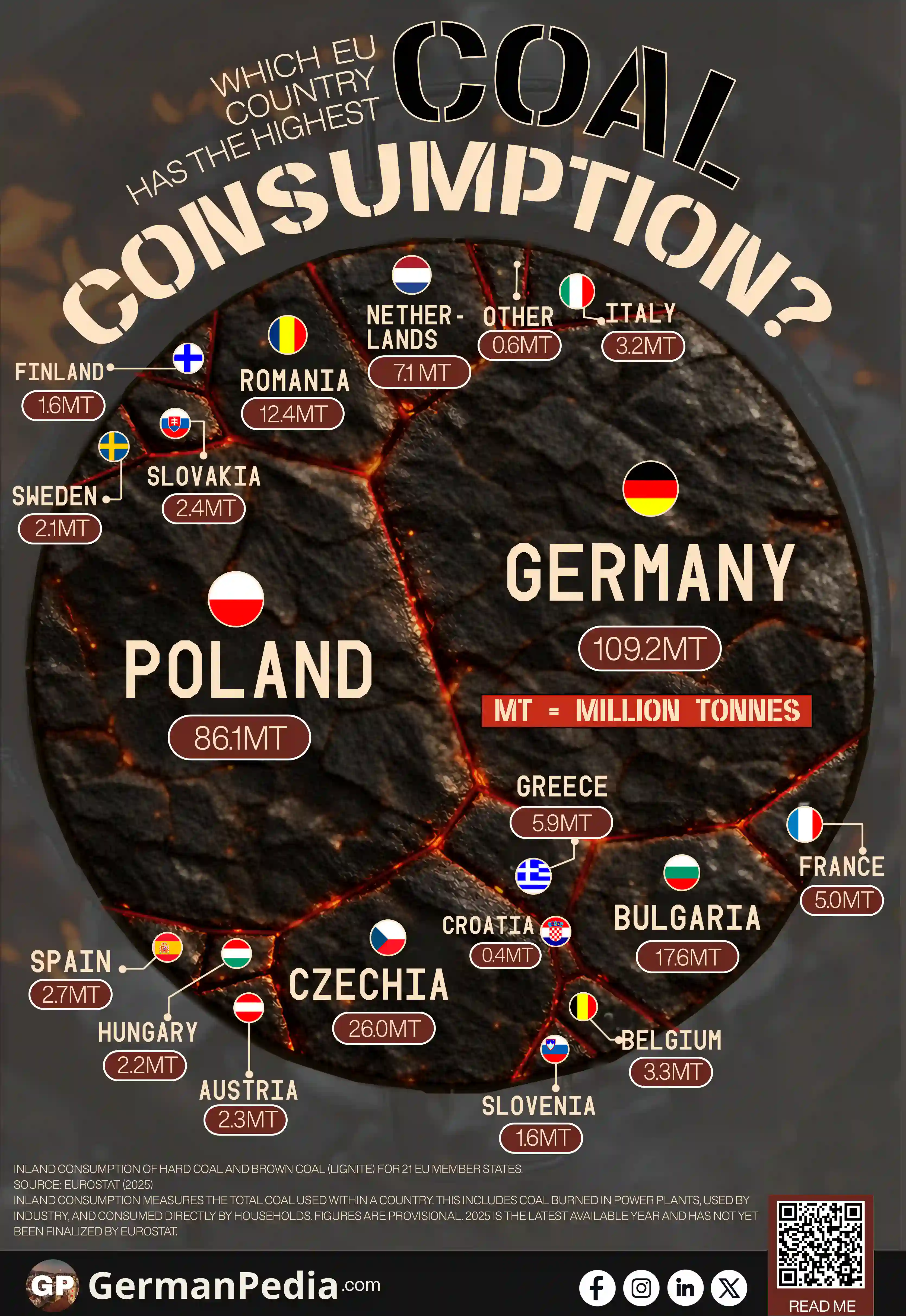
Use this Visualization: You may use this image for free with proper attribution to GermanPedia (i.e., by linking back to GermanPedia).
Need help communicating complex ideas visually? We help you turn data into your most persuasive story. Contact us to learn more.
EU Countries Ranked by Coal Consumption
| Country | Coal Consumption (In million tonnes) | ||
|---|---|---|---|
| Hard Coal | Brown Coal | Total | |
| Germany | 24.7 | 84.5 | 109.2 |
| Poland | 48.3 | 37.8 | 86.1 |
| Czechia | 2.9 | 23.1 | 26.0 |
| Bulgaria | 0.5 | 17.1 | 17.6 |
| Romania | 0.0 | 12.3 | 12.4 |
| Netherlands | 7.1 | 0.0 | 7.1 |
| Greece | 0.0 | 5.8 | 5.9 |
| France | 5.0 | 0.0 | 5.0 |
| Belgium | 3.2 | 0.1 | 3.3 |
| Italy | 3.2 | 0.0 | 3.2 |
| Spain | 2.7 | 0.0 | 2.7 |
| Slovakia | 2.3 | 0.1 | 2.4 |
| Austria | 2.3 | 0.0 | 2.3 |
| Hungary | 0.0 | 2.2 | 2.2 |
| Sweden | 2.1 | 0.0 | 2.1 |
| Slovenia | 0.0 | 1.6 | 1.6 |
| Finland | 1.6 | 0.0 | 1.6 |
| Croatia | 0.4 | 0.0 | 0.4 |
| Denmark | 0.3 | 0.0 | 0.3 |
| Ireland | 0.2 | 0.0 | 0.2 |
| Lithuania | 0.1 | 0.0 | 0.1 |
Source: Eurostat (2025)
Inland consumption measures the total coal used within a country. This includes coal burned in power plants, used by industry, and consumed directly by households.
Figures are provisional. 2025 is the latest available year and has not yet been finalized by Eurostat.

Coal Consumption in the EU Tracks Where the Fuel Is Mined
Coal splits into two main types in this dataset:
- Hard coal formed underground under more heat and pressure over millions of years. That gives it more energy per tonne and a hotter burn.
- Brown coal, also called lignite, formed closer to the surface and more recently. It holds more moisture and carries less energy per tonne as a result.
Germany used 109.2 million tonnes of coal in 2025. It ranks first among all EU countries.
Poland used 86.1 million tonnes. That is the second-highest total coal consumption in the EU.
Poland actually burns more hard coal than Germany does. Germany’s higher overall total comes from its lignite mining instead.
Germany consumed 84.5 million tonnes of brown coal in 2025. That is more than double Poland’s 37.8 million tonnes.
Brown coal rarely crosses borders once it is mined. Transporting it long distances costs more than the fuel is worth.
Germany produced 44% of all the lignite mined in the EU in 2022.
Germany, Poland, Bulgaria, Czechia, Romania, and Greece mined 90% to 95% of all EU lignite between 1990 and 2022. Those same six countries also lead EU lignite consumption today.
Poland and Czechia Are the Only EU Countries Still Mining Hard Coal
Poland burns more hard coal than any other EU country. It consumed 48.3 million tonnes in 2025.
Poland’s total hard coal consumption is nearly twice Germany’s 24.7 million tonnes. Part of that gap comes from how Polish households heat their homes.
In 2024, Poland was the only EU country where solid fuels covered most home heating. That figure reached 26.9%.
Most of Poland’s solid-fuel use is coal. That adds direct residential burning on top of what power plants and industry already consume.
Poland and Czechia are the only EU member states that still mine hard coal domestically. Every other country in the bloc imports the hard coal it burns.
In 2010, EU state aid rules stopped treating subsidies for uncompetitive coal mines as necessary for energy security.
Any coal-mine subsidies allowed after 2010 had to go only to mines already on a fixed closure timeline. Most EU countries wound down their hard coal mining over the following decade under that rule.
Poland is still closing hard coal mines with EU-approved financial support. The EU signed off on an updated version of that support in 2023.
The Netherlands imports all the hard coal it burns. It consumed 7.1 million tonnes in 2025.
The Netherlands mines no brown coal at all. No brown coal exists domestically to extract.
Coal use in the EU now tracks where the fuel is mined, not overall energy demand. Countries with their own coal or lignite deposits, like Germany, Poland, and Czechia, still burn the most.
Malta, Estonia, and Portugal show the opposite pattern. None of the three has any domestic coal or lignite mining.
Each of the three used well under 3,000 tonnes of coal in 2025. That is next to nothing compared with Germany’s 109.2 million tonnes.
More topics
- Energy Consumption for Cooling Has Doubled in the EU
- Italy Uses the Most Cooling Energy in the EU
- Which EU Country Uses the Most Electricity?
- EU Relies on Imports for Natural Gas
- EU Countries With the Most Greenhouse Gas Emissions
- Which countries have the cleanest drinking water?
- Which EU Country Has the Highest Flu Vaccination Rate?
- Most In-Demand Ausbildung Jobs in Germany
- German Cities with the Highest Crime Rates
- GDP per Capita vs Actual Consumption per Capita in the EU
- EU Household Expenditure on Food and Non-Alcoholic Beverages
- EU Rent Price Index by Country Over Time
- Apartment Rents Are Rising Faster Than House Rents in Germany
- Grocery Prices in Germany [2000 – 2025]
- Which EU Countries Had the Highest Inflation Rates?
References
- https://ec.europa.eu/eurostat/statistics-explained/index.php?title=Coal_production_and_consumption_statistics
- https://ec.europa.eu/eurostat/web/products-eurostat-news/w/ddn-20260813-1
- https://ec.europa.eu/eurostat/statistics-explained/index.php?title=Production_of_lignite_in_the_EU_-_statistics
- https://ec.europa.eu/eurostat/statistics-explained/index.php?title=Energy_consumption_in_households
- https://eur-lex.europa.eu/legal-content/EN/TXT/?uri=celex:32010D0787
- https://energy.ec.europa.eu/news/state-aid-commission-approves-amendments-polish-scheme-support-closure-coal-mines-2023-05-05_en