Key Takeaways
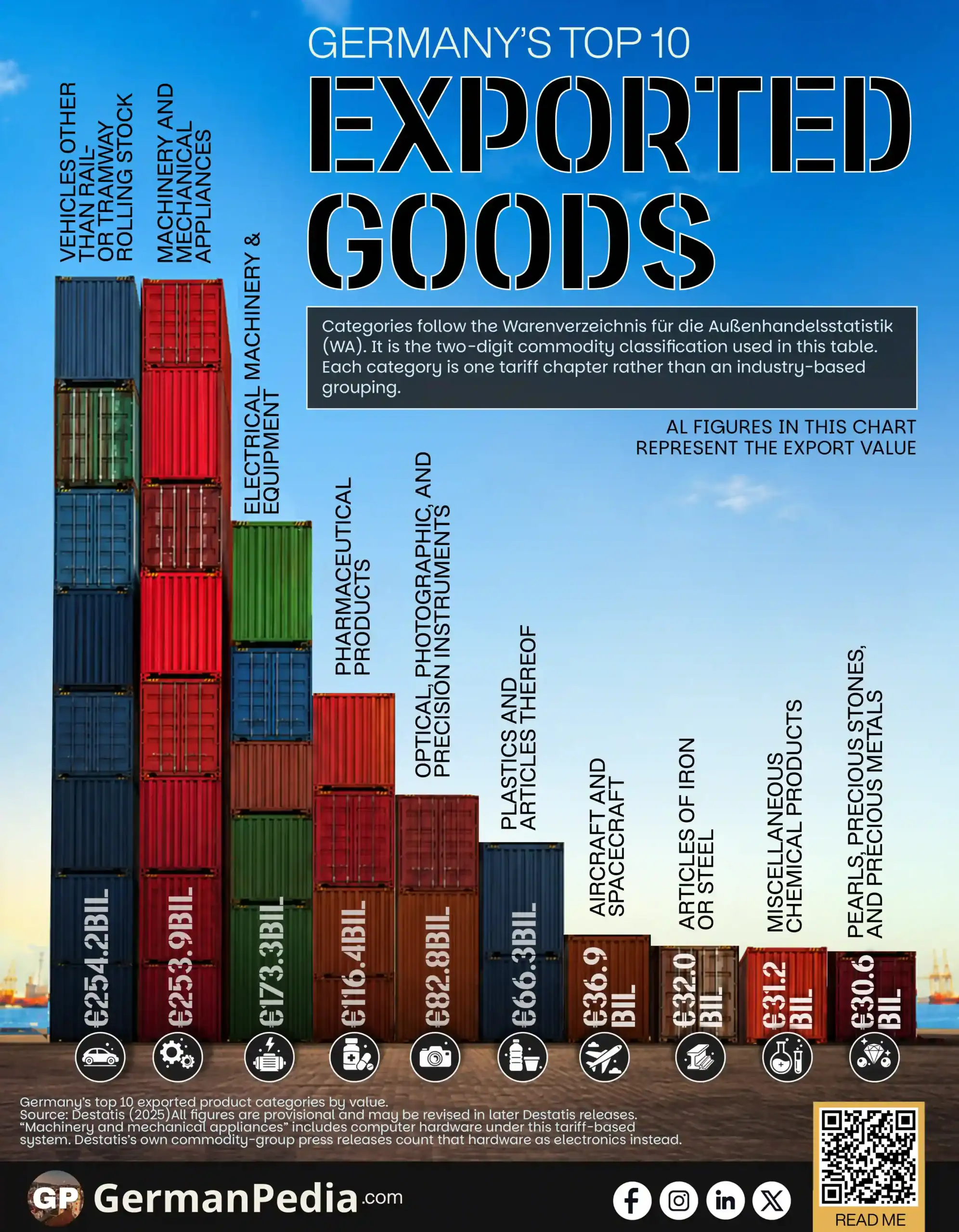
- Vehicles rank first among Germany’s exports at €254.2 billion in 2025. Machinery ranks a close second at €253.9 billion.
- Vehicles, machinery, and electrical equipment together make up 43.6% of everything Germany exported in 2025.
- Pharmaceutical products rank fourth among Germany’s exports at €116.4 billion. Heavy R&D spending and Germany’s lead in mRNA-based medicine helped push this newer entrant into the top tier.
- Decades of R&D investment and specialization in precision manufacturing explain why Germany’s top exports concentrate in cars, machinery, and pharmaceuticals.
Use this Visualization: You may use this image for free with proper attribution to GermanPedia (i.e., by linking back to GermanPedia).
Need help communicating complex ideas visually? We help you turn data into your most persuasive story. Contact us to learn more.
Germany’s Highest-Value Export Categories
| Rank | Category | Export Value (€ billion) |
|---|---|---|
| 1 | Vehicles other than rail- or tramway rolling stock | 254.2 |
| 2 | Machinery and mechanical appliances | 253.9 |
| 3 | Electrical machinery and equipment | 173.3 |
| 4 | Pharmaceutical products | 116.4 |
| 5 | Optical, photographic, and precision instruments | 82.8 |
| 6 | Plastics and articles thereof | 66.3 |
| 7 | Aircraft and spacecraft | 36.9 |
| 8 | Articles of iron or steel | 32.0 |
| 9 | Miscellaneous chemical products | 31.2 |
| 10 | Pearls, precious stones, and precious metals | 30.6 |
Source: Destatis (2025)
Categories follow the Warenverzeichnis für die Außenhandelsstatistik (WA). It is the two-digit commodity classification used in this table. Each category is one tariff chapter rather than an industry-based grouping.
All figures are provisional and may be revised in later Destatis releases.
“Machinery and mechanical appliances” includes computer hardware under this tariff-based system. Destatis’s own commodity-group press releases count that hardware as electronics instead.

Vehicles and Machinery Rank Almost Tied at the Top of Germany’s Exports
Germany exported €1,563 billion worth of goods in 2025.
Vehicles led Germany’s exports in 2025 at €254.2 billion. Machinery followed at €253.9 billion.
That is a gap of less than 0.02% of the country’s total exports.
Vehicles cover more than finished cars alone. The category includes trucks, motorcycles, and tractors along with their parts.
Machinery covers industrial equipment ranging from factory tooling to construction machinery.
Electrical machinery and equipment ranks third at €173.3 billion. That customs chapter groups industrial motors and generators together with telecom hardware and computer components.
Vehicles, machinery, and electrical equipment combined account for 43.6% of everything Germany exported in 2025.
German automakers produce roughly 60% of the world’s premium-branded vehicles. They invested almost €30.3 billion in research and development in 2023.
That was more than a third of all industrial R&D spending in Germany.
Research & Development Spending in the EU ->
A dense network of parts suppliers builds components specifically for German manufacturing lines. Bosch, Continental, and ZF Friedrichshafen are among the largest.
Germany’s Top Car Brands by New Registrations ->
That reputation for engineering carries over into brand value. Mercedes-Benz, BMW, Volkswagen, and Porsche remain among Germany’s most valuable global brands.
Together, the four automotive giants are worth more than $160 billion combined for 2026.
Machinery draws on the same engineering base. Germany controls close to 16% of the world’s machinery trade.
German manufacturers lead 13 of 31 machinery and equipment sectors worldwide.
Much of that strength comes from thousands of small and mid-sized manufacturers known as Germany’s “hidden champions.” These companies lead narrow, specialized product categories worldwide.
Few of them ever become household names.
Pharmaceuticals Climbed Into Germany’s Top Exports List
Pharmaceutical products rank fourth among Germany’s exports at €116.4 billion. This is a newer entrant to the top tier.
Germany is the world’s largest exporter of medicinal products. Its pharmaceutical firms invested €9.6 billion in R&D as of 2022.
Much of that investment followed BioNTech’s mRNA vaccine breakthrough. The company’s success turned Germany into a hub for mRNA-based medicine.
New manufacturing and research sites followed.
Germany’s export list is not a broad basket of goods. It concentrates in precision manufacturing: cars, machine tools, industrial equipment, and now pharmaceuticals.
Decades of R&D investment and specialized engineering built that position.
More topics
- Countries Driving Germany’s Quarter Trillion Export Surplus
- Which Countries Does Germany Import From Most?
- Germany’s Top Export Partners: Where €1.55 Trillion in Goods Go
- Which EU Countries Export the Most Food?
- EU Relies on Imports for Natural Gas
- EU Household Expenditure on Food and Non-Alcoholic Beverages
- EU Countries Are Only Partly Self-Sufficient in Food
- Leading EU Exporters and Importers of Digitally Delivered Services
- US Oil Exports to the EU Are Highly Concentrated
- Which EU Countries Attract the Most Foreign Investment?
- Most Prosperous EU Countries by Prosperity Index
- Causes of Death in Germany By Gender
- How Germany’s Birth Rates Dropped and Deaths Rose
- Germany’s Healthcare Expenditure Vs. Aging Population
- Which EU Country Uses the Most Electricity?
References
- https://genesis.destatis.de/datenbank/online/statistic/51000/table/51000-0005
- https://www.destatis.de/DE/Presse/Pressemitteilungen/2026/02/PD26_056_51.html
- https://www.gtai.de/resource/blob/64100/ebdfca790aa0df33b694bfc4e653f998/20250520_IO_Automotive_WEB.pdf
- https://www.gtai.de/en/invest/industries/industrial-production/machinery-equipment
- https://www.gtai.de/en/invest/industries/healthcare-market-germany/pharmaceutical-industry