Key Takeaways
- Luxembourg’s minimum wage ranks highest in euros among those same 22 countries. It was €2,704 in the first half of 2026.
- Estonia’s minimum wage ranks lowest among the 22 in purchasing power terms. It was only 876 PPS in the first half of 2026.
- Five EU countries have no legal minimum wage: Denmark, Italy, Austria, Finland, and Sweden. Employers and unions set pay through collective bargaining instead.
- The EU countries’ pay gap narrows from about 4.4-to-1 in euros to roughly 2.5-to-1 once cost of living is factored in. This happens because countries with lower wages also tend to have lower prices.
Use this Visualization: You may use this image for free with proper attribution to GermanPedia (i.e., by linking back to GermanPedia).
Need help communicating complex ideas visually? We help you turn data into your most persuasive story. Contact us to learn more.
EU Countries by Monthly Minimum Wage in Euros and Purchasing Power Standards
| Country | Monthly Minimum Wage | |
|---|---|---|
| In € | In PPS | |
| Germany | 2,343 | 2,164 |
| Luxembourg | 2,704 | 2,056 |
| Netherlands | 2,295 | 1,986 |
| Belgium | 2,112 | 1,817 |
| Ireland | 2,391 | 1,756 |
| Slovenia | 1,482 | 1,660 |
| France | 1,823 | 1,652 |
| Spain | 1,425 | 1,556 |
| Poland | 1,139 | 1,547 |
| Lithuania | 1,153 | 1,393 |
| Croatia | 1,050 | 1,339 |
| Portugal | 1,073 | 1,240 |
| Romania | 795 | 1,233 |
| Cyprus | 1,088 | 1,220 |
| Greece | 1,027 | 1,175 |
| Malta | 994 | 1,081 |
| Slovakia | 915 | 1,074 |
| Hungary | 838 | 1,048 |
| Czechia | 924 | 1,015 |
| Bulgaria | 620 | 993 |
| Latvia | 780 | 938 |
| Estonia | 886 | 876 |
Source: Eurostat
Minimum wages are expressed in gross terms, before tax and social security contributions are deducted.
Germany, France, Ireland, and the Netherlands set their minimum wages as hourly rates. That rate converts to a monthly figure for comparison here.
Czechia, Hungary, Poland, and Romania set their minimum wage in national currency, not euros. Their euro figures use the exchange rate in force at the end of the previous month.
Greece, Spain, and Portugal pay their minimum wage over 14 months a year instead of 12. Their figures are adjusted to reflect this.
The PPS figures for this period are estimates and could be revised. The euro figures are not flagged as estimates.
Denmark, Italy, Austria, Finland, and Sweden are excluded because they have no statutory national minimum wage. Collective bargaining between unions and employers sets wages in these five countries instead.

Germany Ranks First in Minimum Wage Among EU Countries
The purchasing power standard adjusts a wage for local prices. It shows what the money actually buys, not just its face value in euros.
In euros, Germany’s minimum wage ranks only third highest in the EU. Luxembourg and Ireland both pay more in euros.
However, they both fall behind Germany once purchasing power is factored in.
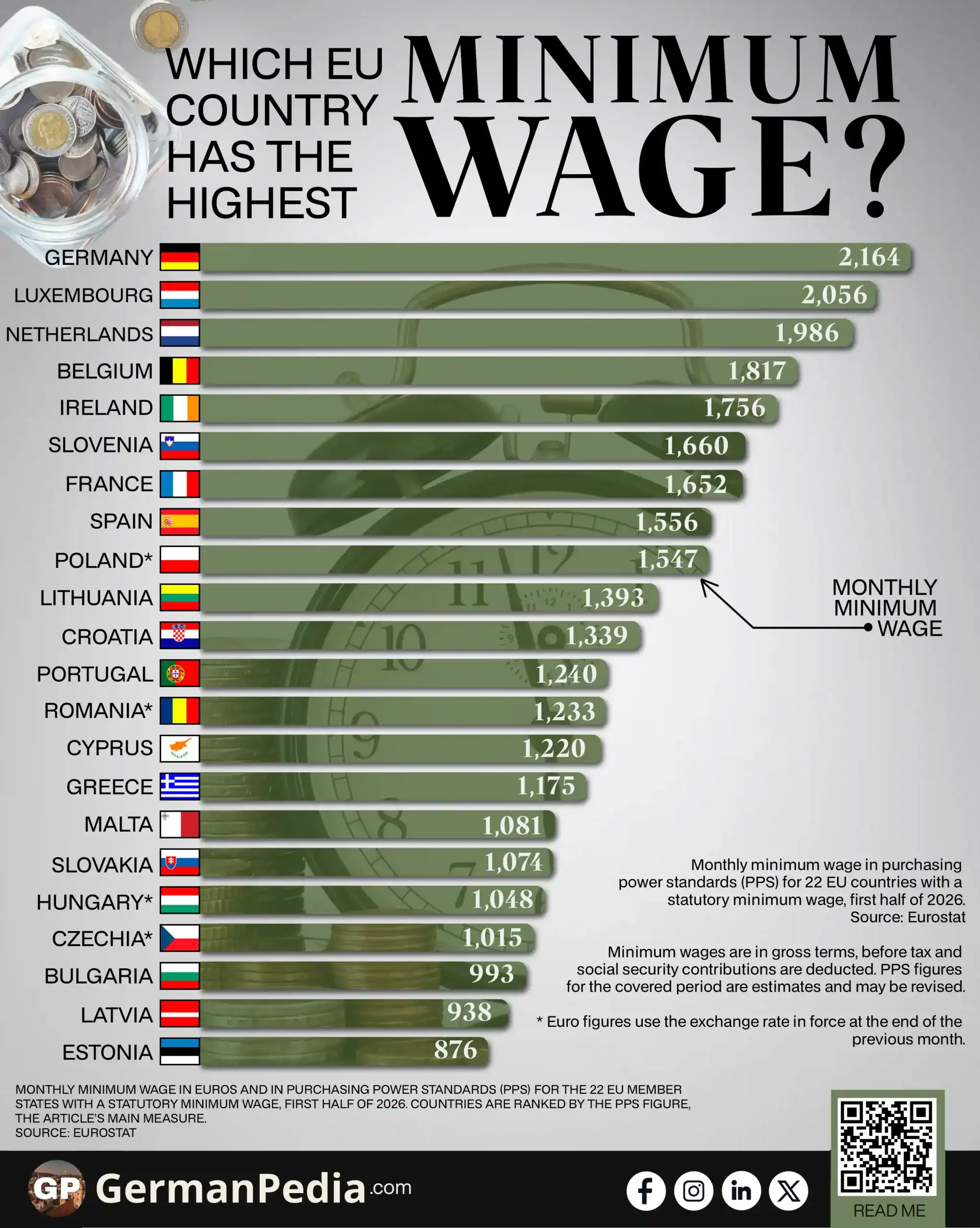
Germany pays a minimum wage of 2,343 euros a month in the first half of 2026. That converts to 2,164 PPS. That is the highest figure among the EU’s 22 countries with a legal minimum wage.
Luxembourg has a minimum wage of 2,704 euros monthly. That converts to 2,056 PPS.
Luxembourg has the EU’s highest food and grocery prices. They run about 22% above the EU average.
That higher cost of living eats into the value of Luxembourg’s wage. Germany’s prices sit closer to the EU average.
Its lower wage still goes further as a result.
The EU’s Minimum-Wage Gap Narrows Once Purchasing Power Is Counted
Among EU countries with a legal minimum wage, the highest minimum wage in euros is about 4.4 times the lowest.
- Luxembourg pays 2,704 euros a month is the highest among EU countries.
- Bulgaria pays 620 euros a month is the lowest.
In PPS terms, the highest minimum wage is only about 2.5 times the lowest.
- Germany’s 2,164 PPS is the highest.
- Estonia’s 876 PPS is the lowest.
Everyday prices vary just as widely across the EU as wages do.
Which EU Country Has the Highest Cost of Living? ->
Denmark’s prices run 40% above the EU average. It is the highest in the EU.
On the other end, Bulgaria’s prices run 37% below the EU average.
Countries that pay lower wages in euros tend to also be cheaper to live in. That is why the wage gap narrows once cost of living is factored in.
More topics
- Highest-Paying Ausbildung in Germany
- Top 25 Fastest-Growing Jobs in Germany
- Highest Paying Jobs in Germany
- Which EU Countries Work From Home the Most?
- GDP of European Countries
- Most In-Demand Ausbildung Jobs in Germany
- Energy Consumption for Cooling Has Doubled in the EU
- Which EU Country Has the Highest Cost of Living?
- EU Household Expenditure on Food and Non-Alcoholic Beverages
- EU Rent Price Index by Country Over Time
- Which EU Countries Had the Highest Inflation Rates?
- Minimum Wages Rose Fastest in Eastern Europe
- Which EU Countries Have the Highest Unemployment?
- The Best EU Countries to Retire In