
Key Takeaways
- The share of EU-employed people who usually work from home rose from 4.7% in 2006 to 8.9% in 2025. It nearly doubled in 19 years.
- Finland (20.9%) and Ireland (19.8%) lead the EU. Both rank among the EU’s highest for ICT specialist employment.
- Several countries that sat below the EU average in 2006 now outrank countries that led the EU that year. Germany, for example, rose from 4.2% to 13.3%. Germany now ranks 4th in the EU.
- Italy and Bulgaria are the only two EU member states where the WFH share fell between 2006 and 2025. Both have large manufacturing sectors with few roles that workers can do remotely.
- The COVID-19 pandemic accelerated WFH adoption. Labour market projections estimated this level would not have been reached until 2027 without the pandemic.
- WFH rates across the EU help track the share of the workforce in roles that can be done remotely.
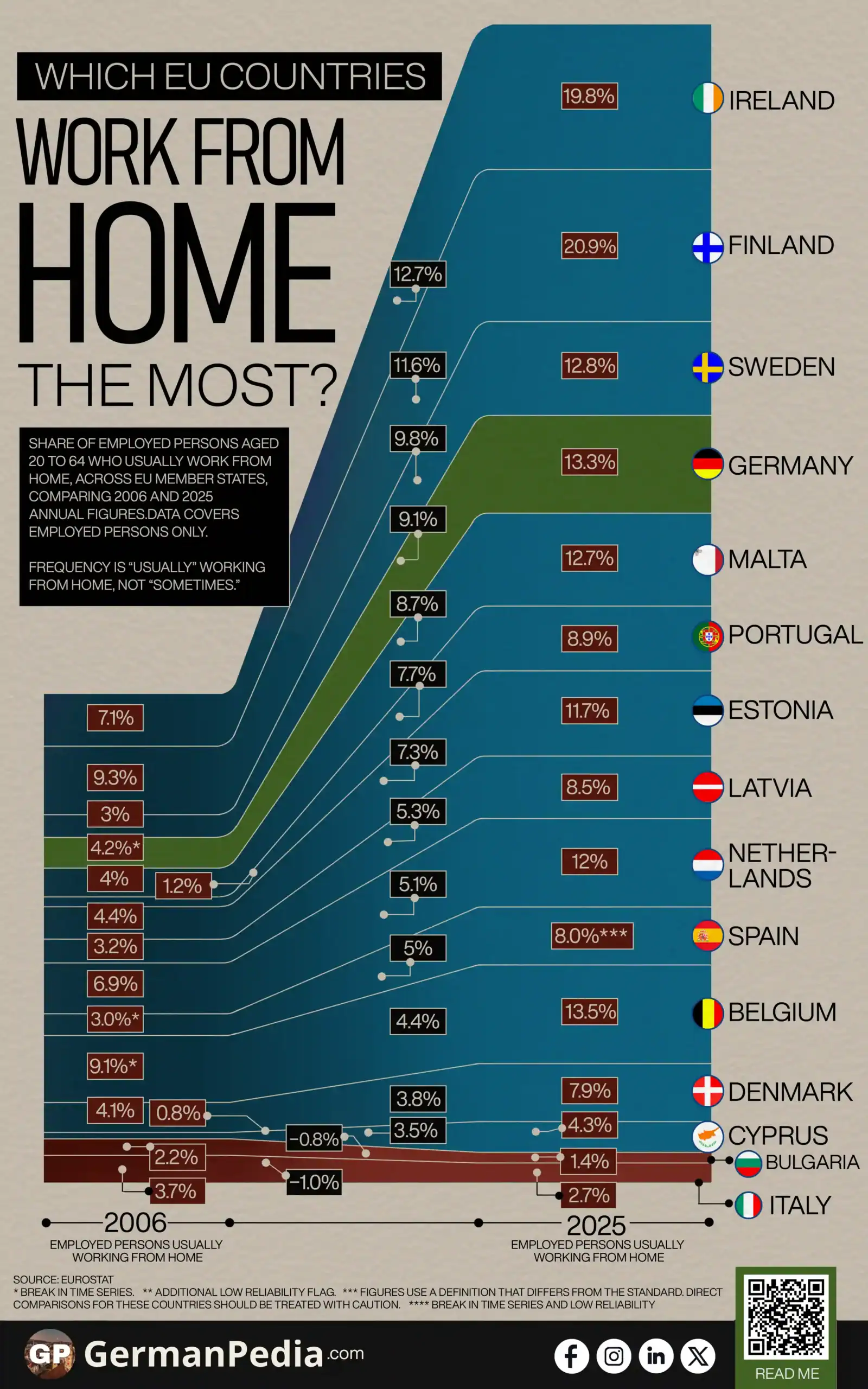
Use this Visualization: You may use this image for free with proper attribution to GermanPedia (i.e., by linking back to GermanPedia).
Need help communicating complex ideas visually? We help you turn data into your most persuasive story. Contact us to learn more.
Employed Persons Usually Working From Home Across EU Countries
| Country | Employed persons usually working from home | ||
|---|---|---|---|
| 2006 (%) | 2025 (%) | Change (pp) | |
| Finland | 9.3 | 20.9 | +11.6 |
| Ireland | 7.1 | 19.8 | +12.7 |
| Belgium | 9.1 | 13.5 | +4.4 |
| Germany | 4.2* | 13.3 | +9.1 |
| Sweden | 3.0 | 12.8 | +9.8 |
| Malta | 4.0 | 12.7 | +8.7 |
| Netherlands | 6.9* | 12.0 | +5.1 |
| Estonia | 4.4 | 11.7 | +7.3 |
| France | 10.5* | 11.3*** | +0.8 |
| Luxembourg | 8.5 | 11.2 | +2.7 |
| Austria | 10.3 | 11.1 | +0.8 |
| Portugal | 1.2 | 8.9 | +7.7 |
| Latvia | 3.2 | 8.5 | +5.3 |
| Spain | 3.0* | 8.0*** | +5.0 |
| Denmark | 4.1 | 7.9 | +3.8 |
| Slovenia | 5.1 | 7.3 | +2.2 |
| Slovakia | 4.2 | 7.3 | +3.1 |
| Czechia | 3.3 | 6.6 | +3.3 |
| Poland | 2.7 | 6.1 | +3.4 |
| Lithuania | 1.9 | 5.2 | +3.3 |
| Croatia | 1.4**** | 4.8 | +3.4 |
| Cyprus | 0.8 | 4.3 | +3.5 |
| Hungary | 2.2 | 4.1 | +1.9 |
| Greece | 1.6 | 2.3 | +0.7 |
| Italy | 3.7 | 2.7 | −1.0 |
| Romania | 0.6 | 1.3 | +0.7 |
| Bulgaria | 2.2 | 1.4 | −0.8 |
| EU-27 | 4.7 | 8.9 | +4.2 |
Source: Eurostat
Data covers employed persons only. Frequency is “usually” working from home, not “sometimes.”
* Break in time series.
** Additional low reliability flag.
*** Figures use a definition that differs from the standard. Direct comparisons for these countries should be treated with caution.
**** Break in time series and low reliability

The share of EU workers usually working from home rose from 4.7% in 2006 to 8.9% in 2025. These figures cover workers who work from home on a regular basis, not those who do so occasionally. The rise was not even across member states. Two countries ended 2025 below their 2006 starting point. Several others barely moved despite two decades of change.
At the peak of the pandemic in 2020, the EU’s WFH share is estimated to have reached around 12%. By 2025, it had settled at 8.9%. This reflects a shift toward hybrid arrangements. Labour market projections estimated that EU WFH adoption would not have reached this level until 2027 without the pandemic. Gains held most firmly in economies oriented toward technology, finance, and professional services. Ireland and Finland are the clearest examples. Both rank among the EU’s highest for ICT specialist employment.
Several countries that started at or below the EU average in 2006 saw the sharpest gains. Three recorded increases above 7 percentage points:
- Portugal: 1.2% → 8.9% (+7.7pp)
- Germany: 4.2% → 13.3% (+9.1pp)
- Sweden: 3.0% → 12.8% (+9.8pp)
Germany now ranks 4th in the EU. Sweden ranks 5th.
Across the EU, only two countries saw their WFH share fall:
- Italy: 3.7% (2006) → 2.7% (2025)
- Bulgaria: 2.2% (2006) → 1.4% (2025)
Italy’s decline reflects two factors. Its economy includes a large share of employment in manufacturing and small businesses, where remote work is less compatible with job roles. Emergency pandemic telework provisions also ended in Italy in September 2022. Many workers returned to working on-site.
Bulgaria’s low and declining rate reflects a small digital economy. Agricultural and manufacturing employment accounts for a large share of Bulgaria’s workforce. This limits the number of roles that workers can do remotely.
The gap between the EU’s highest and lowest WFH rates more than doubled between 2006 and 2025. It rose from 9.7 to 19.6 percentage points. The pandemic accelerated the timeline but not the direction. The divide tracks one factor above all others: the share of the workforce in roles that can be done remotely.
More topics
- Average Working Hours in EU Countries
- Gender Pay Gap Across EU Countries
- Minimum Wages Rose Fastest in Eastern Europe
- Which EU Countries Have the Highest Unemployment?
- Which EU Country Has the Most Press Freedom?
- Which EU Countries Have the Most Soft Power?
- The Best EU Countries to Retire In
- Which EU Country Uses the Most Electricity?
- Leading EU Exporters and Importers of Digitally Delivered Services
- Which EU Country Has the Highest Trade-to-GDP Ratio?
- Which EU Countries Had the Highest Inflation Rates?
- Most Prosperous EU Countries by Prosperity Index
- Where are Billionaires Concentrated in the EU?
- Which EU Countries Have the Highest Fraud Risk?
- EU Old-Age Dependency Ratio by Country
- EU Rent Price Index by Country Over Time
References
- https://ec.europa.eu/eurostat/databrowser/view/lfsa_ehomp__custom_21729172/default/table
- https://www.euronews.com/next/2025/03/22/how-did-the-covid-19-pandemic-affect-remote-work-in-europe
- https://link.springer.com/article/10.1007/s13209-024-00301-w
- https://kliemt.blog/2025/04/18/smart-working-and-short-weeks-are-here-to-stay-in-italy
- https://www.seyfarth.com/news-insights/legal-update-remote-work-in-italy-where-are-we-now.html