
Key Takeaways
- France led the EU with 102.00 million tourist arrivals in 2025. Spain followed closely with 96.80 million.
- Six of the EU’s ten most visited countries sit on the Mediterranean or in Southern Europe. That group includes France, Spain, Italy, Greece, Portugal, and Croatia.
- 82% of Europeans planned to travel between April and September 2026. That is the highest share since 2020.
- Luxembourg recorded the fewest tourist arrivals in this dataset. It reached just 1.41 million in 2025.
- Weather explains part of Southern Europe’s lead. It’s travelers’ second most-cited reason for choosing a 2026 destination.
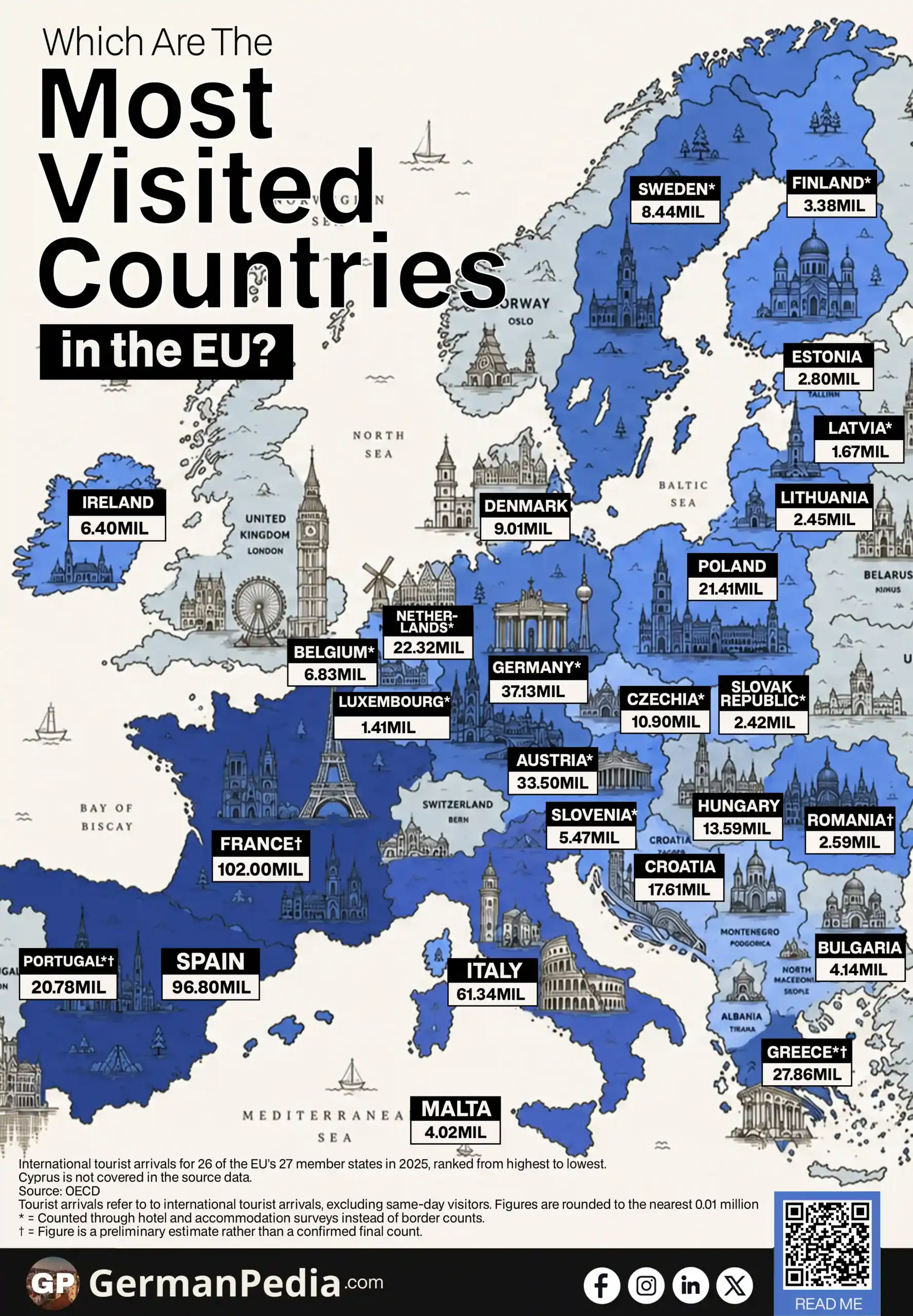
Use this Visualization: You may use this image for free with proper attribution to GermanPedia (i.e., by linking back to GermanPedia).
Need help communicating complex ideas visually? We help you turn data into your most persuasive story. Contact us to learn more.
EU Countries With the Most International Tourist Arrivals
| Country | Arrivals (In millions) |
|---|---|
| France† | 102.00 |
| Spain | 96.80 |
| Italy | 61.34 |
| Germany* | 37.13 |
| Austria* | 33.50 |
| Greece*† | 27.86 |
| Netherlands* | 22.32 |
| Poland | 21.41 |
| Portugal*† | 20.78 |
| Croatia | 17.61 |
| Hungary | 13.59 |
| Czechia* | 10.90 |
| Denmark | 9.01 |
| Sweden* | 8.44 |
| Belgium* | 6.83 |
| Ireland | 6.40 |
| Slovenia* | 5.47 |
| Bulgaria | 4.14 |
| Malta | 4.02 |
| Finland* | 3.38 |
| Estonia | 2.80 |
| Romania† | 2.59 |
| Lithuania | 2.45 |
| Slovak Republic* | 2.42 |
| Latvia* | 1.67 |
| Luxembourg* | 1.41 |
| EU-27 (aggregate)† | 529.56 |
Source: OECD
Tourist arrivals refer to international tourist arrivals, excluding same-day visitors. Figures are rounded to the nearest 0.01 million (10,000 arrivals).
* = Counted through hotel and accommodation surveys instead of border counts.
† = Figure is a preliminary estimate rather than a confirmed final count.

France and Spain Are in a Tight Race for Most Visited EU Country
Summer is the EU’s busiest tourism season. Europeans are especially eager to travel this year.
International tourist arrivals across the EU’s 27 member states reached 529.6 million in 2025.
France recorded 102.00 million tourist arrivals in 2025. That is the highest number among the 26 EU countries covered.
France’s lead traces partly to its regional and seasonal spread. Visitors are drawn beyond Paris to wine regions, coastlines, and mountains throughout the year.
Spain reached 96.80 million tourist arrivals. That trails France by just 5%.
Spain’s pull traces to its established sun-and-beach reputation, especially in the Canary Islands and along the Mediterranean coast.
Germany was Spain’s third-largest source market in 2025, after the UK and France.
Southern and Mediterranean Destinations Fill Majority of EU’s Top Tourist Rankings
Six of the EU’s ten most visited countries sit on the Mediterranean or in Southern Europe.
Alongside France, Spain, and Italy, that group includes Greece, Portugal, and Croatia.
That pattern lines up with current demand, not just past popularity. In April 2026, 82% of Europeans said they planned to travel between April and September that year.
That is the highest share since 2020. Southern and Mediterranean destinations are pulling nearly 60% of that 2026 travel demand:
- Spain: 14%
- Italy: 11%
- France: 8%
- Greece: 6%
- Portugal: 6%
Those figures are travelers’ stated destination preferences for spring and summer 2026, not arrival counts.
Weather helps explain the pull toward the south. It ranked as travelers’ second most-cited reason for choosing a 2026 destination, just behind safety.
Luxembourg and Latvia Recorded the Fewest Tourist Arrivals Among EU Countries
Luxembourg recorded 1.41 million tourist arrivals in 2025. That is the fewest among the 26 EU countries covered.
Latvia recorded the second-fewest total. It reached 1.67 million tourist arrivals.
Country size explains Luxembourg’s and Latvia’s totals, not falling demand. Luxembourg’s population is smaller than many single cities elsewhere in the EU.
Southern Europe’s lead reflects more than history. It reflects what today’s travelers say they want, from climate to culture.
That demand is likely to widen the gap between the top of this ranking and the rest of the EU before autumn arrives.
More topics
- EU Countries Gaining and Losing the Most Tourists
- Best EU Countries for Women
- Where Do Immigrants in Germany Come From?
- Which Countries Do Foreigners in Germany Come From?
- How many Foreign National Prisoners are in the EU?
- Which EU Countries Attract the Most Foreign Investment?
- Energy Consumption for Cooling Has Doubled in the EU
- Which Country Owns Almost a Quarter of the EU’s Wealth?
- Broadband Prices in the EU Over Time
- Bulgaria Now Has the EU’s Highest Smoking Rate
- How much parental leave do you get in the EU?
- Most Popular Degree Programs in Germany
- Which are the toughest prisons in the EU?
- Which EU Country Recycles the Most?
- Most Popular Dog Breeds in Germany
- Top Foreign Destinations for Germans
References
- https://www.oecd.org/content/dam/oecd/en/publications/reports/2026/06/oecd-tourism-trends-and-policies-2026_13326fe2/3fd3cd75-en.pdf
- https://etc-corporate.org/news/european-travel-sentiment-reaches-record-high-for-summer-2026/
- https://www.euronews.com/travel/2026/02/20/france-welcomed-record-visitor-numbers-in-2025-retaining-its-title-as-worlds-most-visited-
- https://www.euronews.com/travel/2026/02/04/spain-plans-to-focus-on-quality-over-quantity-as-tourist-numbers-hit-record-high