
Key Takeaways
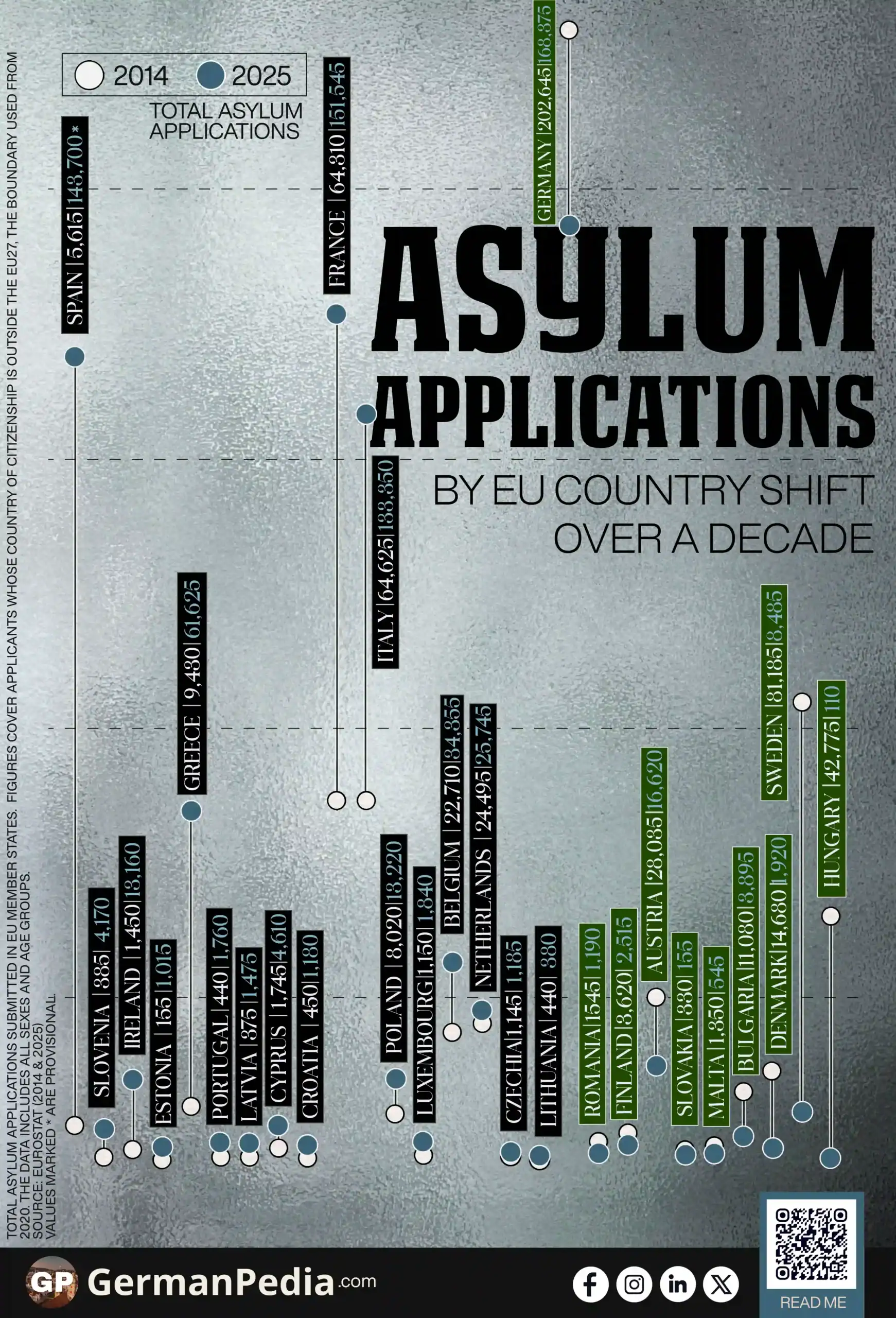
- EU-27 countries received 798,135 asylum applications in 2025. It increased by 34% from 594,180 in 2014.
- Spain recorded the sharpest increase of any EU country. Asylum applications rose from 5,615 in 2014 to 143,700 in 2025.
- Hungary’s asylum applications fell from 42,775 to 110. The country closed its asylum transit zones in 2020. It also moved the asylum application process to its embassy abroad.
- Sweden’s asylum applications dropped 90% after its 2022 governing coalition took power. It adopted a policy built around cutting refugee numbers.
- Greece’s asylum applications rose 554% over the decade. Its position on two of the EU’s main migration routes is often cited as a factor.
Use this Visualization: You may use this image for free with proper attribution to GermanPedia (i.e., by linking back to GermanPedia).
Need help communicating complex ideas visually? We help you turn data into your most persuasive story. Contact us to learn more.
EU Asylum Applications by EU Country
| Country | Total Asylum Applications | ||
|---|---|---|---|
| 2014 | 2025 | Change | |
| European Union – 27 countries | 594,180 | 798,135 | +34% |
| Spain | 5,615 | 143,700* | +2,459% |
| Slovenia | 385 | 4,170 | +983% |
| Ireland | 1,450 | 13,160 | +808% |
| Estonia | 155 | 1,015 | +555% |
| Greece | 9,430 | 61,625 | +554% |
| Portugal | 440 | 1,760 | +300% |
| Latvia | 375 | 1,475 | +293% |
| Cyprus | 1,745 | 4,610 | +164% |
| Croatia | 450 | 1,180 | +162% |
| France | 64,310 | 151,545 | +136% |
| Italy | 64,625 | 133,350 | +106% |
| Poland | 8,020 | 13,220 | +65% |
| Luxembourg | 1,150 | 1,840 | +60% |
| Belgium | 22,710 | 34,355 | +51% |
| Netherlands | 24,495 | 25,745 | +5% |
| Czechia | 1,145 | 1,185 | +3% |
| Lithuania | 440 | 380 | -14% |
| Germany | 202,645 | 168,375 | -17% |
| Romania | 1,545 | 1,190 | -23% |
| Finland | 3,620 | 2,515 | -31% |
| Austria | 28,035 | 16,620 | -41% |
| Slovakia | 330 | 155 | -53% |
| Malta | 1,350 | 545 | -60% |
| Bulgaria | 11,080 | 3,895 | -65% |
| Denmark | 14,680 | 1,920 | -87% |
| Sweden | 81,185 | 8,485 | -90% |
| Hungary | 42,775 | 110 | -99.7% |
Source: Eurostat (2014 & 2025)
Values marked * are provisional.

In 2014, Germany and Sweden together recorded almost half of all asylum applications submitted across the EU. By 2025, their combined share had fallen to about one-fifth. Asylum applications did not disappear. New countries absorbed them. New routes opened.
Hungary and Sweden’s Asylum Applications Collapsed After Policy Changes
Hungary’s asylum applications fell from 42,775 in 2014 to 110 in 2025. That is a drop of more than 99%. A 2020 Court of Justice of the European Union ruling found Hungary’s transit-zone detention of asylum seekers illegal. Hungary closed the transit zones that year. Applicants must now file a statement of intent at a Hungarian embassy abroad before they can enter the country to seek asylum.
Sweden’s asylum applications fell from 81,185 to 8,485 over the same period. That is a decline of 90%. Sweden’s governing coalition formed after the September 2022 election with support from the Sweden Democrats. The Sweden Democrats’ platform centers on reducing the number of asylum applications accepted.
The coalition agreed to the Tidö Agreement in October. The agreement set a broad goal of cutting asylum immigration through stricter residency conditions and tighter enforcement of returns. It also cut Sweden’s annual refugee resettlement quota from 5,000 to 900. The quota is a separate admissions program for refugees referred by the UNHCR. It does not cover people who apply for asylum after arriving in Sweden.
Hungary and Sweden show that national policy can cut asylum applications sharply, even while pressure persists elsewhere in the EU.
Spain Becomes the EU’s Largest Source of New Asylum Applications
Spain recorded 143,700 asylum applications in 2025. Out of that number, 141,035 are first-time asylum applications. That ranks above Italy, France, and Germany. Spain is now the EU’s largest source of new asylum applications.
Venezuelans filed 89,500 first-time asylum applications across the EU that year. Spain received 93% of those asylum applications. Spain’s existing Venezuelan community and shared language with Latin American applicants are commonly cited as reasons asylum applications are concentrated there.
Greece’s asylum applications also rose sharply over the decade. It climbed from 9,430 to 61,625. Greece’s exposure to migration routes from Turkey and, more recently, Libya, is a common factor.
EU Asylum Applications Redistributed Rather Than Declined
EU-27’s total asylum applications grew 34% over the decade. However, that single number hides how completely the underlying picture changed. The countries that drove asylum applications in 2014 are not the countries driving them in 2025. Each country’s path was shaped by its own policy decisions or its own geography, not by any EU-wide coordination. What looks like one EU trend is really dozens of separate national stories.
More topics
- Which EU Country Has the Highest Cost of Living?
- Which Countries Do Foreigners in Germany Come From?
- Where Do People Arriving from Abroad Settle in Germany?
- Where Do Immigrants in Germany Come From?
- EU At-Risk-of-Poverty Rate by Country Shows a Growing Divide
- EU Household Expenditure on Food and Non-Alcoholic Beverages
- Treatable Mortality Rate Improvement Across EU Countries
- Apartment Rents Are Rising Faster Than House Rents in Germany
- Which EU Countries Had the Highest Inflation Rates?
- EU Fertility Rate by Country
- Average Working Hours in EU Countries
- Gender Pay Gap Across EU Countries
- Which EU Countries Have the Highest Unemployment?
- The Best EU Countries to Retire In
- Most Prosperous EU Countries by Prosperity Index
References
- https://ec.europa.eu/eurostat/databrowser/view/migr_asyappctza/default/table
- https://www.euaa.europa.eu/latest-asylum-trends-january-june-2025/applications
- https://eur-lex.europa.eu/legal-content/EN/TXT/?uri=oj:JOC_2020_240_R_0035
- https://help.unhcr.org/hungary/asylum/applying-for-asylum/
- https://www.euaa.europa.eu/asylum-report-2024/314122-national-developments-and-challenges