Key Takeaways
- AB InBev is the largest brewing group in both the EU and the world. It is headquartered in Belgium. It produced 495.49 million hectolitres of beer in 2024. That is 26.4% of global output.
- Eighteen EU-headquartered brewing groups rank among the world’s top 40 brewers. Together, they produced 52.5% of all beer made globally in 2024.
- AB InBev and Heineken alone account for 39.2% of world beer production. That is almost three times the combined output of the other 16 EU groups on the list.
- Germany places six brewing groups on the list. That is more than any other EU country. None of them ranks above 23rd globally.
- Germany counted 1,459 active breweries in 2024. Its brewing groups stay small even though the country has plenty of them.
- AB InBev’s scale traces to repeated mergers. Regulators cleared its 2016 purchase of SABMiller only after AB InBev agreed to sell off nearly all of SABMiller’s European operations.
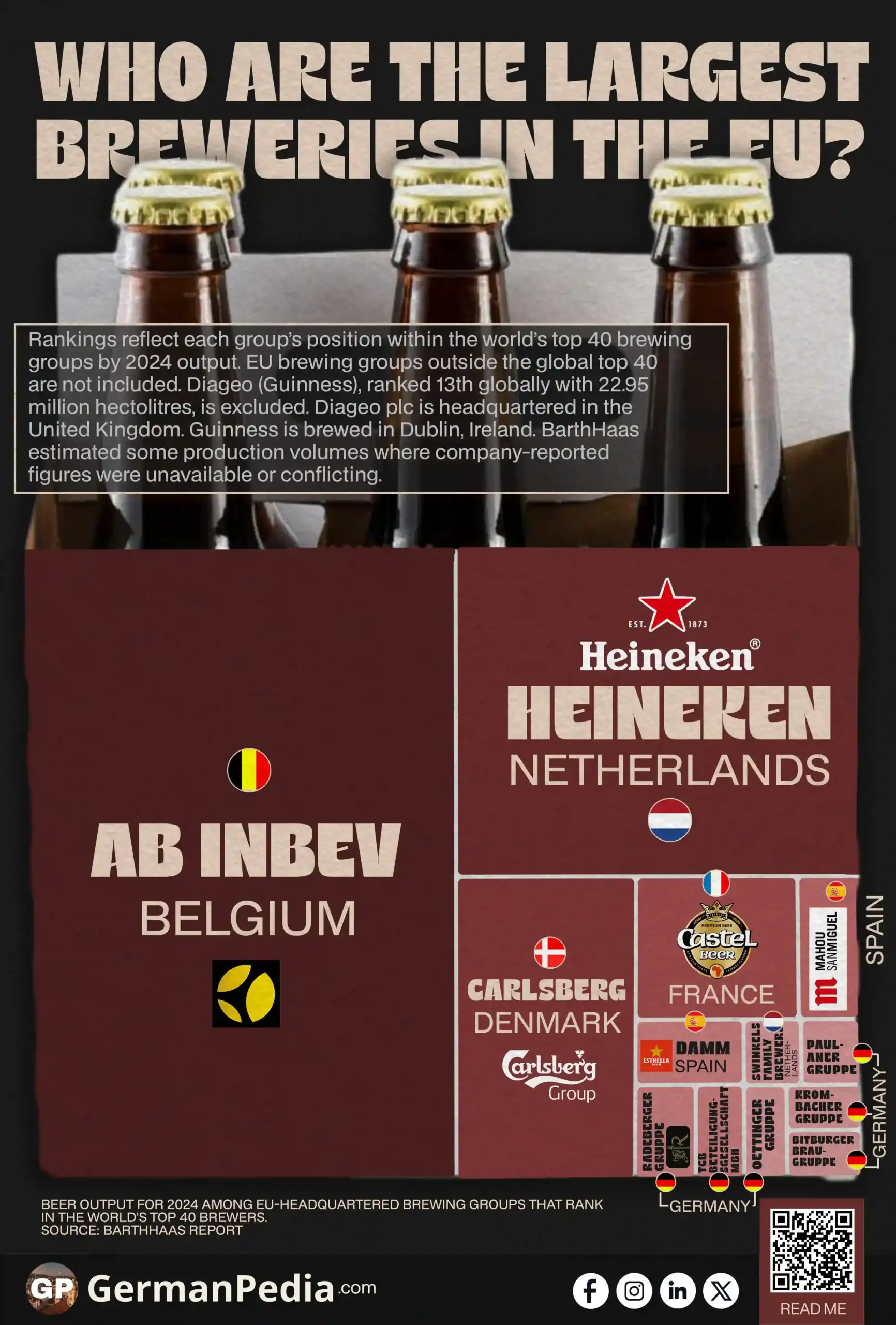
Use this Visualization: You may use this image for free with proper attribution to GermanPedia (i.e., by linking back to GermanPedia).
Need help communicating complex ideas visually? We help you turn data into your most persuasive story. Contact us to learn more.
Beer Output of the Largest EU Brewing Groups
| World Rank | Brewing Group | Country | Annual Beer Output | |
|---|---|---|---|---|
| In mill. hl | % Share of World Production | |||
| 1 | AB InBev | Belgium | 495.49 | 26.4% |
| 2 | Heineken | Netherlands | 240.70 | 12.8% |
| 4 | Carlsberg | Denmark | 101.20 | 5.4% |
| 8 | BGI / Groupe Castel | France | 44.00 | 2.3% |
| 18 | Grupo Mahou-San Miguel | Spain | 15.90 | 0.8% |
| 22 | Damm | Spain | 12.65 | 0.7% |
| 23 | Radeberger Gruppe | Germany | 10.40 | 0.6% |
| 28 | TCB Beteiligungsgesellschaft mbH | Germany | 7.50 | 0.4% |
| 29 | Swinkels Family Brewers | Netherlands | 7.30 | 0.4% |
| 30 | Paulaner Gruppe | Germany | 6.61 | 0.4% |
| 31 | Oettinger Gruppe | Germany | 6.60 | 0.4% |
| 32 | Krombacher Gruppe | Germany | 5.94 | 0.3% |
| 33 | Bitburger Braugruppe | Germany | 5.78 | 0.3% |
| 35 | Olvi Group | Finland | 5.30 | 0.3% |
| 36 | Estrella de Galicia | Spain | 5.30 | 0.3% |
| 37 | Royal Unibrew | Denmark | 5.00 | 0.3% |
| 38 | Martens | Belgium | 4.80 | 0.3% |
| 40 | Financière ACP | France | 4.20 | 0.2% |
Source: BarthHaas Report
Rankings reflect each group’s position within the world’s top 40 brewing groups by 2024 output. EU brewing groups outside the global top 40 are not included. Diageo (Guinness), ranked 13th globally with 22.95 million hectolitres, is excluded. Diageo plc is headquartered in the United Kingdom. Guinness is brewed in Dublin, Ireland. BarthHaas estimated some production volumes where company-reported figures were unavailable or conflicting.

AB InBev and Heineken Make 39% of the World’s Beer
Eighteen EU-headquartered groups rank among the world’s top 40 brewers. Together they produced 984.67 million hectolitres of beer in 2024. That is 52.5% of everything brewed worldwide.
AB InBev and Heineken account for most of that. The two companies alone made 736.19 million hectolitres in 2024. That is 39.2% of world output, almost three times as much as the other 16 EU groups on the list produced combined.
AB InBev’s scale did not happen overnight. The company grew through a string of mergers. The most recent one is the 2016 purchase of SABMiller. Regulators raised concerns that the deal would reduce competition and raise prices in several European countries. They cleared it only after AB InBev agreed to sell off nearly all of SABMiller’s European business.
Germany’s Six Brewing Groups All Rank Outside the World’s Top 20
Germany places six brewing groups on this list. That is more than any other EU country is represented. However, none of them ranks above 23rd globally. Radeberger Gruppe is Germany’s highest-ranked group at the 23rd position. The other five all fall between 28th and 33rd.
Combined, the six German groups produced 42.83 million hectolitres in 2024. That is less than a fifth of Heineken’s output alone.
Germany counted 1,459 active breweries nationwide in 2024. A large number of small brewers, rather than a few large ones, defines its beer industry on this list.
Spain is the only other EU country with more than two entries on the list. It places three groups. However, none ranks higher than 18th.
The EU’s brewing industry splits into two tiers. A handful of companies reached global scale through decades of acquisitions. Most of the rest operate at a fraction of that scale. Scale on this list comes from consolidation. It is not from how many breweries a country has.
More topics
- EU Household Expenditure on Food and Non-Alcoholic Beverages
- Beer Sales in Germany Have Fallen in 2026
- Germany Drinks 40% Less Beer Than It Did in 1980
- EU Countries Are Only Partly Self-Sufficient in Food
- Leading EU Exporters and Importers of Digitally Delivered Services
- US Oil Exports to the EU Are Highly Concentrated
- Countries Driving Germany’s Quarter Trillion Export Surplus
- Germany’s Top Export Partners: Where €1.55 Trillion in Goods Go
- Which EU Countries Attract the Most Foreign Investment?
- Most Prosperous EU Countries by Prosperity Index
- Causes of Death in Germany By Gender
- How Germany’s Birth Rates Dropped and Deaths Rose
- Germany’s Healthcare Expenditure Vs. Aging Population
- Which EU Countries Had the Highest Inflation Rates?
- EU Self-Supplied Water Use by Economic Sector
References
- https://www.barthhaas.com/fileadmin/user_upload/01-barthhaas-2022/Resources/BarthHaas_Report/2025/eng/Web_BarthHaas_Report_2024_25..pdf
- https://europa.eu/rapid/press-release_IP-16-1900_en.htm
- https://www.destatis.de/DE/Themen/Staat/Steuern/Verbrauchsteuern/Publikationen/Downloads-Verbrauchsteuern/statistischer-bericht-brauwirtschaft-2140922247005.html