
Key Takeaways
- Two of the three highest-paying Ausbildung professions are in the dairy industry.
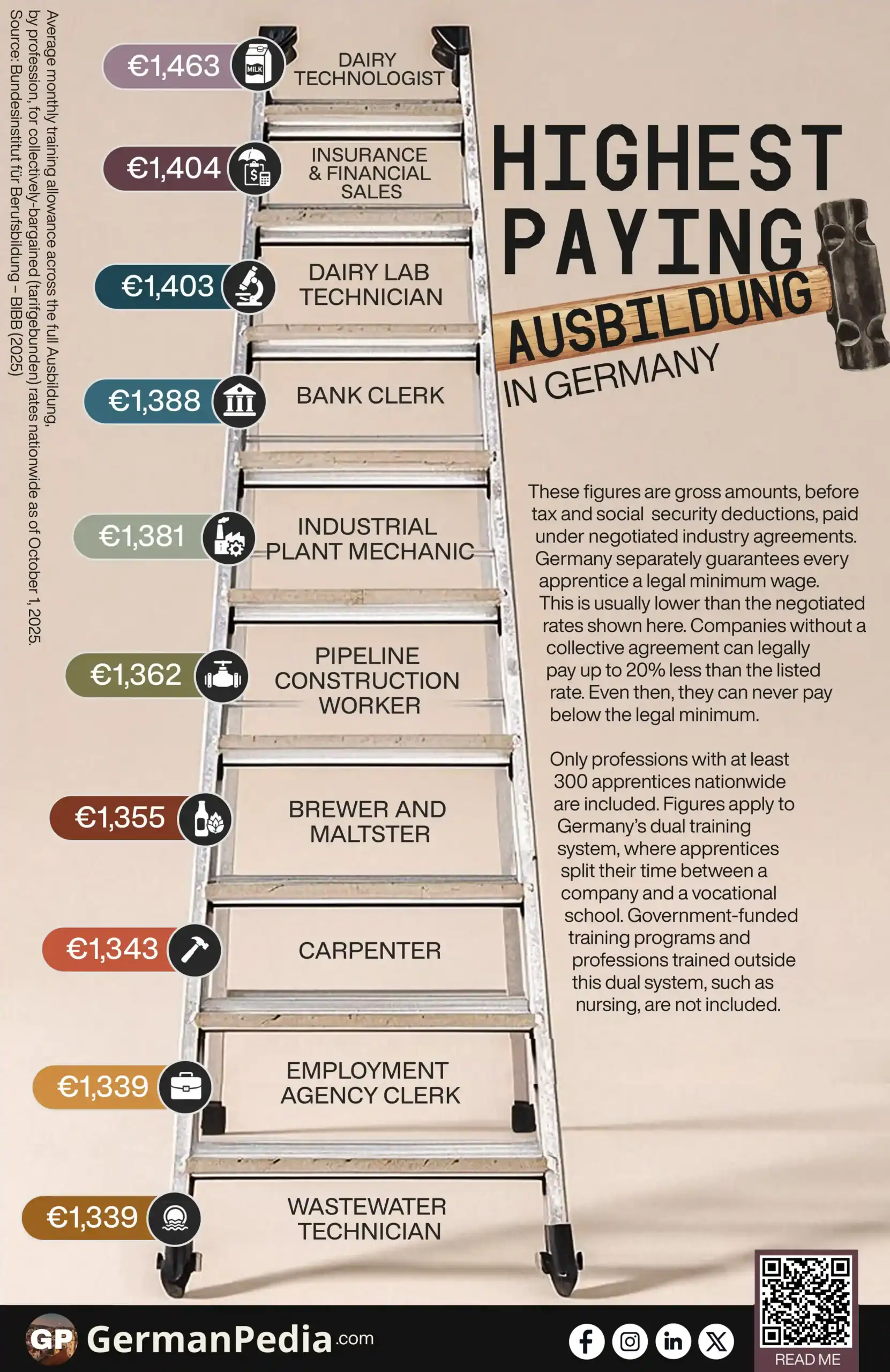
- Milchtechnologe/-technologin (dairy technologist) has the highest average Ausbildung allowance in Germany at €1,463 a month. Milchwirtschaftliche/-r Laborant/-in (dairy lab technician) ranks third at €1,403 a month.
- Six public-sector apprenticeships rank among the 15 highest-paid Ausbildung professions in Germany. All six pay within €9 of each other a month.
- Carpentry apprentices see one of the sharpest pay jumps during training. Pay rises from €1,070 a month in year one to €1,527 by year three.
- Ausbildung pay depends more on how a profession negotiates wages than on job prestige. Public-sector professions share one pay scale, while private-sector standouts pay more because employers compete for scarce apprentices.
Use this Visualization: You may use this image for free with proper attribution to GermanPedia (i.e., by linking back to GermanPedia).
Need help communicating complex ideas visually? We help you turn data into your most persuasive story. Contact us to learn more.
Highest Ausbildung Allowances by Profession
| Ausbildung Profession | Sector | Average Monthly Allowance |
|---|---|---|
| Milchtechnologe/-technologin (Dairy Technologist) | Agriculture | €1,463 |
| Kaufmann/-frau für Versicherungen und Finanzanlagen (Insurance and Financial Sales) | Industry and Commerce | €1,404 |
| Milchwirtschaftliche/-r Laborant/-in (Dairy Lab Technician) | Agriculture | €1,403 |
| Bankkaufmann/-frau (Bank Clerk) | Industry and Commerce | €1,388 |
| Anlagenmechaniker/-in (Industrial Plant Mechanic) | Industry and Commerce | €1,381 |
| Rohrleitungsbauer/-in (Pipeline Construction Worker) | Industry and Commerce | €1,362 |
| Brauer/-in und Mälzer/-in (Brewer and Maltster) | Industry and Commerce | €1,355 |
| Zimmerer/Zimmerin (Carpenter) | Skilled Trades | €1,343 |
| Fachangestellte/-r für Arbeitsmarktdienstleistungen (Employment Agency Clerk) | Public Sector | €1,339 |
| Umwelttechnologe/-in für Abwasserbewirtschaftung (Wastewater Technician) | Public Sector | €1,339 |
Source: Bundesinstitut für Berufsbildung – BIBB (2025)
These figures are gross amounts, before tax and social security deductions, paid under negotiated industry agreements.
Germany separately guarantees every apprentice a legal minimum wage. This is usually lower than the negotiated rates shown here. Companies without a collective agreement can legally pay up to 20% less than the listed rate. Even then, they can never pay below the legal minimum.
Only professions with at least 300 apprentices nationwide are included. Figures apply to Germany’s dual training system, where apprentices split their time between a company and a vocational school. Government-funded training programs and professions trained outside this dual system, such as nursing, are not included.

What is an Ausbildung?
Germany trains new workers through a dual system called Ausbildung. Trainees split their week between a company, where they learn the job, and a vocational school, where they study the theory. Training typically lasts 2 to 3.5 years, depending on the profession. Every apprentice receives a monthly allowance called Ausbildungsvergütung throughout the training period, not only after graduation.
German law has guaranteed every apprentice a minimum monthly training allowance since 2020. A collective bargaining agreement is a contract between a trade union and an employer group. It sets one standard pay rate for every company in that industry and region. Companies bound by such an agreement must pay at least the negotiated rate. Companies outside a collective agreement can pay up to 20% less than that rate, never below the legal minimum. These figures reflect collectively-bargained rates. Individual pay can differ.
Dairy Ausbildung Apprenticeships Pay More Than Banking or Insurance
Two of the three highest-paid Ausbildung allowances in the country belong to the dairy industry. A dairy technologist apprenticeship (Milchtechnologe/-technologin) ranks first among all Ausbildung professions in Germany. It pays €1,463 a month. A dairy lab technician apprenticeship (Milchwirtschaftliche/-r Laborant/-in) ranks third at €1,403 monthly.
An insurance and financial sales apprenticeship (Kaufmann/-frau für Versicherungen und Finanzanlagen) ranks second at €1,404 a month. The standard bank clerk apprenticeship (Bankkaufmann/-frau) ranks fourth at €1,388.
Companies in professions facing applicant shortages have raised apprentice pay faster than others, to attract more candidates. That helps explain why physically demanding trades like pipeline construction outearn some office-based apprenticeships.
Public-Sector Ausbildung Apprenticeships Pay Nearly the Same Amount
Six public-sector apprenticeships rank among the 15 highest-paid Ausbildung professions in Germany. An employment agency clerk apprenticeship (Fachangestellte/-r für Arbeitsmarktdienstleistungen) and a wastewater technician apprenticeship (Umwelttechnologe/-in für Abwasserbewirtschaftung) both rank ninth, at €1,339 a month. The two jobs have almost nothing in common day to day.
TVAöD sets the same wage scale across the entire public sector, regardless of the specific job. It is a collective bargaining agreement. Private-sector pay varies far more by profession.
Carpentry and Pipeline Apprentices See the Biggest Pay Jumps During Training
The four-year average hides how pay actually arrives. The carpentry apprenticeship (Zimmerer/Zimmerin) starts at €1,070 a month in year one and rises to €1,527 by year three. The pipeline construction apprenticeship (Rohrleitungsbauer/-in) follows a similar pattern. It starts at €1,162 and reaches €1,501 by year three.
Bank Clerk apprenticeships (Bankkaufmann/-frau) pay far more evenly across the same period. First-year trainees earn €1,333 a month. That is close to the €1,455 paid to third-year trainees.
A first-year carpentry apprentice takes home hundreds of euros less per month than the average suggests. A first-year bank trainee already earns close to the full rate.
Ausbildung pay depends more on how a profession negotiates wages than on job prestige. Someone choosing an apprenticeship for pay should look at the year-by-year progression. They should also confirm whether their employer is bound by the collective agreement behind these figures.
More topics
- Top 25 Fastest-Growing Jobs in Germany
- Highest Paying Jobs in Germany
- Which EU Countries Work From Home the Most?
- GDP of European Countries
- Which EU Country Recycles the Most?
- Energy Consumption for Cooling Has Doubled in the EU
- Which EU Country Has the Highest Cost of Living?
- EU Household Expenditure on Food and Non-Alcoholic Beverages
- EU Rent Price Index by Country Over Time
- Grocery Prices in Germany [2000 – 2025]
- Which EU Countries Had the Highest Inflation Rates?
- Minimum Wages Rose Fastest in Eastern Europe
- Which EU Countries Have the Highest Unemployment?
- The Best EU Countries to Retire In
- Most Prosperous EU Countries by Prosperity Index