
Key Takeaways
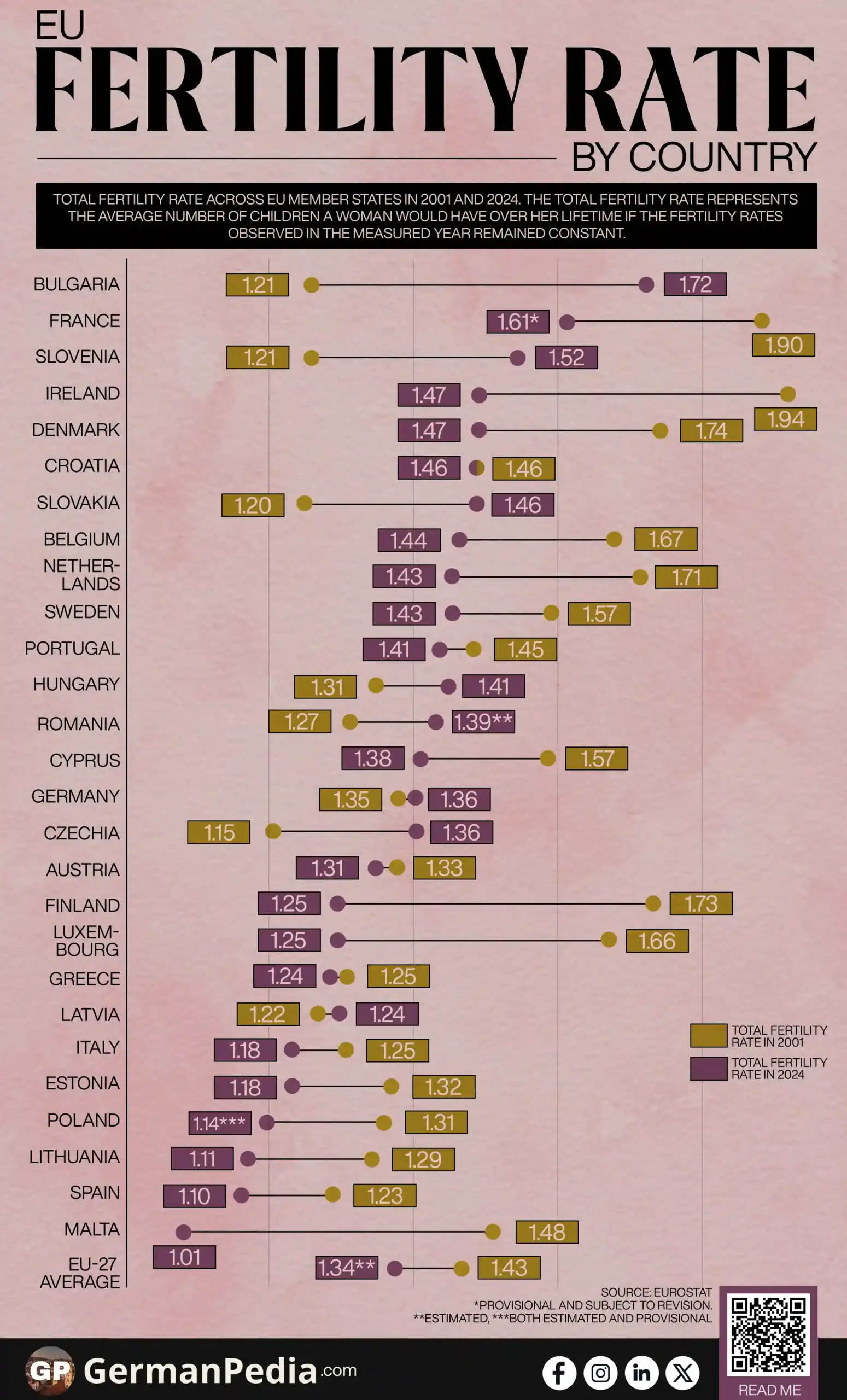
- The EU-27 total fertility rate fell to 1.34 in 2024. It is the lowest recorded value since 2001.
- The total fertility rate measures the average number of children a woman would have in her lifetime based on a single year’s birth rates. No EU country reaches the replacement level of 2.1.
- Bulgaria recorded the highest fertility rate in the EU in 2024 at 1.72. Bulgarian women have their first child around age 27, roughly three years earlier than the EU average.
- The top four countries in 2001 fell sharply. This includes Ireland, France, Finland, and Denmark. Ireland dropped from 1.94 to 1.47. Finland dropped from 1.73 to 1.25.
- Eastern EU countries that ranked lowest in 2001 have mostly recovered. Bulgaria, Slovenia, Slovakia, and Czechia all recorded higher fertility rates in 2024 than in 2001.
- In Finland, 75% of the total fertility decline since 2010 comes from fewer first births. Women are postponing or forgoing parenthood entirely, not simply stopping at fewer children.
Use this Visualization: You may use this image for free with proper attribution to GermanPedia (i.e., by linking back to GermanPedia).
Need help communicating complex ideas visually? We help you turn data into your most persuasive story. Contact us to learn more.
Total Fertility Rate Across EU Countries
| Country | Total Fertility Rate | |
|---|---|---|
| 2001 | 2024 | |
| Bulgaria | 1.21 | 1.72 |
| France | 1.90 | 1.61* |
| Slovenia | 1.21 | 1.52 |
| Ireland | 1.94 | 1.47 |
| Denmark | 1.74 | 1.47 |
| Croatia | 1.46 | 1.46 |
| Slovakia | 1.20 | 1.46 |
| Belgium | 1.67 | 1.44 |
| Netherlands | 1.71 | 1.43 |
| Sweden | 1.57 | 1.43 |
| Portugal | 1.45 | 1.41 |
| Hungary | 1.31 | 1.41 |
| Romania | 1.27 | 1.39** |
| Cyprus | 1.57 | 1.38 |
| Germany | 1.35 | 1.36 |
| Czechia | 1.15 | 1.36 |
| Austria | 1.33 | 1.31 |
| Finland | 1.73 | 1.25 |
| Luxembourg | 1.66 | 1.25 |
| Greece | 1.25 | 1.24 |
| Latvia | 1.22 | 1.24 |
| Italy | 1.25 | 1.18 |
| Estonia | 1.32 | 1.18 |
| Poland | 1.31 | 1.14*** |
| Lithuania | 1.29 | 1.11 |
| Spain | 1.23 | 1.10 |
| Malta | 1.48 | 1.01 |
| EU-27 average | 1.43 | 1.34** |
Source: Eurostat
*provisional and subject to revision.
**estimated
***both estimated and provisional

Bulgaria leads the EU fertility ranking in 2024. Ireland sits below the EU average. Finland ranks near the bottom. These are not the positions anyone who looked at the 2001 data would have predicted.
The total fertility rate measures the average number of children a woman would have over her lifetime, based on the birth rates recorded in a single year. It is a snapshot of current fertility behavior, not a forecast. In 2024, the EU-27 average stood at 1.34. That is the lowest figure recorded since Eurostat first tracked the EU-wide total in 2001.
Countries Highest in 2001 Have Fallen the Furthest
The four EU countries with the highest fertility rates in 2001 have all dropped sharply:
- Ireland: 1.94 → 1.47
- France: 1.90 → 1.61
- Denmark: 1.74 → 1.47
- Finland: 1.73 → 1.25
The countries that sat at the bottom of the EU ranking in 2001 show the opposite pattern:
- Bulgaria: 1.21 → 1.72
- Slovenia: 1.21 → 1.52
- Slovakia: 1.20 → 1.46
- Czechia: 1.15 → 1.36
- Croatia: 1.46 (unchanged since 2001)
This is not a uniform decline across the EU. It is a rearrangement. Eastern countries that once sat at the lowest end of the table now rank near or above the EU average. Western countries that once led the table have fallen toward it or below it.
Western Europe Is Postponing Parenthood
75% of Finland’s fertility decline since 2010 comes from fewer first births. Women are postponing parenthood or forgoing it entirely. That is a structural shift, not a timing adjustment. When women delay having their first child by several years, many reach the end of their reproductive years with fewer children than planned, or none at all.
Spain sits at 1.10 in 2024. It is among the lowest three in the EU. The average age at first birth has risen across Southern and Western Europe. Childfree lifestyles have become more common. The fall in first births compounds. With fewer first births, there are fewer second and third births by the same women.
No EU Country Reaches the Replacement Rate
The replacement rate is the fertility level at which a population maintains its size without immigration. For most developed countries, that threshold sits at 2.1 children per woman. No EU country comes close.
Bulgaria’s 1.72 ranks highest in the EU. Bulgarian women have their first child at around age 27. This is roughly three years earlier than the EU average. Earlier first births raise the total fertility rate structurally, because fewer women reach the end of their reproductive years without having had a child at all.
Hungary spent approximately 5% of GDP on family subsidies over the past decade, including tax credits and housing grants for families with multiple children. Its fertility rate rose from 1.23 in 2011 to 1.61 in 2021. It stood at 1.41 in 2024. The policies brought forward some births. However, they did not sustain a return to higher fertility. The gains have not held.
The gap between Bulgaria at 1.72 and Malta at 1.01 is 0.71. That is the widest spread within the EU. Both numbers sit far below 2.1. The entire EU, from its highest to its lowest, falls in a range where no country replaces its population through births alone.
More topics
- Which EU Cities Have the Most Millionaires?
- Which EU Country Has the Highest Trade-to-GDP Ratio?
- Most Popular EU Tourist Destinations by Overnight Stays
- How Much Water Do EU Households Use?
- Where are Billionaires Concentrated in the EU?
- Top 10 Richest Women in the EU
- Top 10 Biggest EU Companies Led by Women
- Top 13 Most Valuable Brands in the EU
- Income Millionaires In Germany by State
- The Best EU Countries to Retire In
- EU Passports Are Among the Strongest in the World
- GDP per Capita vs Actual Consumption per Capita in the EU
- Which Are the Busiest Airports in the EU?
- The Busiest Container Ports in Europe by TEU
- Which EU Countries Have the Most Soft Power?
References
- https://ec.europa.eu/eurostat/web/products-eurostat-news/w/ddn-20260306-1
- https://pmc.ncbi.nlm.nih.gov/articles/PMC9127029/
- https://cosm.aei.org/hungarys-fertility-outcomes-highlight-pro-natal-policy-limitations/
- https://www.novinite.com/articles/236598/Bulgaria+Leads+EU+in+Fertility,+Women+in+the+Country+Also+Become+Mothers+at+Youngest+Age