Key Takeaways
- EU governments collectively spent €746 billion on public education in 2022, covering pre-primary through tertiary level.
- Germany recorded the highest government spending on education in the EU in 2022 at 170,029.6 million PPS.
- Germany’s scale is driven by two factors. It is the EU’s most populous country and its largest economy, with a nominal GDP of €4.3 trillion.
- Sweden ranks eighth in absolute spending at 29,682.0 million PPS. However, recorded the highest public education expenditure as a share of GDP in the EU at 6.9%.
- Absolute spending reflects population and economic mass. GDP share reflects political priority.
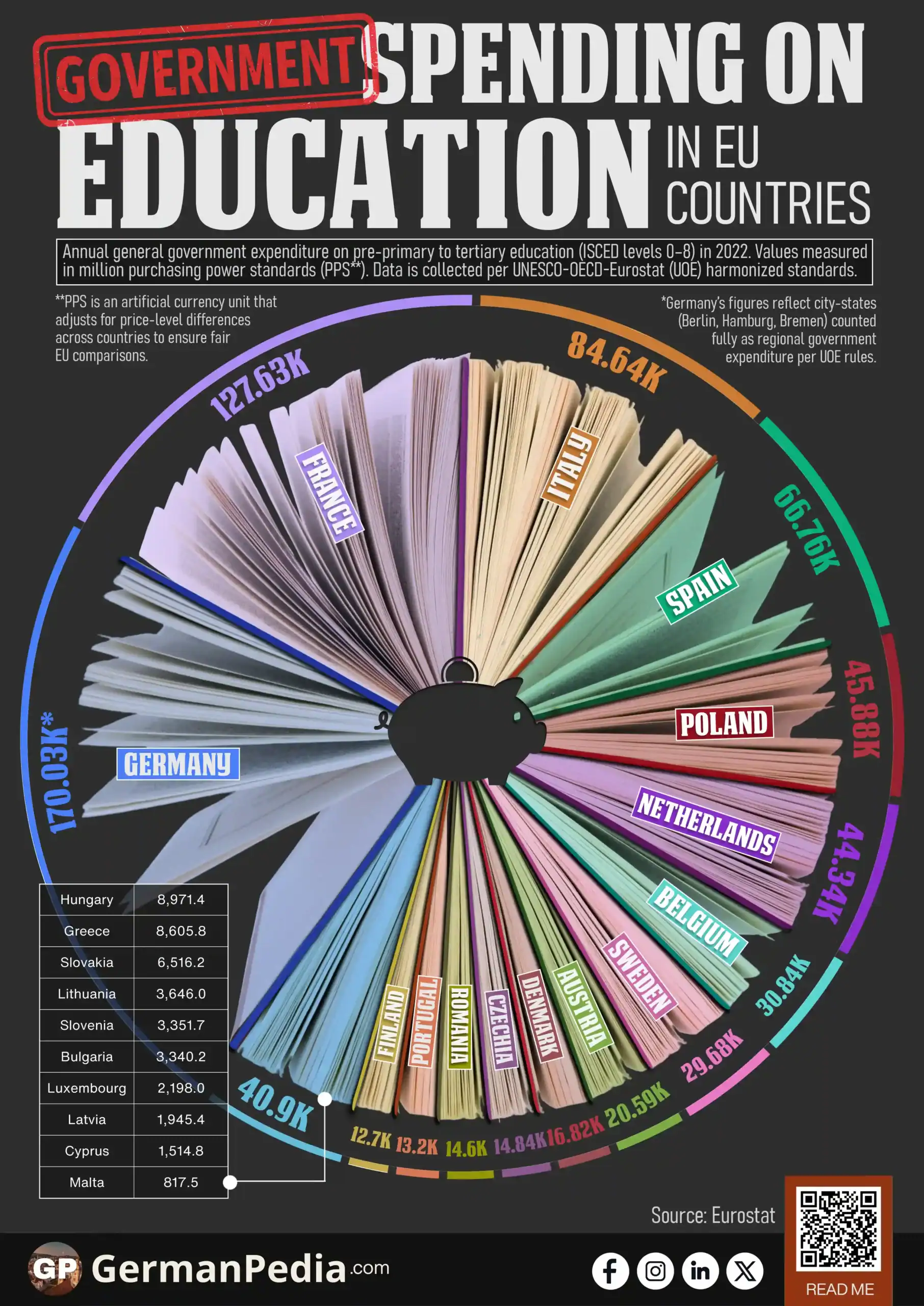
Use this Visualization: You may use this image for free with proper attribution to GermanPedia (i.e., by linking back to GermanPedia).
Need help communicating complex ideas visually? We help you turn data into your most persuasive story. Contact us to learn more.
EU Government Spending on Education
| Country | Government Spending (In Million PPS) |
|---|---|
| Germany | 170,029.6* |
| France | 127,627.8 |
| Italy | 84,639.7 |
| Spain | 66,761.7 |
| Poland | 45,878.4 |
| Netherlands | 44,337.5 |
| Belgium | 30,841.1 |
| Sweden | 29,682.0 |
| Austria | 20,585.2 |
| Denmark | 16,824.1 |
| Czechia | 14,837.7 |
| Romania | 14,553.8 |
| Portugal | 13,205.6 |
| Finland | 12,742.4 |
| Hungary | 8,971.4 |
| Greece | 8,605.8 |
| Slovakia | 6,516.2 |
| Lithuania | 3,646.0 |
| Slovenia | 3,351.7 |
| Bulgaria | 3,340.2 |
| Luxembourg | 2,198.0 |
| Latvia | 1,945.4 |
| Cyprus | 1,514.8 |
| Malta | 817.5 |
| Estonia | – |
| Ireland | – |
| Croatia | – |
Values are measured in million purchasing power standards (PPS**). Data is collected per UNESCO-OECD-Eurostat (UOE) harmonized standards.
Source: Eurostat
*Germany’s figures reflect city-states (Berlin, Hamburg, Bremen) counted fully as regional government expenditure per UOE rules. This elevates regional totals compared to countries splitting similar entities.
**PPS is an artificial currency unit that adjusts for price-level differences across countries to ensure fair EU comparisons.

Germany Leads EU Education Spending
In 2022, EU governments collectively spent €746 billion on public education, from pre-primary through tertiary level. Germany topped that list by a wide margin. Its total reached 170,029.6 million PPS. That is more than France and Italy’s education spending combined.
Two factors explain Germany’s scale. It is the EU’s most populous country, with around 83 million residents in 2022. It also has the largest economy in the EU, with a nominal GDP of €4.3 trillion in 2024.
More students mean more schools, more teachers, and more public money required to run the system. Larger economies also generate larger nominal budgets even when spending the same share of GDP as smaller peers.
The same logic applies in reverse for smaller countries, like the Baltic states. Fewer residents mean fewer students and smaller total budgets, regardless of how seriously a government funds education:
- Luxembourg: 2,198.0 million PPS
- Latvia: 1,945.4 million PPS
- Cyprus: 1,514.8 million PPS
Bigger Education Budgets Do Not Always Mean Greater Commitment to Education
Sweden ranks eighth in the EU by absolute spending at 29,682.0 million PPS. But as a share of its economy, no EU country invested more in education in 2022.
In 2022, Sweden recorded the highest public education expenditure as a share of GDP in the EU at 6.9%. Belgium followed at 6.2%. Romania registered the lowest at 2.9%.
Germany’s education spending as a share of GDP sits at 4.79%. That number is just slightly above the EU average of 4.7% and well below Sweden’s figure. This shows that a country can rank high in total spending and low in national commitment, and vice versa.
Across the EU, absolute spending reflects population and economic mass. GDP share reflects political priority. It does not measure education outcomes. It does, however, give a starting point for understanding how seriously each government treats education as a public investment.
More topics
- Employment in the EU Is Shifting Toward Higher Education
- Primary School Teacher Salaries in Public Institutions in the EU
- Internet Use for Mental Health Information Across the EU
- The Best EU Countries to Retire In
- Happiness vs Income in the EU
- GDP per Capita vs Actual Consumption per Capita in the EU
- Which EU Countries Have the Highest Diabetes Prevalence?
- Most Visited AI Websites in Germany
- EU Alternatives to Common US Platforms
- Environmental Impact of AI Websites in Germany
- Where are Data Centers Concentrated in the EU?
- How Do Germans Perceive Other Countries as Allies and Threats?
- Which EU Countries Have the Most Soft Power?
- EU Passports Are Among the Strongest in the World
- Which EU Countries Have the Highest Obesity Rates?
References
- https://ec.europa.eu/eurostat/databrowser/view/educ_uoe_fine01__custom_21404762/default/table?lang=en&page=time:2023
- https://ec.europa.eu/eurostat/databrowser/view/educ_uoe_fine06/default/table?lang=en
- https://ec.europa.eu/eurostat/web/products-eurostat-news/w/ddn-20250703-2
- https://eurydice.eacea.ec.europa.eu/eurypedia/germany/funding-education