
Key Takeaways
- Germany recorded 85.3 million international overnight stays in 2024, up 5.4% from 2023. However, it is still below the 2019 pre-pandemic peak.
- Tourists from European countries dominate Germany’s inbound tourism. It is driven by proximity and strong transport links. This kind of tourism refers to non-residents who are travelling to a different country, outside their home country.
- The Netherlands is Germany’s largest source market. It contributed about 14% of all international overnight stays in 2024.
- Leisure travel remains the main purpose of European trips to Germany (59%). Business travel (21%) also plays an above-average share of Europe’s business tourism.
Use this Visualization: You may use this image for free with proper attribution to GermanPedia (i.e., by linking back to GermanPedia).
Change in international tourists in Germany over time
| Year | Overnight stays of international visitors (in Mil.) | YoY Change (in %) |
|---|---|---|
| 2024 | 85.3 | 5.4 |
| 2023 | 80.9 | 18.8 |
| 2022 | 68.1 | 119.7 |
| 2021 | 31.0 | -3.1 |
| 2020 | 32.0 | -64.4 |
| 2019 | 89.9 | 2.5 |
| 2018 | 87.7 | 4.5 |
| 2017 | 83.9 | |
| 1993 | 34.7 |
Source: German National Tourist Board
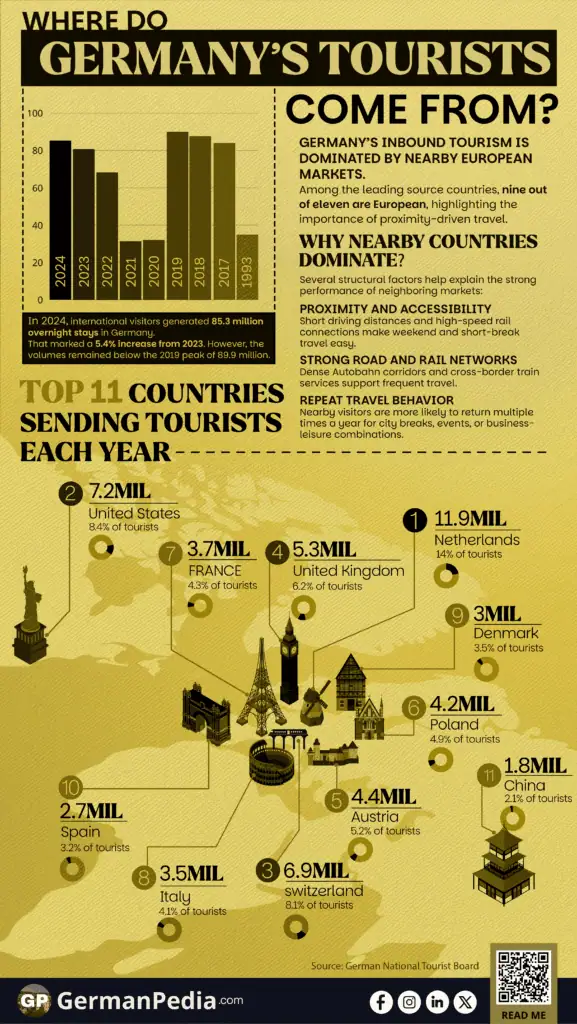
In 2024, international visitors generated 85.3 million overnight stays in Germany. That marked a 5.4% increase from 2023. However, the volume remained below the 2019 peak of 89.9 million.

11 countries that send the most tourists to Germany every year
| Country of origin | Overnight stay of international visitors | |
| In millions | In % | |
| Netherlands | 11.9 | 14.0 |
| United States | 7.2 | 8.4 |
| Switzerland | 6.9 | 8.1 |
| United Kingdom | 5.3 | 6.2 |
| Austria | 4.4 | 5.2 |
| Poland | 4.2 | 4.9 |
| France | 3.7 | 4.3 |
| Italy | 3.5 | 4.1 |
| Denmark | 3 | 3.5 |
| Spain | 2.7 | 3.2 |
| China | 1.8 | 2.1 |
Source: German National Tourist Board
Germany’s inbound tourism continues to be dominated by nearby European markets.
Among the leading source countries, nine out of eleven are European. This highlights the importance of proximity-driven travel.
The Netherlands ranked as Germany’s top source market for tourists. It accounted for 11.9 million overnight stays in 2024.
Meanwhile, non-EU countries such as the United States and China also show long-haul demand. This reinforces Germany’s role as a short-break, repeat-visit destination within Europe.
Why Nearby Countries Dominate Inbound Tourism to Germany?
Several structural factors help explain the strong inbound tourism performance of neighboring markets:
- Proximity and accessibility: Short driving distances and high-speed rail connections make weekend and short-break travel easy.
- Strong road and rail networks: Dense Autobahn corridors and cross-border train services support frequent travel.
- Repeat travel behavior: Nearby visitors are more likely to return multiple times a year for city breaks, events, or business-leisure combinations.
Why Do Europeans Visit Germany?
A different mix of motivations shapes European travel to Germany. This include
- Holidays or leisure are the main reasons for tourist visits. Around 59% of European trips to Germany in 2024 were leisure trips.
- Business travel: About 21% of European trips to Germany were for business. It is well above the average share seen across European outbound travel.
- Other private travel, such as visiting friends and relatives, accounted for the remainder.
This combination highlights Germany’s dual role as both a leisure destination and a key business travel hub in Europe.
More topics
- Highest Paying Jobs in Germany
- Popular Study Destinations for German Students
- Educational Attainment in European Countries
- Grocery Prices in Germany Have Increased Since 2000
- Germany’s Smoking Rate Has Declined Over Two Decades
- Germany’s Electricity Mix: From Coal to Renewables
- Changes in Harvest of Germany’s Five Key Crops
- Top German Companies by Revenue
- Germany’s Top Car Brands by New Registrations
- Unemployment Across Germany: A Federal State Breakdown
- Where Germany’s Tourists Come From
- Germany’s Largest National Parks, Ranked by Size
- Which Federal States Drive Germany’s Economy?
- How Marriage Rates Have Fallen in Germany: 1990–2023
- Leading Causes of Death in Germany