
Key Takeaways
- The Schleswig-Holstein Wadden Sea is the largest national park in Germany. It has an area of 4,410km².
- The largest parks in Germany are coastal. The two Wadden Sea national parks alone cover thousands of square kilometers.
- Most inland national parks are under 300 km², reflecting higher population density and competing land uses.
- Larger parks are less fragmented and protect whole ecosystems, while smaller parks focus on preserving sensitive habitats and biodiversity hotspots.
A national park is a legally protected area established to conserve natural ecosystems while allowing people to experience nature in a controlled and sustainable way.
The size gap between Germany’s national parks varies dramatically.
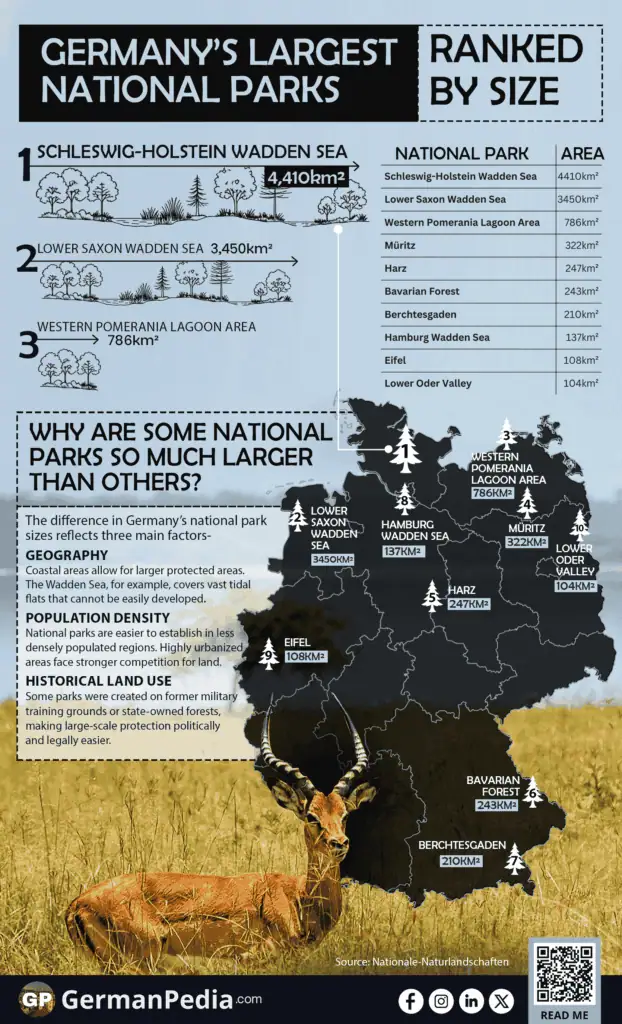
Use this Visualization: You may use this image for free with proper attribution to GermanPedia (i.e., by linking back to GermanPedia).
Largest National Parks in Germany
| National Park Name | Area (km²) | Location/State |
|---|---|---|
| Schleswig-Holstein Wadden Sea | 4,410 | Schleswig-Holstein |
| Lower Saxon Wadden Sea | 3,450 | Lower Saxony |
| Western Pomerania Lagoon Area | 786 | Mecklenburg-Vorpommern |
| Müritz | 322 | Mecklenburg-Vorpommern |
| Harz | 247 | Lower Saxony and Saxony-Anhalt |
| Bavarian Forest | 243 | Bavaria |
| Berchtesgaden | 210 | Bavaria |
| Hamburg Wadden Sea | 137 | Hamburg |
| Eifel | 108 | North Rhine-Westphalia |
| Lower Oder Valley | 104 | Brandenburg |
Source: Nationale-Naturlandschaften

Why Are Some National Parks So Much Larger Than Others?
The difference in Germany’s national park sizes reflects three main factors:
- Geography: Coastal areas allow for larger protected areas. The Wadden Sea, for example, covers vast tidal flats that cannot be easily developed.
- Population density: National parks are easier to establish in less densely populated regions. Highly urbanized areas face stronger competition for land.
- Historical land use: Some parks were created on former military training grounds or state-owned forests, making large-scale protection politically and legally easier
Coastal vs Inland National Parks in Germany
Germany’s national parks can be grouped based on their physical geography. In this guide, we focus on two main categories:
1. Coastal or Marine National Parks
Germany’s largest national parks are almost entirely coastal or marine. These include:
- Schleswig-Holstein Wadden Sea (4,410 km²)
- Lower Saxon Wadden Sea (3,450 km²)
- Western Pomerania Lagoon Area (786 km²)
These parks cover vast tidal flats, lagoons, and shallow coastal waters. Their size allows for the protection of entire ecosystems, including migratory bird routes and marine food chains. Large parks also tend to be less fragmented, which improves ecological resilience.
2. Terrestrial or Inland National Parks in Germany
Inland national parks protect land-based ecosystems, such as forests, mountains, wetlands, and river landscapes. Most inland national parks are much smaller, typically below 300 km².
Examples include:
- Müritz (322 km²)
- Harz (247 km²)
- Bavarian Forest (243 km²)
- Eifel (108 km²)
These parks are located in more densely populated regions, where land is shared with settlements, agriculture, and transport infrastructure. As a result, they focus on specific habitats, such as forests, mountains, or wetlands, rather than vast continuous landscapes.
What Does National Park Size Mean?
Park size influences what a protected area can achieve.
- Large parks are better suited to protecting wide-ranging species, absorbing climate-related shocks, and maintaining complete ecosystems.
- Smaller parks play a crucial role in conserving rare or specialized habitats, preserving biodiversity hotspots, and connecting broader conservation networks.
Together, both types form a complementary system: large parks provide scale, while smaller parks deliver targeted protection where land is scarce.
More topics
- Highest Paying Jobs in Germany
- Popular Study Destinations for German Students
- Educational Attainment in European Countries
- Grocery Prices in Germany Have Increased Since 2000
- Germany’s Smoking Rate Has Declined Over Two Decades
- Germany’s Electricity Mix: From Coal to Renewables
- Changes in Harvest of Germany’s Five Key Crops
- Top German Companies by Revenue
- Germany’s Top Car Brands by New Registrations
- Unemployment Across Germany: A Federal State Breakdown
- Where Germany’s Tourists Come From
- Germany’s Largest National Parks, Ranked by Size
- Which Federal States Drive Germany’s Economy?
- How Marriage Rates Have Fallen in Germany: 1990–2023
- Leading Causes of Death in Germany